 뒤로
뒤로Biology and the Nature of Science: Foundations, Theories, and Experimental Design
스터디 가이드 - 스마트 노트
 자료에 맞춘 맞춤형 노트, 핵심 정의, 예시, 맥락을 확장해 제공합니다.
Biology: The Study of Life
Introduction to Biology
Biology is the scientific study of life, focusing on the structure, function, growth, origin, evolution, and distribution of living organisms. It encompasses a wide range of topics, from the chemical basis of life to the complexity of ecosystems.
Biology: The study of the structure and function of the living world.
Major themes include the chemical basis of life, cell structure and function, information and energy flow, and evolution.
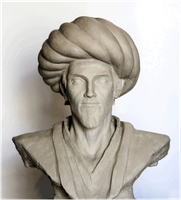
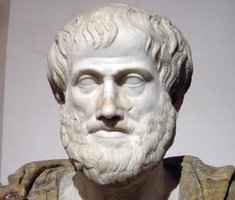
Additional info: The roots of scientific inquiry trace back to ancient philosophers such as Aristotle and Alhazen, who emphasized observation and reasoning.
Levels of Biological Organization
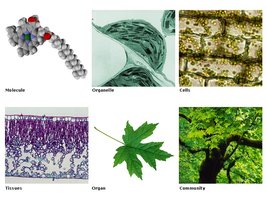
Biology examines life at multiple levels, from molecules to the biosphere.
Molecule: Chemical structures that form the basis of life.
Organelle: Specialized structures within cells.
Cell: The basic unit of life.
Tissue: Groups of similar cells performing a function.
Organ: Structures composed of tissues with specific functions.
Community: Interacting populations of different species.
Biology and the Nature of Science
What is Science?
Science is derived from the Latin word for "knowledge" and represents a systematic way of understanding the natural world through observation and experimentation.
Knowledge is built through observation and experimentation.
The scientific method is the process by which scientific knowledge is acquired.
Scientific Theory
A scientific theory is an explanation for a broad class of phenomena or observations that is supported by a wide body of evidence. This differs from the everyday use of "theory," which often means speculation or a guess.
Examples of major scientific theories:
Cell Theory: All organisms are made of cells.
Chromosome Theory of Inheritance: Hereditary information is transmitted via chromosomes.
Theory of Evolution: Organisms change over time through natural selection.
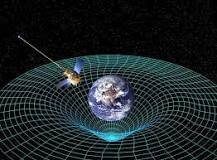
Other examples: Germ theory of disease, atomic theory, theory of relativity, Big Bang theory.
The Scientific Method
Steps of the Scientific Method
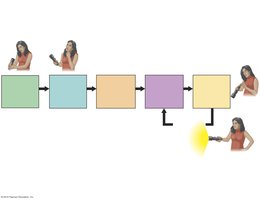
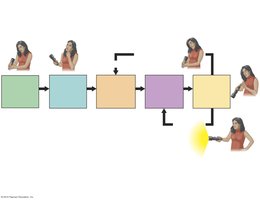
The scientific method is a logical approach to solving problems and answering questions about the natural world.
Observation/Ask a Question: Identify a phenomenon or problem.
Develop a Hypothesis: Propose a testable explanation.
Design the Experiment: Plan how to test the hypothesis.
Predictions: State expected outcomes if the hypothesis is correct.
Perform Experiment/Data Collection: Gather measurable data.
Data Analysis/Conclusions: Interpret results and draw conclusions.
Hypotheses and Predictions
A hypothesis is a proposed explanation for an observation, which must be testable and falsifiable. A prediction is a measurable or observable result that must be correct if the hypothesis is valid.
Testable: Can be examined through experimentation.
Falsifiable: Can be shown to be false by evidence.
Support for a hypothesis adds to scientific evidence but does not prove it absolutely.
Experimental Design
Experiments are structured to test hypotheses by comparing groups and measuring variables.
Control Group: Kept constant for comparison.
Experimental Group(s): Modified in some way to test the hypothesis.
Independent Variable: The factor that is changed between groups.
Dependent Variable: The data measured or collected.
Constants: Factors kept the same across all groups.
Case Study: Cell Theory and Spontaneous Generation
Historical Controversy
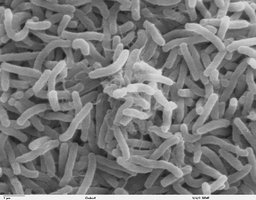
In the mid-1800s, scientists debated whether cells arose spontaneously or only from pre-existing cells.
Hypothesis #1: Spontaneous Generation – Cells arise spontaneously from nonliving matter.
Hypothesis #2: All-Cells-From-Cells – Cells are produced only when preexisting cells grow and divide.
Additional info: Pasteur's experiment used straight-necked and swan-necked flasks to test these hypotheses. Only the straight-necked flask, exposed to airborne particles, developed cells, supporting the all-cells-from-cells hypothesis.
Experimental Design in Biology: Examples
Why Do Giraffes Have Long Necks?
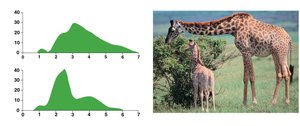
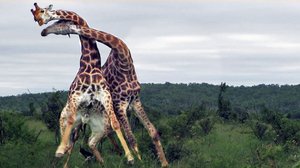
Two hypotheses have been proposed to explain the evolution of long necks in giraffes:
Food Competition Hypothesis: Long necks evolved to reach food unavailable to other mammals.
Sexual Competition Hypothesis: Long necks evolved because longer-necked males win more fights for mates.
How Do Ants Navigate?
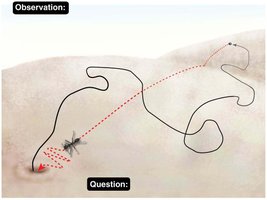
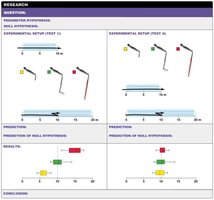
Desert ants can return to their nest in a straight line after meandering in search of food. The pedometer hypothesis suggests that ants use stride length and number to calculate distance.
Experimental groups: "Stumps" (shortened legs), "Normal" (unaltered), "Stilts" (lengthened legs).
Prediction: Ants with stilts will overshoot the nest; ants with stumps will stop short.
Experimental Design – Mutant Frogs
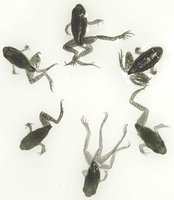
Since 1980, amphibian populations have declined, with increased deformities observed. Possible causes include increased UV-B radiation, chemical pollution, and parasitic flatworms. Experiments can be designed to test each factor's effect on deformity rates.
Independent Variables: UV-B exposure, chemical pollutants (e.g., Atrazine), presence of trematodes.
Dependent Variable: Percentage of frogs with deformities.
Control Group: Frogs not exposed to any suspected factor.
Constants: Environmental conditions, frog species, developmental stage.
Key Terms and Concepts
Theory: Broad explanation supported by evidence.
Hypothesis: Testable, falsifiable explanation for an observation.
Experiment: Controlled test of a hypothesis.
Prediction: Expected outcome if hypothesis is correct.
Scientific Method: Systematic approach to inquiry.
Null Hypothesis: Statement that there is no effect or difference.
Cells-from-cells: Principle that cells arise only from pre-existing cells.
Summary Table: Experimental Design Components
Component | Definition | Example |
|---|---|---|
Hypothesis | Testable explanation for an observation | "The flashlight’s batteries are dead." |
Prediction | Expected result if hypothesis is correct | "If I replace the batteries, the flashlight will work." |
Independent Variable | Factor changed in the experiment | Type of batteries used |
Dependent Variable | Data measured or collected | Whether the flashlight works |
Control Group | Group kept constant for comparison | Flashlight with old batteries |
Constants | Factors kept the same across groups | Flashlight model, testing environment |
