 뒤로
뒤로Biomolecules: Structure, Function, and Synthesis in General Biology
스터디 가이드 - 스마트 노트
 자료에 맞춘 맞춤형 노트, 핵심 정의, 예시, 맥락을 확장해 제공합니다.
Biomolecules: Structure and Function
Overview of Biomolecules
Biomolecules are essential organic compounds that form the basis of life. Cells synthesize large macromolecules from a limited set of small molecules, primarily through polymerization. The four major classes of biomolecules are nucleic acids, proteins, carbohydrates, and lipids. These macromolecules are typically polymers, composed of repeating monomer units.
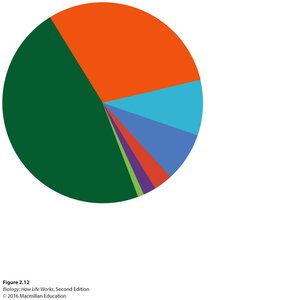
Nucleic acids (~15%): DNA and RNA, polymers of nucleotides.
Proteins (~50%): Polypeptides, polymers of amino acids.
Carbohydrates (~15%): Polysaccharides, polymers of monosaccharides.
Lipids (~15%): Not true polymers, but assembled from glycerol and fatty acids.
Cells are composed of about 80% water, with the remaining 20% consisting of these biomolecules in the proportions listed above.
Monomers and Polymers
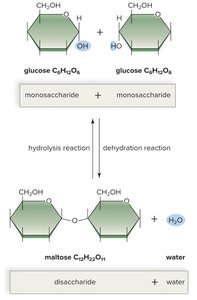
Macromolecules are often called polymers because they are made from identical or similar building blocks called monomers. The process of assembling polymers from monomers is called dehydration synthesis (condensation), while breaking polymers into monomers is called hydrolysis.
Dehydration Synthesis: Removes a water molecule to form a new bond between monomers.
Hydrolysis: Adds a water molecule to break a bond, releasing monomers.
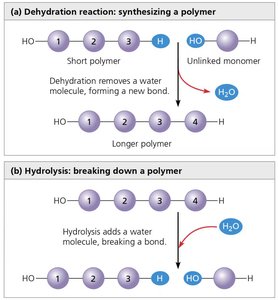
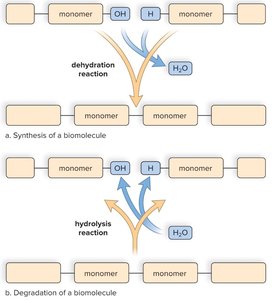
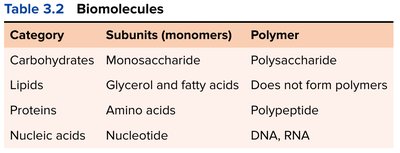
Table: Biomolecules, Monomers, and Polymers
Category | Subunits (Monomers) | Polymer |
|---|---|---|
Carbohydrates | Monosaccharide | Polysaccharide |
Lipids | Glycerol and fatty acids | Does not form polymers |
Proteins | Amino acids | Polypeptide |
Nucleic acids | Nucleotide | DNA, RNA |
Carbon: The Backbone of Life
Properties of Carbon
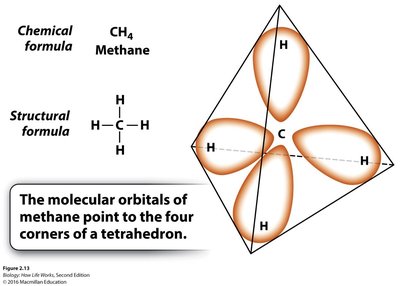
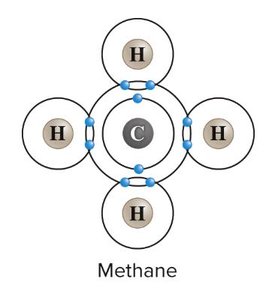
Life’s molecular diversity is based on the properties of carbon. Carbon atoms can form four covalent bonds, allowing for a variety of shapes and functions in organic molecules. Carbon-based molecules are called organic compounds.
Carbon can bond to four other atoms, branching in up to four directions.
Each bond can rotate freely, enabling complex molecular structures.
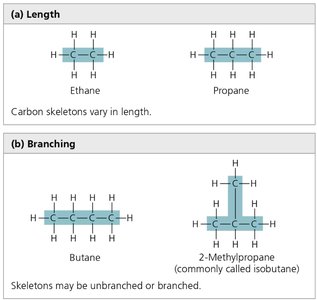
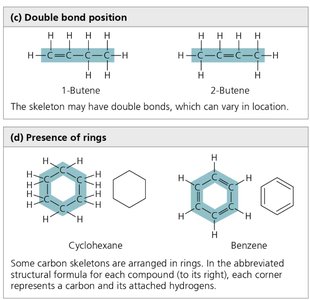
Carbon skeletons can vary in length, branching, double bond position, and presence of rings.
Functional Groups
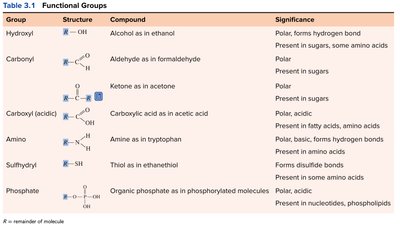
Functional groups are specific groups of atoms attached to the carbon backbone that participate in chemical reactions. They are key to the structural and functional diversity of biomolecules.
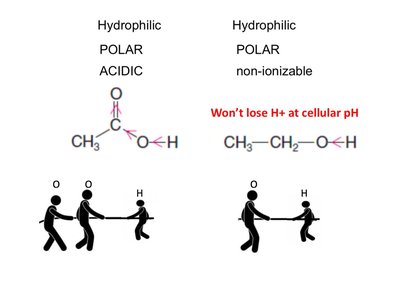
Hydroxyl (–OH): Polar, forms hydrogen bonds.
Carbonyl (C=O): Polar, present in sugars.
Carboxyl (–COOH): Polar, acidic, present in fatty acids and amino acids.
Amino (–NH2): Polar, basic, forms hydrogen bonds.
Sulfhydryl (–SH): Forms disulfide bonds.
Phosphate (–PO4): Polar, acidic, present in nucleotides and phospholipids.
Carbohydrates
Structure and Synthesis
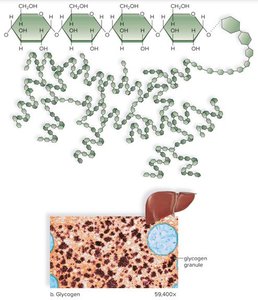
Carbohydrates are composed of monosaccharide monomers, such as glucose. Two monosaccharides can join via dehydration synthesis to form a disaccharide, releasing water. Polysaccharides are long chains of monosaccharides.
Monosaccharide: Simple sugar (e.g., glucose, C6H12O6).
Disaccharide: Two monosaccharides joined (e.g., maltose, C12H22O11).
Polysaccharide: Many monosaccharides joined (e.g., glycogen).
Lipids
Structure and Synthesis
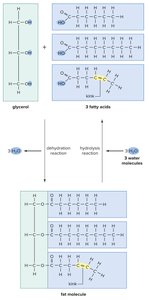
Lipids are not true polymers but are assembled from glycerol and fatty acids. The formation of a fat molecule involves dehydration synthesis, joining glycerol and three fatty acids, releasing three water molecules.
Glycerol: Three-carbon alcohol.
Fatty acids: Long hydrocarbon chains with a carboxyl group.
Triglyceride: Glycerol + 3 fatty acids.
Proteins
Structure and Synthesis
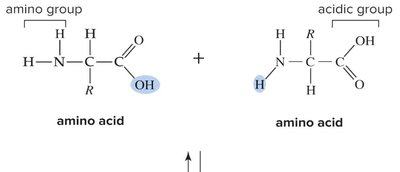
Proteins are polymers of amino acids, joined by peptide bonds via dehydration synthesis. The sequence and properties of amino acid side chains (R groups) determine protein folding and function.
Amino acid: Monomer unit with amino, carboxyl, and R group.
Peptide bond: Covalent bond formed between amino acids.
Polypeptide: Chain of amino acids.
Protein Structure Levels
Primary structure: Sequence of amino acids.
Secondary structure: Hydrogen bonds form alpha helices and beta sheets.
Tertiary structure: 3D folding due to side chain interactions.
Quaternary structure: Multiple polypeptide subunits interact.
Protein Function and Denaturation
Proteins serve as enzymes, structural components, and signaling molecules. Changes in temperature or pH can denature proteins, altering their shape and function.
Enzymes: Catalysts for biochemical reactions (e.g., DNA polymerase).
Denaturation: Loss of 3D structure and function due to environmental changes.
Nucleic Acids
Structure and Synthesis
Nucleic acids (DNA and RNA) are polymers of nucleotide monomers. Each nucleotide consists of a sugar, phosphate group, and nitrogenous base. Nucleotides are linked by phosphodiester bonds via dehydration synthesis.
DNA: Double-stranded helix, stable, stores genetic information.
RNA: Single-stranded, less stable, involved in protein synthesis.
Phosphodiester bond: Links 5' phosphate of one nucleotide to 3' hydroxyl of another.
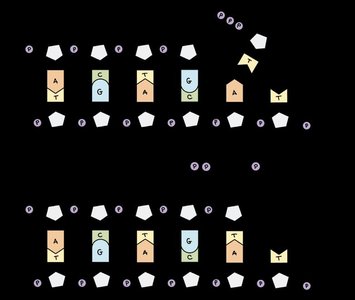
Base Pairing and Replication
DNA strands are antiparallel and held together by hydrogen bonds between complementary bases (A-T, G-C). During replication, each strand serves as a template for a new strand.
Base pairing: Adenine (A) pairs with Thymine (T); Guanine (G) pairs with Cytosine (C).
Replication: Parental strands separate, and new daughter strands are synthesized.
Other Functions of Nucleotides
Nucleotides also serve as energy carriers (e.g., ATP) and signaling molecules in cells.
pH and Biomolecules
Impact of pH
pH affects the ionization state of functional groups in biomolecules, influencing their structure and function. Acidic groups donate H+ ions, while basic groups accept H+ ions. Changes in pH can alter protein folding and activity.
Low pH: High concentration of H+, acids cannot donate H+.
High pH: Low concentration of H+, bases cannot accept H+.
Summary Table: Functional Groups
Group | Structure | Compound | Significance |
|---|---|---|---|
Hydroxyl | –OH | Alcohol (ethanol) | Polar, forms hydrogen bonds |
Carbonyl | C=O | Aldehyde, ketone | Polar, present in sugars |
Carboxyl | –COOH | Carboxylic acid | Polar, acidic |
Amino | –NH2 | Amine | Polar, basic |
Sulfhydryl | –SH | Thiols | Forms disulfide bonds |
Phosphate | –PO4 | Organic phosphate | Polar, acidic |
Class Recap
Understanding pH and its impact on biomolecules
Role of carbon in biomolecule diversity
Importance of functional groups in structure and function
Mechanisms of polymer synthesis and degradation (dehydration synthesis and hydrolysis)
