 뒤로
뒤로Carbohydrates: Structure, Classification, and Properties
스터디 가이드 - 스마트 노트
 자료에 맞춘 맞춤형 노트, 핵심 정의, 예시, 맥락을 확장해 제공합니다.
Carbohydrates
Definition and General Properties
Carbohydrates are essential biomolecules that serve as the primary source of energy for most living organisms. They are defined as polyhydroxy derivatives of aldehydes or ketones, meaning they contain multiple hydroxyl (–OH) groups along with either an aldehyde or ketone functional group.
General Formula: Most simple carbohydrates follow the formula Cn(H2O)n.
Classification: Carbohydrates are classified based on the number of sugar units and the type of carbonyl group present.
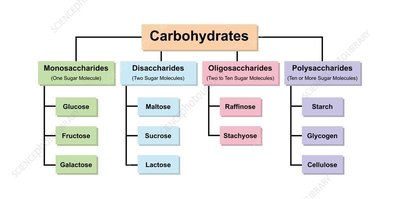
Classification of Carbohydrates
Monosaccharides
Monosaccharides are the simplest carbohydrates, consisting of a single sugar unit. They are classified by the number of carbon atoms and the type of carbonyl group (aldose or ketose).
Aldoses: Monosaccharides with an aldehyde group.
Ketoses: Monosaccharides with a ketone group.
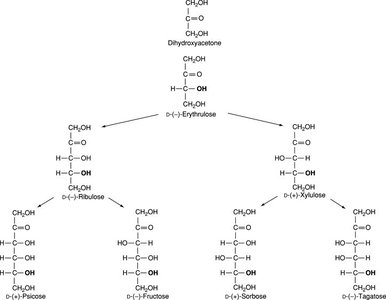
Number of 'C' atoms | Name of the monosaccharide | Aldose | Ketose |
|---|---|---|---|
3 | Triose | Glyceraldehyde (Glyceroe) | Dihydroxyacetone |
4 | Tetrose | Erythrose | Erythrulose |
5 | Pentose | Ribose | Ribulose |
6 | Hexose | Glucose | Fructose |
7 | Heptose | Glucoheptose | Sedoheptulose |
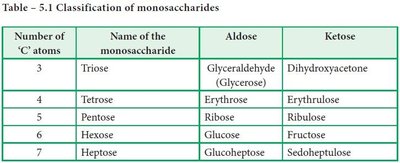
Structures of Common Aldoses
Aldoses are monosaccharides with an aldehyde group at one end. Their structures vary based on the arrangement of hydroxyl groups along the carbon chain.
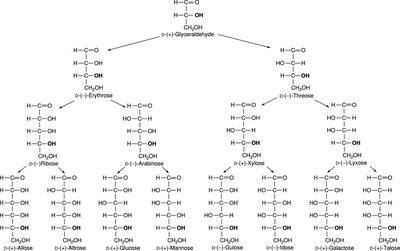
Structures of Common Ketoses
Ketoses are monosaccharides with a ketone group, typically at the second carbon atom. Their diversity arises from the number of carbons and the arrangement of hydroxyl groups.
Disaccharides
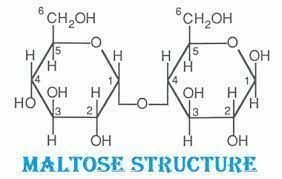
Disaccharides are carbohydrates composed of two monosaccharide units joined by a glycosidic bond. Common examples include maltose, sucrose, and lactose.
Maltose: Composed of two glucose units.
Sucrose: Composed of glucose and fructose.
Lactose: Composed of glucose and galactose.
Oligosaccharides and Polysaccharides
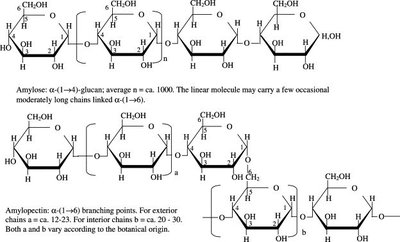
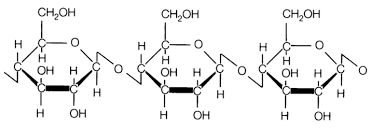
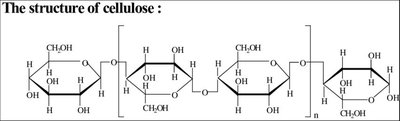
Oligosaccharides contain 3–10 monosaccharide units, while polysaccharides are large polymers with more than ten sugar units. Polysaccharides serve as storage (e.g., starch, glycogen) or structural (e.g., cellulose) molecules in cells.
Starch: Storage polysaccharide in plants, composed of amylose and amylopectin.
Glycogen: Storage polysaccharide in animals, highly branched.
Cellulose: Structural polysaccharide in plant cell walls, composed of β-glucose units.
Properties and Reactions of Monosaccharides (Glucose & Fructose)
Isomerism in Monosaccharides
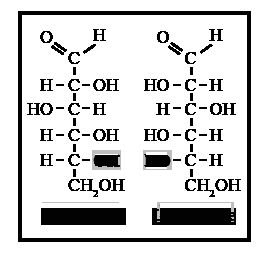
Monosaccharides can exist as structural isomers (same formula, different structure) and stereoisomers (same structure, different spatial arrangement). D- and L- isomers refer to the orientation of the hydroxyl group on the asymmetric carbon farthest from the carbonyl group.
Oxidation Reactions
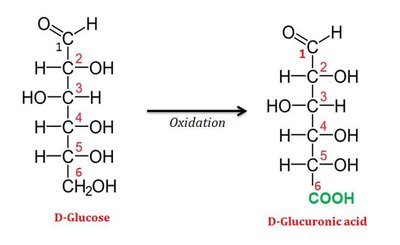
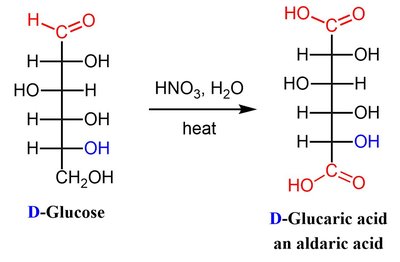
Monosaccharides like glucose can undergo oxidation to form various acids:
Glucuronic acid: Formed by oxidation of the primary alcohol group at C-6 of glucose.
Glucaric acid (aldaric acid): Formed by oxidation of both the aldehyde and the primary alcohol group.
Ring Structure of Glucose
Glucose commonly exists in a cyclic (ring) form in solution, resulting from the reaction between the aldehyde group and a hydroxyl group to form a hemiacetal.
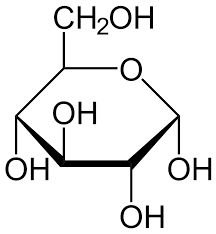
Example: The conversion of glucose from its linear to cyclic form is essential for its biological function and recognition by enzymes.
Additional info: Carbohydrates play critical roles in energy storage, structural integrity, and cell signaling. Their diversity in structure allows for a wide range of biological functions.
