 뒤로
뒤로Carbon and the Molecular Diversity of Life: Study Notes
스터디 가이드 - 스마트 노트
 자료에 맞춘 맞춤형 노트, 핵심 정의, 예시, 맥락을 확장해 제공합니다.
Carbon and the Molecular Diversity of Life
Introduction
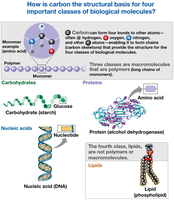
Carbon is a fundamental element in biology due to its unique ability to form four covalent bonds, allowing for the construction of a vast array of complex and diverse organic molecules. This property underlies the molecular diversity essential for life, forming the backbone of carbohydrates, proteins, nucleic acids, and lipids.
The Formation of Bonds with Carbon
Electron Configuration and Bonding
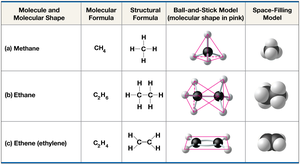
Electron Configuration: Carbon has four valence electrons, enabling it to form four covalent bonds with various atoms.
Tetrahedral Geometry: When bonded to four other atoms, carbon adopts a tetrahedral shape. Double bonds between carbons result in planar structures.
Versatility: Carbon can bond with many elements, including itself, forming chains and rings of varying length and complexity.
Carbon Chains and Skeletons
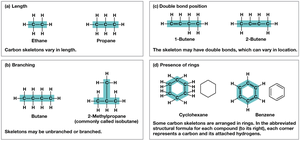
Carbon Chains: Serve as the skeletons of most organic molecules, varying in length, branching, and ring formation.
Double Bonds: The presence and position of double bonds further increase structural diversity.
Example: Carbon Dioxide
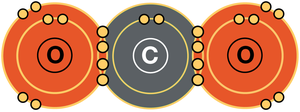
CO2: A simple molecule where carbon forms double bonds with oxygen, illustrating carbon's bonding versatility.
Hydrocarbons and Isomers
Hydrocarbons
Definition: Organic molecules consisting only of carbon and hydrogen.
Properties: Hydrophobic and can release large amounts of energy during reactions (e.g., fats).
Isomers
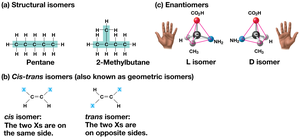
Structural Isomers: Differ in covalent arrangement of atoms.
Cis-Trans Isomers: Differ in spatial arrangement due to double bonds.
Enantiomers: Mirror images of each other, important in biological systems due to their different activities.
Chemical Groups Most Important to Life
Functional Groups
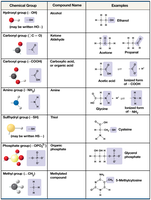
Functional groups are specific groups of atoms within molecules that are responsible for the characteristic chemical reactions of those molecules. They replace hydrogens on the carbon skeleton and are critical in determining molecular function.
Seven Key Functional Groups: Hydroxyl, Carbonyl, Carboxyl, Amino, Sulfhydryl, Phosphate, Methyl.
Each group participates in characteristic chemical reactions.
Macromolecules: Polymers and Monomers
Polymer Formation and Breakdown
Polymers: Long molecules made of repeating units called monomers.
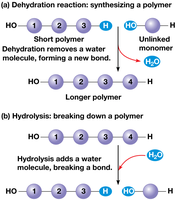
Dehydration Reaction: Joins monomers by removing a water molecule.
Hydrolysis: Breaks polymers into monomers by adding water.
Enzymes: Catalyze both dehydration and hydrolysis reactions.
Carbohydrates
Monosaccharides
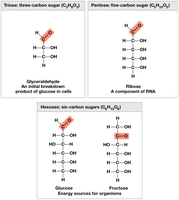
Definition: Simple sugars with formulas typically multiples of CH2O (e.g., glucose).
Classification: By number of carbons (triose, pentose, hexose) and position of carbonyl group (aldose or ketose).
Function: Major nutrients and building blocks for other molecules.
Disaccharides and Polysaccharides
Disaccharides: Formed by dehydration reaction between two monosaccharides (e.g., sucrose), linked by glycosidic bonds.
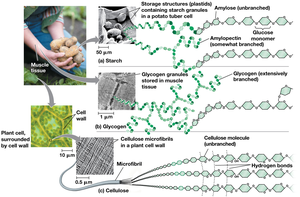
Polysaccharides: Large polymers of sugars; storage forms include starch (plants) and glycogen (animals).
Proteins
Structure and Function
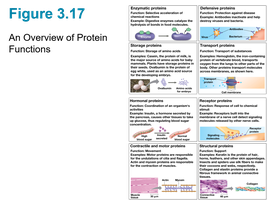
Functions: Include catalysis (enzymes), defense, storage, transport, communication, movement, and support.
Polypeptides: Unbranched polymers of amino acids.
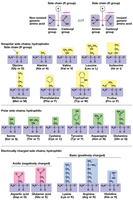
Amino Acids: Organic molecules with amino and carboxyl groups; differ by their R groups (side chains).
Amino Acid Properties and Peptide Bonds
R Groups: Determine the chemical nature of each amino acid (nonpolar, polar, acidic, basic).
Peptide Bonds: Link amino acids into polypeptides.
Protein Structure
Primary Structure: Sequence of amino acids.
Secondary Structure: Coils and folds (α-helix, β-sheet) due to hydrogen bonding.
Tertiary Structure: Overall 3D shape from side chain interactions.
Quaternary Structure: Association of multiple polypeptides.
Example: Sickle-cell disease results from a single amino acid change in hemoglobin, altering protein function.
Protein Denaturation
Denaturation: Loss of native structure due to changes in pH, salt, temperature, etc.; often results in loss of function.
Determining Structure: X-ray crystallography is used to determine protein 3D structure.
Lipids
Structure and Types
Definition: Hydrophobic molecules, not true polymers, mainly hydrocarbons.
Types: Fats, phospholipids, steroids.
Fats: Composed of glycerol and fatty acids; can be saturated (no double bonds, solid at room temp) or unsaturated (one or more double bonds, liquid at room temp).
Nucleic Acids
DNA and RNA
Genes: Units of inheritance made of DNA, which is a polymer of nucleotides.
Types: DNA (deoxyribonucleic acid) and RNA (ribonucleic acid).
Gene Expression: DNA directs synthesis of RNA, which directs protein synthesis.
Nucleotide Structure
Nucleotide: Consists of a nitrogenous base, pentose sugar, and phosphate group.
Nitrogenous Bases: Pyrimidines (C, T, U) and purines (A, G); T is in DNA, U is in RNA.
DNA Structure
Double Helix: Two antiparallel strands held together by hydrogen bonds between complementary bases (A-T, G-C).
Genetic Information: Sequence of nucleotides encodes genetic information passed from parent to offspring.
Applications in Evolution
Molecular Biology: DNA and protein sequences are used to assess evolutionary relationships among species.
