 뒤로
뒤로Cell Cycle, Meiosis, Mendelian Genetics, and Molecular Basis of Inheritance – Study Guide
스터디 가이드 - 스마트 노트
 자료에 맞춘 맞춤형 노트, 핵심 정의, 예시, 맥락을 확장해 제공합니다.
Cell Cycle and Mitosis
Overview of the Cell Cycle
The cell cycle is the series of events that cells go through as they grow and divide. It consists of interphase (cell growth and DNA replication) and M-phase (mitosis and cytokinesis).
Interphase: The cell grows, performs its normal functions, and duplicates its DNA.
M-phase: The cell divides its copied DNA and cytoplasm to make two new cells.
Interphase lasts much longer than M-phase.
Phases of the Cell Cycle
Phase | Summary of Events |
|---|---|
G1 | Cell growth, duplication of cellular components, G1 checkpoint (restriction point): cell commits to division or exits the cycle |
S | DNA replication (synthesizing DNA), duplication of centrosome |
G2 | Cell growth, checkpoint for entry into M phase; cell continues or undergoes apoptosis if errors are detected |
M-phase | Division of the nucleus (mitosis) and cytoplasm (cytokinesis) |
Key Structures in Mitosis
Centrosome: Organizes the mitotic spindle; contains a pair of centrioles and asters.
Centriole: Each centrosome contains two centrioles.
Microtubules: Protein tubes that help move chromosomes during cell division.
Plant vs. Animal Cytokinesis
Animal cells: Form a cleavage furrow to split the cell.
Plant cells: Form a cell plate that develops into a new cell wall.
Cell Cycle Checkpoints and Regulation
Checkpoints ensure the cell only proceeds to the next stage if conditions are favorable. Cyclins and cyclin-dependent kinases (CDKs) regulate these checkpoints.
G1 checkpoint: Restriction point; cell may enter G0 or undergo apoptosis if DNA is damaged.
G2 checkpoint: Cyclins accumulate and bind CDKs to form MPF (Mitosis Promoting Factor), allowing entry into M phase.
M checkpoint: Ensures chromosomes are properly attached to the spindle before division.
Genes Controlling the Cell Cycle
Proto-oncogenes: Promote cell division (e.g., cyclins, CDKs).
Tumor suppressor genes: Inhibit cell division (e.g., p53 gene).
Loss of Cell Cycle Control and Cancer
Cancer results from uncontrolled cell division due to mutations in proto-oncogenes or tumor suppressor genes. Cells lose the ability to respond to regulatory signals, leading to tumor formation.
Meiosis and Sexual Life Cycles
Karyotypes
A karyotype is an image of a complete set of chromosomes, often used to detect chromosomal abnormalities in medicine.
Chromosome Number After Division
Mitosis: Daughter cells have the same number of chromosomes as the parent cell (diploid).
Meiosis: Daughter cells have half the number of chromosomes (haploid).
Haploid vs. Diploid Cells
Diploid (2n): Two sets of chromosomes; found in somatic (body) cells.
Haploid (n): One set of chromosomes; found in gametes (sperm and egg).
Genetic Variation in Sexual Reproduction
Synapsis and crossing over: Exchange of genetic material between homologous chromosomes during prophase I of meiosis.
Independent assortment: Random distribution of maternal and paternal chromosomes during metaphase I.
Random mating: Fusion of gametes from different individuals increases genetic diversity.
Key Terms
Gene: Segment of DNA that codes for a protein.
Chromosome: DNA-protein complex carrying genetic information.
Locus: Specific location of a gene on a chromosome.
Homologous chromosomes: Chromosome pairs with the same genes, one from each parent.
Asexual reproduction: Offspring genetically identical to parent.
Sexual reproduction: Offspring have unique combinations of parental genes.
Mendelian Genetics
Mendel’s Laws
Law of Segregation: Each individual has two alleles for each gene, which segregate during gamete formation.
Law of Independent Assortment: Alleles of different genes assort independently during gamete formation.
Patterns of Inheritance
Incomplete dominance: Heterozygote shows a blend of traits (e.g., gray puppies from black and white parents).
Codominance: Both alleles are expressed distinctly (e.g., MN blood group).
Multiple allelic traits: More than two alleles exist for a gene (e.g., ABO blood group).
Sex-linked inheritance: Traits controlled by genes on sex chromosomes.
Pleiotropy: One gene affects multiple traits (e.g., cystic fibrosis).
Polygenic traits: Multiple genes contribute additively to a trait (e.g., skin color).
Epistasis: One gene affects the expression of another gene.
Genotype and Phenotype
Homozygous: Two identical alleles for a gene.
Heterozygous: Two different alleles for a gene.
Dominant: Allele that determines phenotype if present.
Recessive: Allele expressed only when dominant allele is absent.
Genotype: Genetic makeup for a specific gene.
Phenotype: Observable traits resulting from genotype.
Pedigrees
A pedigree is a family tree that tracks inheritance of traits and can help determine genotypes of family members.
The Molecular Basis of Inheritance
Structure of a Nucleotide
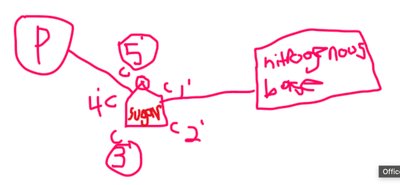
A nucleotide is the building block of DNA, consisting of a phosphate group, deoxyribose sugar, and a nitrogenous base. The carbons of the sugar are numbered 1' to 5', with the 3' and 5' carbons being critical for forming the DNA backbone.
Antiparallel Structure of DNA
DNA strands run in opposite directions: one strand runs 5' to 3', the other 3' to 5'. This orientation is called antiparallel.
DNA Replication: Semiconservative Model
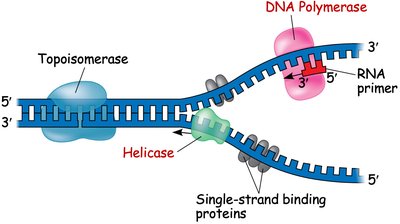
DNA replication is semiconservative: each new DNA molecule consists of one parental strand and one new strand. Replication occurs during the S phase of the cell cycle.
Key Enzymes and Proteins in DNA Replication
Topoisomerase: Relieves strain ahead of the replication fork.
Helicase: Unwinds the DNA double helix.
Single-strand binding proteins: Stabilize unwound DNA.
DNA polymerase: Synthesizes new DNA strands in the 5' to 3' direction.
RNA primer: Provides a starting point for DNA synthesis.
DNA Packaging in Chromosomes
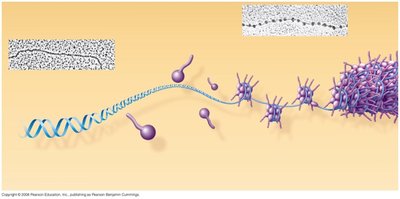
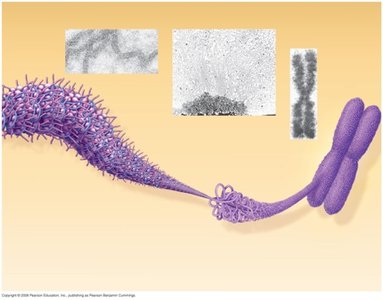
DNA is packaged into chromosomes through several levels of organization:
"Naked" DNA double helix (2 nm)
Histone proteins and nucleosomes (10 nm fiber)
30 nm fiber (coiled nucleosomes)
Loops and scaffolds (300 nm fiber)
Metaphase chromosome (700 nm)
Mutation Prevention and DNA Repair
DNA polymerase proofreading: Corrects errors during replication, reducing mutation rate.
Nucleotide excision repair: Removes and replaces damaged DNA segments.
Gene Expression: From Gene to Protein
Purpose of DNA
DNA contains the instructions for making proteins, which determine cell structure and function.
Types of RNA in Protein Synthesis
RNA Type | Name | Function |
|---|---|---|
mRNA | Messenger | Carries genetic information from DNA to ribosomes |
rRNA | Ribosomal | Forms the core of ribosomes, the site of protein synthesis |
tRNA | Transfer | Brings amino acids to the ribosome during translation |
Central Dogma: DNA to RNA to Protein
Genetic information flows from DNA to RNA (transcription) and from RNA to protein (translation).
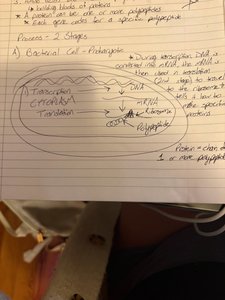
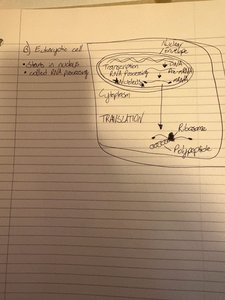
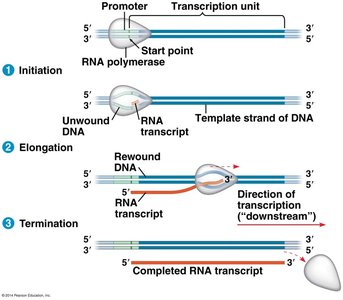
Transcription: Synthesis of RNA from DNA
Initiation: RNA polymerase binds to the promoter with the help of transcription factors (TATA box in eukaryotes).
Elongation: RNA polymerase unwinds DNA and synthesizes RNA in the 5' to 3' direction.
Termination: RNA polymerase reaches a terminator sequence and releases the RNA transcript.
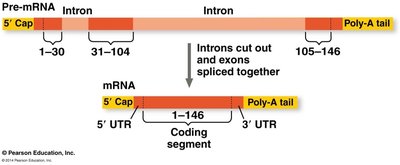
RNA Processing in Eukaryotes
5' capping: Addition of a modified guanine nucleotide to the 5' end.
Poly-A tail: Addition of a string of adenines to the 3' end.
RNA splicing: Removal of introns (non-coding regions); exons (coding regions) are joined together.
Note: RNA processing occurs only in eukaryotes.
The Genetic Code
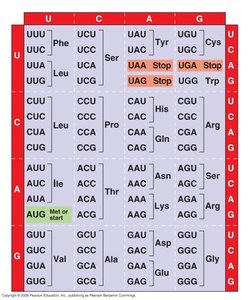
The genetic code is redundant; multiple codons can specify the same amino acid, which helps minimize the effects of mutations.
Translation: Protein Synthesis at the Ribosome
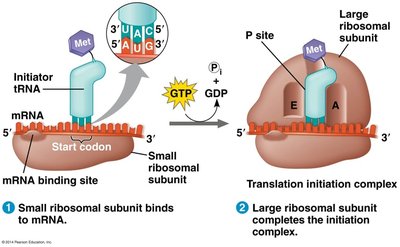
Initiation: Small ribosomal subunit binds mRNA; initiator tRNA (carrying methionine) binds the start codon (AUG); large subunit joins to form the initiation complex.
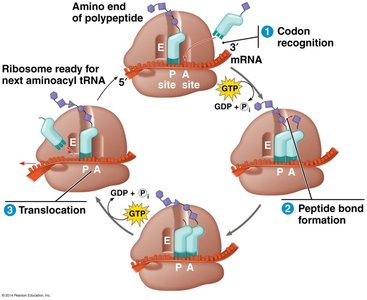
Elongation: tRNAs bring amino acids to the ribosome; peptide bonds form between amino acids; ribosome moves along mRNA.
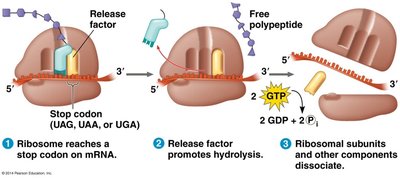
Termination: When a stop codon is reached, a release factor binds, causing the polypeptide to be released and the ribosome to dissociate.
Summary Table: Key Differences in Prokaryotic and Eukaryotic Gene Expression
Feature | Prokaryotes | Eukaryotes |
|---|---|---|
Location of transcription | Cytoplasm | Nucleus |
mRNA processing | None | 5' capping, poly-A tail, splicing |
Transcription and translation | Can be simultaneous | Separate (not simultaneous) |
