 뒤로
뒤로Cellular Respiration: Citric Acid Cycle & Electron Transport System
스터디 가이드 - 스마트 노트
 자료에 맞춘 맞춤형 노트, 핵심 정의, 예시, 맥락을 확장해 제공합니다.
Cellular Respiration
Overview of Cellular Respiration
Cellular respiration is the process by which cells extract energy from glucose and other organic molecules to produce ATP, the main energy currency of the cell. This process involves a series of metabolic pathways that occur in the cytoplasm and mitochondria of eukaryotic cells.
Stages: Glycolysis, Preparatory Step, Citric Acid Cycle (Krebs Cycle), Electron Transport System
Location: Mitochondria (Citric Acid Cycle and Electron Transport System)
Purpose: To convert biochemical energy from nutrients into ATP, releasing waste products such as CO2 and H2O
Citric Acid Cycle (Krebs Cycle)
Steps and Key Events
The citric acid cycle, also known as the Krebs cycle, is a series of chemical reactions used by all aerobic organisms to generate energy. It occurs in the inner membrane region of the mitochondria and processes the acetyl groups derived from glucose catabolism.
Entry: Acetyl CoA delivers an acetyl group, which combines with oxaloacetate to form citric acid.
Decarboxylation: Carbons are removed as CO2 during the cycle.
Redox Reactions: NAD+ and FAD act as coenzymes, picking up hydrogen ions and electrons to become NADH and FADH2.
ATP Production: ATP is produced by substrate-level phosphorylation.
Cycle Completion: The cycle regenerates oxaloacetate to begin again.
For each glucose molecule: The cycle turns twice (once for each acetyl group).
Summary of Products (per glucose):
2 ATP (substrate-level phosphorylation)
6 NADH
2 FADH2
4 CO2 (waste)
Electron Transport System (ETS)
Mechanism and ATP Synthesis
The electron transport system is the final stage of cellular respiration, occurring in the inner mitochondrial membrane. It uses the high-energy electrons from NADH and FADH2 to power ATP synthesis.
Electron Transfer: NADH and FADH2 donate electrons to carrier proteins in the membrane.
Proton Gradient: Energy from electrons is used to pump H+ ions into the outer mitochondrial compartment, creating a gradient.
ATP Synthase: H+ ions flow back through ATP synthase, catalyzing the formation of ATP from ADP and inorganic phosphate (Pi).
Oxygen: Acts as the final electron acceptor, combining with H+ and electrons to form water.
ATP Yield: Approximately 34 ATP molecules are produced by oxidative phosphorylation.
Equation:
Overall Summary of Cellular Respiration (Stages 1-4)
Glucose is fully catabolized to CO2 and H2O.
Net gain: 36 ATP (after accounting for 2 ATP used to shuttle NADH into mitochondria).
Waste products: 6 CO2, 6 H2O.
Alternative Energy Sources
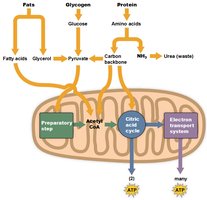
Catabolism of Fats and Proteins
When glycogen stores are depleted, cells can metabolize fats and proteins for energy.
Fats: Triglycerides are broken into glycerol and fatty acids. Glycerol enters glycolysis or is converted to pyruvate; fatty acids are converted to acetyl CoA for the citric acid cycle. Fats yield about twice as much ATP as glycogen.
Proteins: Broken into amino acids; the amine group is removed (excreted as urea), and the carbon backbone enters the citric acid cycle at various points. Protein catabolism increases during starvation.
Anaerobic Respiration
ATP Production Without Oxygen
Cells can produce ATP anaerobically (without oxygen) for short periods. Glycolysis is an example of anaerobic respiration. In the absence of oxygen, pyruvate is converted to lactic acid instead of entering the mitochondria, causing muscle fatigue and cramping.
Glycolysis: Occurs in the cytoplasm, produces 2 ATP per glucose.
Lactic Acid: End product in humans under anaerobic conditions.
Key Terms and Definitions
ATP (Adenosine Triphosphate): The main energy carrier in cells.
NAD+ (Nicotinamide Adenine Dinucleotide): Electron carrier, becomes NADH when reduced.
FAD (Flavin Adenine Dinucleotide): Electron carrier, becomes FADH2 when reduced.
Oxidative Phosphorylation: ATP production using energy derived from the transfer of electrons in the electron transport chain.
Substrate-Level Phosphorylation: Direct formation of ATP by transferring a phosphate group to ADP from a substrate.
