 뒤로
뒤로Chapter 23: The Evolution of Populations – Mechanisms and Patterns
스터디 가이드 - 스마트 노트
 자료에 맞춘 맞춤형 노트, 핵심 정의, 예시, 맥락을 확장해 제공합니다.
Mechanisms That Cause Evolution
Introduction to Population Evolution
Evolution at the population level involves changes in allele frequencies over generations, a process known as microevolution. While natural selection acts on individuals, only populations evolve. Three primary mechanisms drive these changes: natural selection, genetic drift, and gene flow.
Natural selection: Differential survival and reproduction lead to adaptation to the environment.
Genetic drift: Random events cause unpredictable fluctuations in allele frequencies, especially in small populations.
Gene flow: Movement of alleles between populations through migration or gamete transfer.
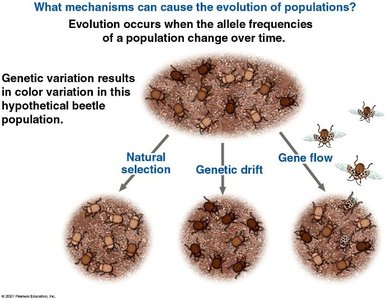
Example: In a beetle population, color variation may be shaped by all three mechanisms, leading to evolutionary change over time.
The Hardy-Weinberg Principle and Population Genetics
Hardy-Weinberg Equilibrium
The Hardy-Weinberg equilibrium describes a population in which allele and genotype frequencies remain constant from generation to generation, provided that certain conditions are met. This principle provides a null model for detecting evolutionary change.
Gene pool: The total collection of alleles at all loci in a population.
Population: A group of individuals of the same species living in the same area and interbreeding.
Genetic variation: Required for evolution, but not all variation leads to evolutionary change unless acted upon by evolutionary mechanisms.
The Hardy-Weinberg equation for two alleles (p and q) at a locus is:
= frequency of homozygous dominant genotype
= frequency of heterozygous genotype
= frequency of homozygous recessive genotype
Conditions for Hardy-Weinberg Equilibrium
For a population to remain in Hardy-Weinberg equilibrium (i.e., not evolve), five conditions must be met:
Condition | Consequence if Condition Does Not Hold |
|---|---|
No mutations | The gene pool is modified if mutations occur or if entire genes are deleted or duplicated. |
Random mating | If individuals mate within a subset of the population, random mixing of gametes does not occur and genotype frequencies change. |
No natural selection | Allele frequencies change when individuals with different genotypes show differences in survival or reproductive success. |
Extremely large population size | In small populations, allele frequencies fluctuate by chance over time (genetic drift). |
No gene flow | By moving alleles into or out of populations, gene flow can alter allele frequencies. |
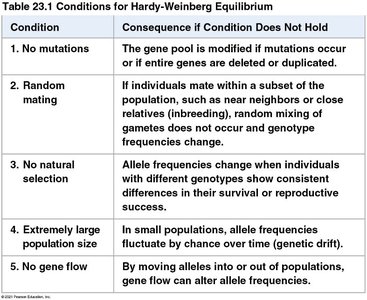
Additional info: In real populations, these conditions are rarely all met, so allele and genotype frequencies often change over time.
Mechanisms That Alter Allele Frequencies
Genetic Drift
Genetic drift is a process in which chance events cause unpredictable fluctuations in allele frequencies from one generation to the next. It is especially significant in small populations and can lead to the loss of genetic variation or fixation of harmful alleles.
Founder effect: Occurs when a few individuals become isolated from a larger population, leading to a gene pool that differs from the original population.
Bottleneck effect: A sudden reduction in population size due to environmental change, resulting in a gene pool that may not reflect the original population's genetic diversity.
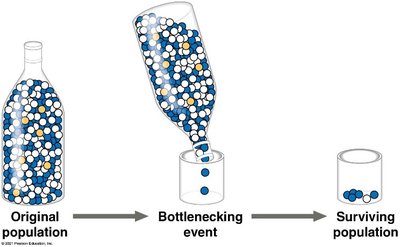
Genetic drift is significant in small populations.
It can cause allele frequencies to change at random.
It can lead to a loss of genetic variation within populations.
It can cause harmful alleles to become fixed.
Gene Flow
Gene flow is the movement of alleles among populations, often through the migration of individuals or the transfer of gametes (e.g., pollen). Gene flow tends to reduce genetic differences between populations over time and can introduce new alleles into a population.
Gene flow can counteract the effects of genetic drift and natural selection by homogenizing allele frequencies across populations.
Natural Selection and Its Types
Natural selection can alter the frequency distribution of heritable traits in three main ways:
Directional selection: Favors individuals at one extreme of the phenotypic range, shifting the population's trait distribution in one direction.
Disruptive selection: Favors individuals at both extremes of the phenotypic range, increasing variation and potentially leading to speciation.
Stabilizing selection: Favors intermediate variants and acts against extreme phenotypes, reducing variation and maintaining the status quo for a trait.
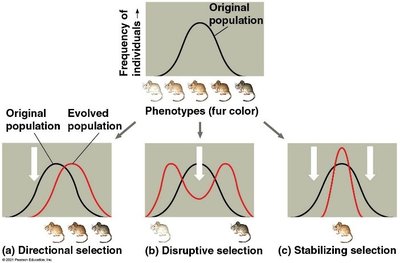
Example: In a population of rodents, directional selection might favor darker fur if the environment becomes darker, while disruptive selection could favor both very light and very dark fur if intermediate colors are less advantageous.
