 뒤로
뒤로DNA Tools and Biotechnology: Techniques and Applications
스터디 가이드 - 스마트 노트
 자료에 맞춘 맞춤형 노트, 핵심 정의, 예시, 맥락을 확장해 제공합니다.
DNA Tools and Biotechnology
DNA Sequencing and DNA Cloning
Modern biology relies on DNA technology to sequence and manipulate genetic material for research, medicine, and industry. Genetic engineering refers to the direct manipulation of genes for practical purposes, such as producing proteins or modifying organisms.
DNA sequencing determines the complete nucleotide sequence of a gene.
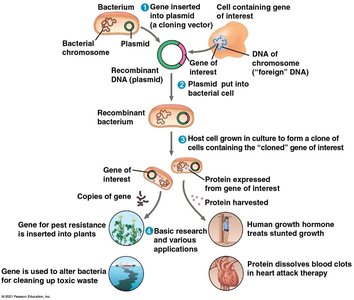
DNA cloning is the process of making multiple identical copies of a DNA segment. This is often achieved using plasmids, which are small, circular DNA molecules that replicate independently of the bacterial chromosome.
When foreign DNA is inserted into a plasmid, the resulting molecule is called recombinant DNA.
Recombinant plasmids can be introduced into bacteria, which then replicate the plasmid and the inserted gene, a process known as gene cloning.
Cloning vectors are plasmids or other agents used to carry foreign DNA into host cells.
Gene cloning is essential for amplifying genes and producing protein products for research, medicine, and industry.
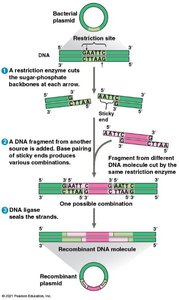
Using Restriction Enzymes to Make Recombinant DNA
Restriction enzymes are bacterial proteins that cut DNA at specific sequences called restriction sites. These enzymes generate restriction fragments, often with single-stranded overhangs called sticky ends, which can base-pair with complementary sequences from other DNA fragments. DNA ligase is used to seal the sugar-phosphate backbone, creating stable recombinant DNA molecules.
Restriction enzymes allow precise cutting and pasting of DNA from different sources.
Sticky ends facilitate the joining of DNA fragments from different origins.
DNA ligase ensures the recombinant DNA is covalently bonded and stable.
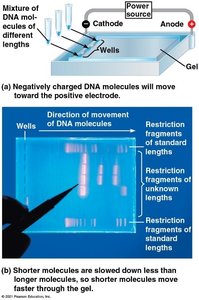
Gel Electrophoresis
Gel electrophoresis is a technique used to separate DNA fragments by size. DNA samples are loaded into wells in a gel matrix and subjected to an electric field. Negatively charged DNA moves toward the positive electrode, with shorter fragments migrating faster than longer ones. This method allows visualization and analysis of DNA fragments, such as those produced by restriction enzyme digestion.
Used to check the size and purity of DNA fragments.
Essential for confirming the presence of recombinant DNA or for DNA fingerprinting.
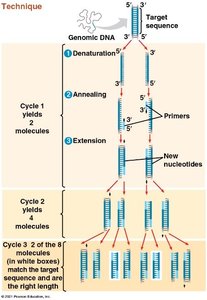
Polymerase Chain Reaction (PCR)
The polymerase chain reaction (PCR) is a powerful technique for amplifying specific DNA sequences. It involves repeated cycles of:
Denaturation: Heating to separate DNA strands.
Annealing: Cooling to allow primers to bind to target sequences.
Extension: DNA polymerase synthesizes new DNA strands from the primers.
Uses heat-stable DNA polymerases (e.g., Taq polymerase).
Primers determine the specificity of the amplification.
PCR can amplify DNA from ancient samples, forensic evidence, or single cells.
Errors may occur during amplification, so PCR does not replace gene cloning in cells for all applications.
Studying Gene Expression
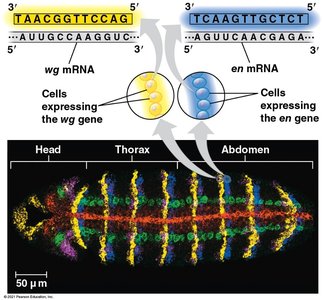
To study gene expression, scientists detect specific mRNAs using nucleic acid hybridization with labeled nucleic acid probes. In situ hybridization uses fluorescent probes to visualize the location of specific mRNAs within intact tissues or organisms, revealing patterns of gene expression.
Different probes can be labeled with distinct fluorescent dyes for multiplex analysis.
Allows researchers to study gene activity in development and disease.
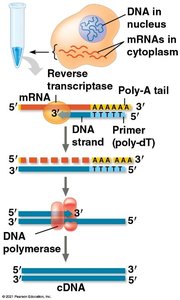
Reverse Transcriptase PCR (RT-PCR)
RT-PCR is used to compare mRNA levels between samples. Reverse transcriptase synthesizes complementary DNA (cDNA) from mRNA, which is then amplified by PCR. This technique is valuable for measuring gene expression quantitatively.
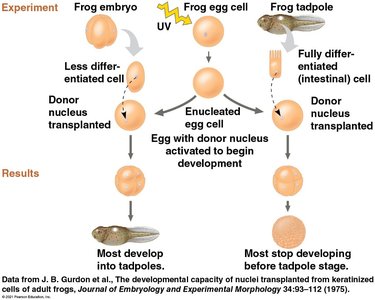
Cloned Organisms and Stem Cells
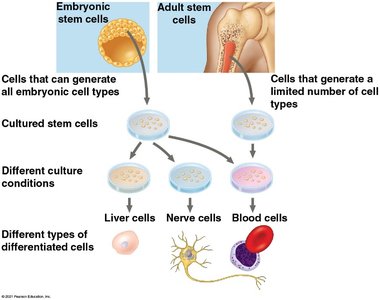
Organismal cloning produces genetically identical organisms from a single parent cell. Stem cells are undifferentiated cells capable of self-renewal and differentiation into specialized cell types.
Nuclear transplantation involves replacing the nucleus of an egg cell with the nucleus from a differentiated cell. The developmental potential of the transplanted nucleus decreases with the age of the donor cell.
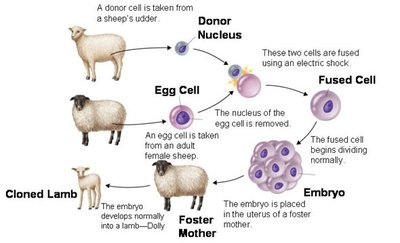
Reproductive Cloning of Mammals
The first mammal cloned from an adult cell was Dolly the sheep, produced by nuclear transplantation. This process demonstrated that differentiated animal cells can be reprogrammed to develop into a whole organism, though efficiency and health issues remain.
Stem Cells of Animals
Embryonic stem (ES) cells are pluripotent, capable of differentiating into nearly any cell type. Adult stem cells are multipotent, able to generate several, but not all, cell types. ES cells are valuable for research and potential therapies, while adult stem cells maintain and repair tissues in the body.
Therapeutic cloning aims to produce ES cells for treating diseases.
Ethical debates surround the use of embryonic stem cells.
Genome-Wide Association Studies and SNPs
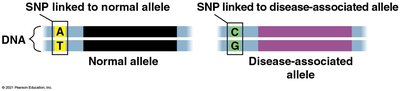
Researchers use genome-wide association studies (GWAS) to identify genetic markers associated with diseases. Single nucleotide polymorphisms (SNPs) are single base-pair variations in the genome that can serve as markers for disease-associated alleles. SNPs are usually found in noncoding regions but can be closely linked to disease-causing mutations.
GWAS helps locate genes involved in inherited disorders.
SNPs are valuable for mapping genetic traits and understanding genetic diversity.
Additional info: The notes above expand on the original content by providing definitions, context, and examples for each technique and concept, ensuring a comprehensive and self-contained study guide for General Biology students.
