뒤로
뒤로DNA Transcription, Translation, and Gene Expression
스터디 가이드 - 스마트 노트
 자료에 맞춘 맞춤형 노트, 핵심 정의, 예시, 맥락을 확장해 제공합니다.
Gene Expression: DNA, RNA, and Protein Synthesis
Overview of Gene Expression
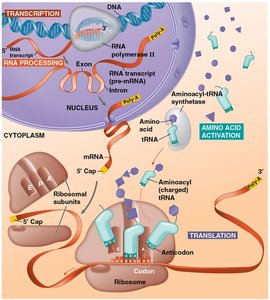
Gene expression is the process by which information encoded in DNA is used to direct the synthesis of proteins, which carry out cellular functions. Because DNA is confined to the nucleus, its instructions are transcribed into RNA, which is then translated into protein at the ribosome.
DNA serves as the template for RNA synthesis.
RNA acts as the intermediary, carrying genetic information from DNA to the ribosome.
Protein is synthesized based on the RNA sequence, determining cell structure and function.

Epigenetic Regulation of Gene Expression
Chromatin Structure and Histone Modification
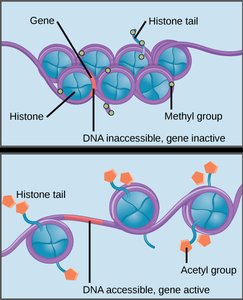
Epigenetic regulation involves modifications to DNA or histone proteins that affect gene accessibility without altering the DNA sequence. DNA is wrapped around histones, forming nucleosomes.
Histone acetylation opens chromatin, making DNA accessible for transcription.
Histone methylation can make DNA inaccessible, silencing gene expression.
Epigenetic changes are reversible and can be influenced by environmental factors.
Transcription: DNA to RNA
Initiation of Transcription
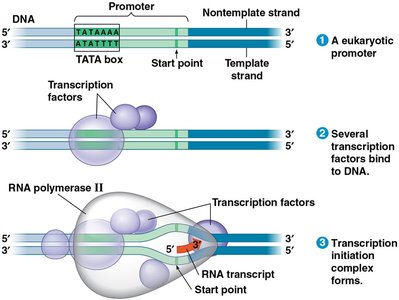
Transcription begins at a promoter region, often containing a TATA box, where transcription factors and RNA polymerase II assemble.
Promoter: DNA sequence where transcription machinery binds.
Transcription factors: Proteins that help RNA polymerase bind to DNA.
TATA box: A region rich in adenine and thymine, crucial for initiation.
Transcription Process
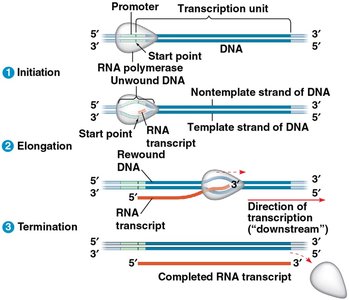
Transcription proceeds in three main steps: initiation, elongation, and termination.
Initiation: RNA polymerase binds and unwinds DNA.
Elongation: RNA polymerase synthesizes RNA using the DNA template.
Termination: RNA polymerase releases the completed RNA transcript.
RNA Processing: Pre-mRNA to mRNA
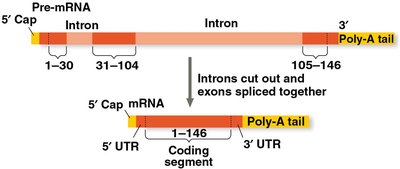
Modification and Splicing
Before RNA can be translated, it must be processed.
5' Cap and Poly-A tail are added to protect RNA from degradation.
Introns (non-coding regions) are removed; exons (coding regions) are joined.
Processed RNA is called messenger RNA (mRNA).
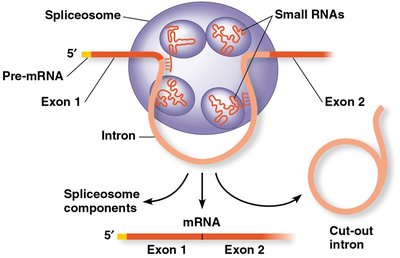
Spliceosomes and RNA Splicing
Spliceosomes, composed of RNA and proteins, remove introns and splice exons together.
Spliceosome: Complex responsible for intron removal.
Introns remain in the nucleus; exons exit as mRNA.
Translation: mRNA to Protein
Translation Mechanism
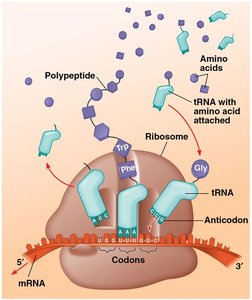
Translation occurs at the ribosome, where mRNA is decoded to synthesize proteins.
Ribosome: Site of protein synthesis, composed of rRNA and proteins.
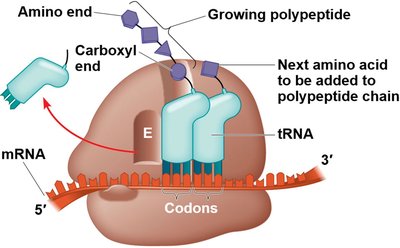
tRNA: Brings amino acids to the ribosome, matching mRNA codons with anticodons.
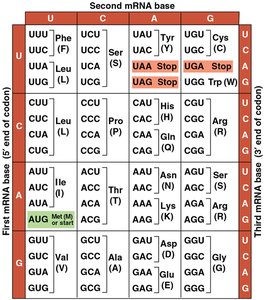
Each codon (three nucleotides) specifies an amino acid.
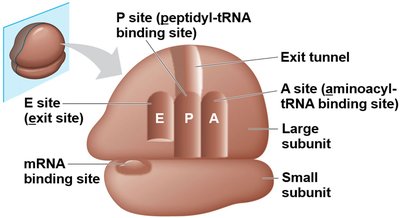
Ribosome Structure and Function
Ribosomes have three binding sites for tRNA: A (aminoacyl), P (peptidyl), and E (exit).
A site: tRNA arrives with amino acid.
P site: Polypeptide chain grows.
E site: tRNA exits after delivering amino acid.
Translation Termination
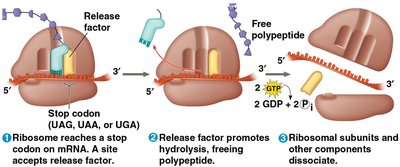
Translation ends when a stop codon is reached, and a release factor frees the polypeptide.
Start codon: AUG (methionine).
Stop codons: UAG, UAA, UGA.
Release factor promotes hydrolysis, releasing the protein.
Recap: Central Dogma of Molecular Biology
Summary of Steps
DNA is transcribed in the nucleus to RNA.
RNA is processed to become mRNA.
mRNA leaves the nucleus and is translated at the ribosome.
tRNA brings amino acids to the ribosome, matching mRNA codons.
Amino acids are linked to form a polypeptide chain.
Codon Chart and Translation Practice
Using the Codon Chart
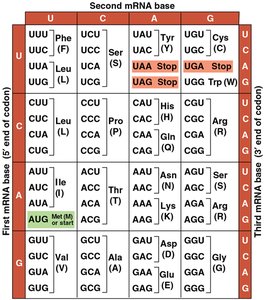
Each codon codes for a specific amino acid. The chart is used to decode mRNA sequences.
First letter: row block.
Second letter: column block.
Third letter: specific row.
Start codon: AUG (methionine).
Stop codons: UAG, UAA, UGA.
Mutations and Their Effects
Types of Mutations
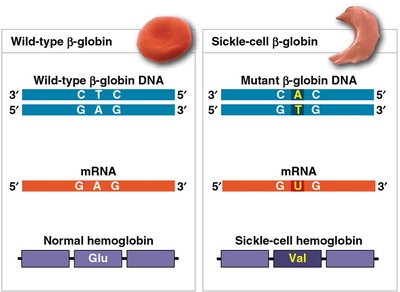
Mutations are changes in DNA that can affect protein structure and function.
Point mutation: Change in a single nucleotide.
Substitution: Wrong nucleotide replaces the correct one.
Silent mutation: No change in amino acid.
Missense mutation: Different amino acid coded.
Nonsense mutation: Codes for a stop codon.
Insertion/Deletion: Extra or missing nucleotide causes frameshift.
Mutagens: Physical or chemical agents causing mutations.
Carcinogens: Mutagens that cause cancer.
Evolution Through Mutations
Mutations and Phenotypic Variation
Mutations can involve single nucleotides or entire genes, leading to new phenotypes. If these phenotypes are advantageous, they may drive evolutionary changes and speciation.
Mutations can result in new traits (e.g., blue eyes).
Advantageous mutations may be selected for in populations.
Mutations are a source of genetic diversity and evolution.