 뒤로
뒤로Gene Expression: From Gene to Protein
스터디 가이드 - 스마트 노트
 자료에 맞춘 맞춤형 노트, 핵심 정의, 예시, 맥락을 확장해 제공합니다.
Gene Expression: From Gene to Protein
Overview of Gene Expression
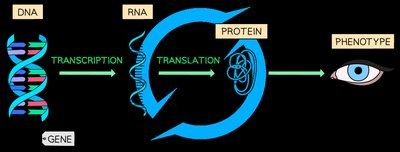
Gene expression is the process by which information encoded in DNA directs the synthesis of proteins, which are essential for cellular structure and function. This process involves two main stages: transcription and translation. Proteins serve as the link between genotype and phenotype, determining the traits of an organism.
Transcription: Synthesis of RNA from a DNA template.
Translation: Synthesis of a polypeptide (protein) using the information in mRNA.
Central Dogma: The flow of genetic information is typically DNA → RNA → Protein.

DNA vs. RNA
DNA and RNA are nucleic acids that differ in structure and function. DNA stores genetic information, while RNA acts as a messenger and functional molecule in protein synthesis.
DNA: Double-stranded, contains deoxyribose sugar, bases are A, T, C, G.
RNA: Single-stranded, contains ribose sugar, bases are A, U, C, G.
Transcription: From DNA to RNA
Basic Principles of Transcription
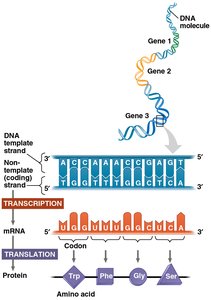
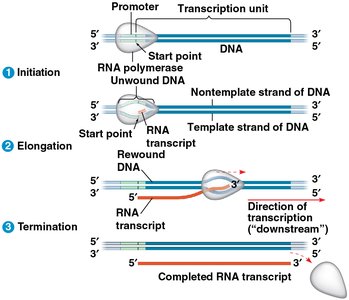
Transcription is the process by which a segment of DNA is used as a template to synthesize a complementary RNA strand. In eukaryotes, this occurs in the nucleus; in prokaryotes, it occurs in the cytoplasm.
RNA polymerase catalyzes RNA synthesis, binding to the DNA at the promoter region.
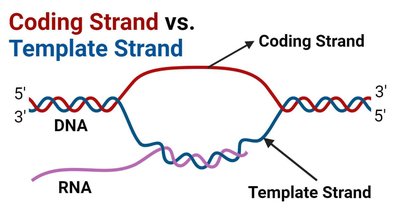
The template strand of DNA is used to assemble a complementary RNA molecule.
The coding strand of DNA has the same sequence as the RNA (except T is replaced by U).
Stages of Transcription
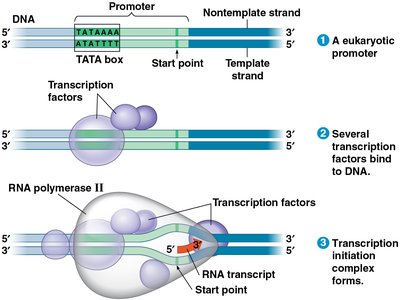
Initiation: RNA polymerase binds to the promoter, aided by transcription factors in eukaryotes (e.g., TATA box).
Elongation: RNA polymerase moves along the DNA, synthesizing RNA in the 5' to 3' direction.
Termination: In prokaryotes, transcription stops at a terminator sequence; in eukaryotes, the transcript is released after a polyadenylation signal.
RNA Processing in Eukaryotes
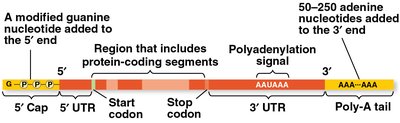
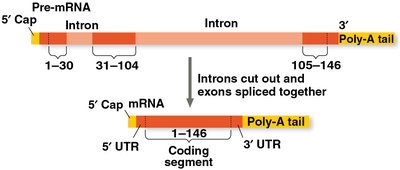
In eukaryotic cells, the primary RNA transcript (pre-mRNA) undergoes several modifications before becoming mature mRNA.
5' Cap: Modified guanine nucleotide added to the 5' end.
Poly-A Tail: 50–250 adenine nucleotides added to the 3' end.
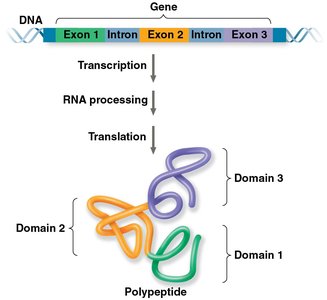
RNA Splicing: Removal of noncoding regions (introns) and joining of coding regions (exons).
Alternative RNA Splicing
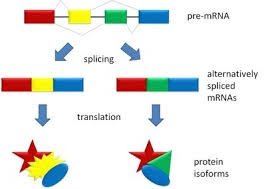
Alternative splicing allows a single gene to code for multiple proteins by varying which exons are included in the final mRNA.
Translation: From RNA to Protein
The Genetic Code
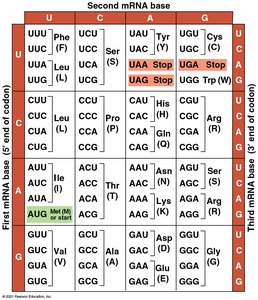
The genetic code is a set of rules by which the nucleotide sequence of mRNA is translated into the amino acid sequence of a protein. Each three-nucleotide sequence (codon) specifies a particular amino acid.
There are 64 codons: 61 code for amino acids, 3 are stop signals.
The code is redundant but not ambiguous.
Codons must be read in the correct reading frame.
Molecular Components of Translation
Translation occurs in the cytoplasm and involves mRNA, transfer RNA (tRNA), and ribosomes.
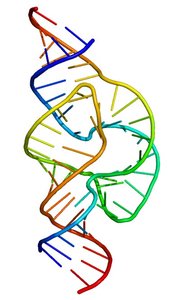
tRNA: Brings amino acids to the ribosome; has an anticodon that pairs with mRNA codons.
Ribosome: Site of protein synthesis; has three binding sites (A, P, E) for tRNA.
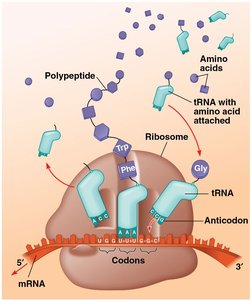
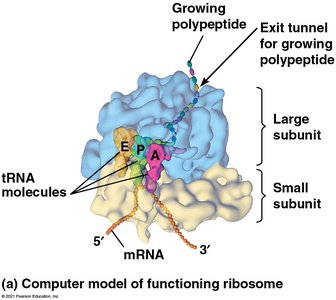
Stages of Translation
Initiation: Small ribosomal subunit binds mRNA and initiator tRNA (carrying methionine) at the start codon (AUG).
Elongation: Amino acids are added one by one to the growing polypeptide chain.
Termination: Occurs when a stop codon is reached; a release factor binds, releasing the polypeptide.
Protein Folding and Targeting
After translation, polypeptides fold into their functional three-dimensional shapes and may be targeted to specific cellular locations.
Signal peptides direct proteins to the endoplasmic reticulum or other organelles.
Polypeptides may be modified after translation (post-translational modifications).
Mutations and Gene Editing
Types of Mutations
Mutations are changes in the genetic material that can affect protein structure and function.
Point mutations: Change a single nucleotide pair (substitutions, insertions, deletions).
Silent mutations: Do not change the amino acid sequence.
Missense mutations: Change one amino acid to another.
Nonsense mutations: Change an amino acid codon to a stop codon.
Frameshift mutations: Insertions or deletions that alter the reading frame.
CRISPR and Gene Editing
CRISPR-Cas9 is a revolutionary gene-editing technology that allows scientists to make precise changes to DNA, including correcting disease-causing mutations.
Cas9 protein, guided by RNA, cuts the target DNA sequence.
DNA repair mechanisms can introduce or correct mutations.
Summary Table: Key Steps in Gene Expression
Step | Location (Eukaryotes) | Main Molecules Involved | Key Events |
|---|---|---|---|
Transcription | Nucleus | DNA, RNA polymerase, pre-mRNA | DNA template used to synthesize RNA |
RNA Processing | Nucleus | pre-mRNA, enzymes, spliceosome | 5' cap, poly-A tail, splicing of introns |
Translation | Cytoplasm | mRNA, tRNA, ribosome | mRNA codons translated into amino acid sequence |
Protein Folding/Targeting | Cytoplasm/ER | Polypeptide, chaperones, signal peptides | Folding, modification, and targeting of protein |
