 뒤로
뒤로General Biology Exam Study Guide: Chromosomes, Cell Cycle, Genetics, and Molecular Biology
스터디 가이드 - 스마트 노트
 자료에 맞춘 맞춤형 노트, 핵심 정의, 예시, 맥락을 확장해 제공합니다.
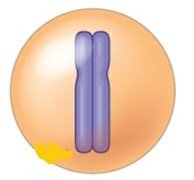
Q1. The chromosome below is composed of?
Background
Topic: Chromosome Structure
This question tests your understanding of the physical structure of chromosomes, specifically the number and arrangement of DNA molecules in a replicated chromosome.
Key Terms and Concepts:
Chromosome: A structure composed of DNA and proteins that contains genetic information.
Sister Chromatids: Two identical copies of a chromosome connected by a centromere, formed after DNA replication.
Double-stranded DNA molecule: The standard structure of DNA, consisting of two complementary strands.
Step-by-Step Guidance
Observe the image: Notice that the chromosome appears to have two identical arms joined together.
Recall that after DNA replication, each chromosome consists of two sister chromatids, each containing a double-stranded DNA molecule.
Consider the possible answer choices and relate them to the structure shown: Is it single- or double-stranded DNA, and how many molecules are present?
Think about the difference between a chromatid and a chromosome, and how many DNA molecules are present in each chromatid.
Try solving on your own before revealing the answer!
Final Answer: C. two double-stranded DNA molecules.
Each chromatid contains one double-stranded DNA molecule, and the chromosome shown has two sister chromatids, so there are two double-stranded DNA molecules present.
Q2. Which of the following statements does NOT accurately describe the initial stage of the cell cycle that would most likely be disrupted if animal cells were treated with the specific chemical?
Background
Topic: Cell Cycle Regulation
This question tests your knowledge of the stages of the cell cycle and how specific chemicals can disrupt different phases, such as DNA synthesis, spindle formation, and chromosome separation.
Key Terms and Concepts:
S phase: The phase of interphase where DNA is replicated.
Prophase, Metaphase, Anaphase, Cytokinesis: Stages of mitosis and cell division, each with specific cellular events.
Mitotic spindle, kinetochores, cohesins, contractile ring: Structures and proteins involved in chromosome movement and cell division.
Step-by-Step Guidance
Read each statement and identify which stage of the cell cycle it refers to (S phase, prophase, metaphase, anaphase, cytokinesis).
Consider what would happen if a chemical interfered with the process described in each statement.
Recall the order of events in the cell cycle and what is required for each stage to proceed normally.
Identify which statement does not accurately match the disruption described with the correct stage of the cell cycle.
Try solving on your own before revealing the answer!
Final Answer: E. Cytokinesis would be disrupted by a chemical that interferes with the formation of the contractile ring of microtubules that deepen the cleavage furrow.
The contractile ring involved in cytokinesis is made of actin microfilaments, not microtubules. The statement is inaccurate because it misidentifies the cytoskeletal component involved.
Q3. One difference between cancer cells and normal cells is that cancer cells:
Background
Topic: Cancer Cell Biology
This question examines your understanding of how cancer cells differ from normal cells in terms of cell cycle regulation, growth, and division.
Key Terms and Concepts:
Density-dependent inhibition: Normal cells stop dividing when they come into contact with each other.
Anchorage dependence: Normal cells need to be attached to a substrate to divide.
G0 phase: A resting phase where cells are not actively dividing.
M phase: The phase of the cell cycle where mitosis occurs.
Step-by-Step Guidance
Review the characteristics of normal cell growth and how cancer cells bypass these controls.
Consider which options describe properties unique to cancer cells versus normal cells.
Recall that cancer cells often lose the ability to respond to signals that regulate cell growth and division.
Eliminate options that describe normal cell behavior rather than cancer cell behavior.
Try solving on your own before revealing the answer!
Final Answer: B. are shunted into G0
Cancer cells do not typically enter the G0 phase; they continue to divide uncontrollably, unlike normal cells that can exit the cell cycle and enter G0.
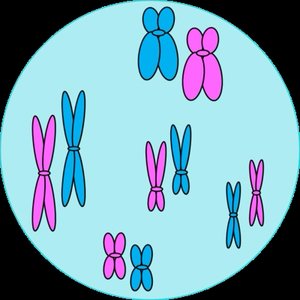
Q4. Assuming this is a cell from an organism with a diploid number of 10 (2n = 10), determine which of the following correctly lists the number of chromosomes, chromatids, sets of chromosomes, and homologous pairs?
Background
Topic: Chromosome Number and Structure
This question tests your ability to interpret chromosome numbers and structures in a diploid organism, including the concepts of chromatids, homologous pairs, and sets of chromosomes.
Key Terms and Concepts:
Diploid (2n): Two sets of chromosomes, one from each parent.
Chromatid: Each of the two identical halves of a replicated chromosome.
Homologous pairs: Pairs of chromosomes with the same genes but possibly different alleles.
Set of chromosomes: A complete set of different chromosomes (n).
Step-by-Step Guidance
Identify the diploid number (2n = 10), which means there are 10 chromosomes in a somatic cell.
After DNA replication, each chromosome consists of two sister chromatids, so calculate the total number of chromatids.
Determine the number of sets of chromosomes (n) and the number of homologous pairs.
Match these numbers to the answer choices provided.
Try solving on your own before revealing the answer!
Final Answer: A. 10 chromosomes, 20 chromatids, 5 sets of chromosomes, 5 homologous pairs
With a diploid number of 10, there are 10 chromosomes (2n), 20 chromatids after replication, 5 sets of chromosomes (n), and 5 homologous pairs.
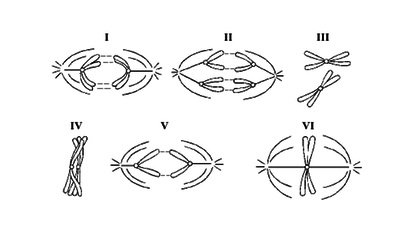
Q5. Choose the statements below that are CORRECT about the stages of mitosis and meiosis shown in the images.
Background
Topic: Mitosis and Meiosis Stages
This question tests your ability to identify and distinguish between the stages of mitosis and meiosis based on diagrams.
Key Terms and Concepts:
Anaphase, Prophase, Metaphase: Stages of cell division with distinct chromosomal arrangements.
Homologous chromosomes vs. sister chromatids: Homologous chromosomes are pairs from each parent; sister chromatids are identical copies.
Mitosis vs. Meiosis: Mitosis produces identical cells; meiosis produces gametes with half the chromosome number.
Step-by-Step Guidance
Examine each image (I-VI) and note the arrangement and separation of chromosomes or chromatids.
Recall the defining features of each stage in mitosis and meiosis (e.g., homologous chromosomes separate in Anaphase I of meiosis).
Match each image to the correct stage and process (mitosis or meiosis).
Identify which statements accurately describe the images.
Try solving on your own before revealing the answer!
Final Answer: A. image I is Anaphase I; B. image II is Anaphase of mitosis; C. image III is Prophase I; D. image IV is Prophase II; E. image V is Anaphase II; F. image VI is Metaphase I
Each image corresponds to a specific stage of mitosis or meiosis based on the arrangement and movement of chromosomes.
