 뒤로
뒤로General Biology Study Notes: The Cell, Membranes, and Cellular Respiration (Chapters 4–6)
스터디 가이드 - 스마트 노트
 자료에 맞춘 맞춤형 노트, 핵심 정의, 예시, 맥락을 확장해 제공합니다.
Introduction to the Cell
Principles of Microscopy
Microscopes are essential tools for studying cells, allowing scientists to observe structures not visible to the naked eye.
Light Microscope (LM): Uses visible light to illuminate specimens; can view living cells but limited in resolution (~200 nm).
Transmission Electron Microscope (TEM): Passes electrons through thin sections; reveals internal cell structures at high resolution but requires non-living samples.
Scanning Electron Microscope (SEM): Scans the surface with electrons; produces detailed 3D images of cell surfaces.
Limits to Cell Size
Cell size is constrained by the need to maintain a surface-area-to-volume ratio that supports adequate exchange of materials with the environment.
Cells must be large enough to house DNA, proteins, and organelles, but small enough for efficient diffusion.
Prokaryotic vs. Eukaryotic Cells
Prokaryotic cells: Lack a membrane-bound nucleus; DNA is in a nucleoid region. No true organelles. Examples: Bacteria, Archaea.
Eukaryotic cells: Have a membrane-bound nucleus and various organelles. Examples: Plants, Animals, Fungi, Protists.
Both types have a plasma membrane, DNA, ribosomes, and cytosol.
Common Features of All Cells
Plasma membrane
DNA (genetic material)
Ribosomes (protein synthesis)
Cytosol (fluid component of cytoplasm)
Unique Structures in Plant Cells
Rigid cell wall
Chloroplasts
Central vacuole
Plasmodesmata (channels for communication)
Nucleus and Ribosomes
Nuclear Envelope and Nucleus
The nucleus is surrounded by a double membrane called the nuclear envelope, which contains pores for molecular traffic.
Nucleus: Contains most of the cell’s DNA; directs protein synthesis via mRNA.
Nucleolus: Site of ribosomal RNA (rRNA) synthesis.
Ribosomes
Free ribosomes: Suspended in cytoplasm; make proteins for use within the cell.
Bound ribosomes: Attached to the endoplasmic reticulum (ER) or nuclear envelope; make proteins for export or for organelles.
Endomembrane System
Components and Functions
Nuclear envelope: Separates nucleus from cytoplasm; continuous with ER.
Endoplasmic reticulum (ER): Biosynthetic factory; rough ER (with ribosomes) synthesizes proteins, smooth ER (no ribosomes) synthesizes lipids and detoxifies.
Golgi apparatus: Modifies, sorts, and ships cell products.
Lysosomes: Digestive compartments; break down macromolecules.
Vacuoles: Storage and maintenance (e.g., central vacuole in plants stores water and nutrients).
Plasma membrane: Boundary for cell; regulates entry and exit of substances.
Smooth vs. Rough ER
Rough ER: Studded with ribosomes; synthesizes membrane and secretory proteins.
Smooth ER: Lacks ribosomes; synthesizes lipids, detoxifies drugs, stores calcium ions.
Energy-Converting Organelles
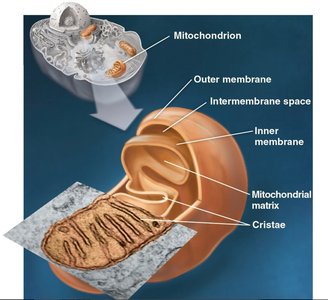
Mitochondria
Mitochondria are the sites of cellular respiration, converting chemical energy from food into ATP.
Present in nearly all eukaryotic cells.
Structure: Outer membrane, inner membrane (with folds called cristae), intermembrane space, and mitochondrial matrix.
Chloroplasts
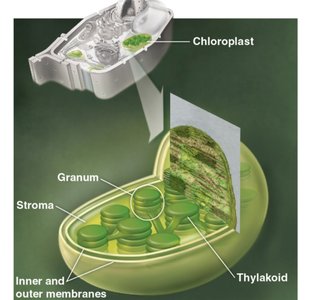
Chloroplasts are the sites of photosynthesis in plants and algae, converting solar energy into chemical energy (sugars).
Structure: Outer and inner membranes, stroma (fluid), thylakoids (membranous sacs), and grana (stacks of thylakoids).
Semiautonomous Organelles
Mitochondria and chloroplasts contain their own DNA and ribosomes, supporting the endosymbiont theory (origin as free-living prokaryotes).
Peroxisomes
Involved in the breakdown of fatty acids and detoxification of harmful substances.
Cytoskeleton and Cell Surfaces
Cytoskeleton Components
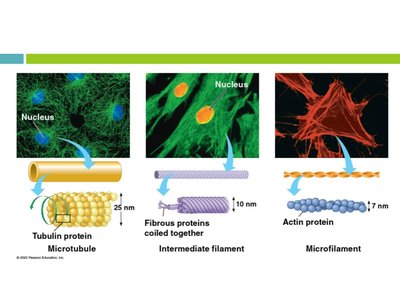
The cytoskeleton is a network of protein fibers that provides structural support, cell shape, and motility.
Microtubules: Hollow tubes made of tubulin; maintain cell shape, serve as tracks for organelle movement.
Microfilaments (actin filaments): Thin rods; support cell shape, involved in cell movement.
Intermediate filaments: Rope-like; reinforce cell shape, anchor organelles.
Cilia and Flagella
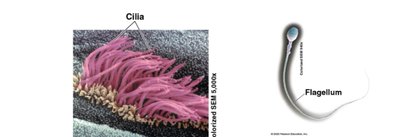
Cilia: Short, numerous; move like oars to propel cells or move fluid over surfaces.
Flagella: Longer, usually one or a few; move with a whip-like motion.
Both structures move by the bending of microtubules powered by motor proteins (dynein).
Extracellular Matrix (ECM) and Cell Junctions
ECM: Network of glycoproteins and other molecules outside animal cells; provides support, adhesion, and communication.
Intercellular junctions:
Plasmodesmata: Channels in plant cell walls for communication.
Gap junctions: Channels in animal cells for molecule exchange.
Desmosomes: Anchor cells together in sheets.
Tight junctions: Prevent leakage between cells.
Membrane Structure and Function
Fluid Mosaic Model
Cell membranes are composed of a phospholipid bilayer with embedded proteins, forming a dynamic and flexible structure.
Fluid: Lipids and proteins can move laterally within the layer.
Mosaic: Diverse proteins embedded in the bilayer.
Selective Permeability
Membranes allow some substances to cross more easily than others.
Small, nonpolar molecules (e.g., O2, CO2) diffuse freely; ions and polar molecules require transport proteins.
Diffusion and Osmosis
Diffusion: Movement of particles from high to low concentration (passive, no energy required).
Osmosis: Diffusion of water across a selectively permeable membrane.
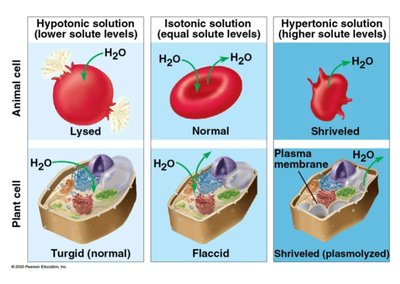
Tonicity and Cell Volume
Isotonic: Equal solute concentration; no net water movement.
Hypotonic: Lower solute concentration outside; water enters cell (animal cells lyse, plant cells become turgid).
Hypertonic: Higher solute concentration outside; water leaves cell (animal cells shrivel, plant cells plasmolyze).
Transport Across Membranes
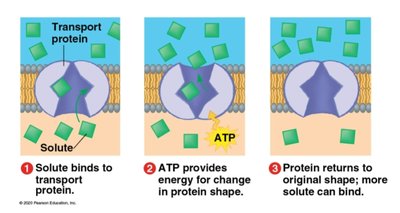
Facilitated diffusion: Passive transport via specific proteins for ions and polar molecules.
Active transport: Moves substances against their concentration gradient; requires energy (ATP) and transport proteins.
Bulk Transport: Endocytosis and Exocytosis
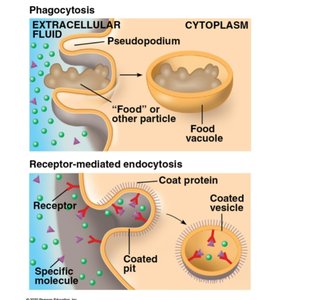
Exocytosis: Export of large molecules via vesicles fusing with the plasma membrane.
Endocytosis: Import of substances via vesicle formation; includes phagocytosis (cell eating), pinocytosis (cell drinking), and receptor-mediated endocytosis (specific uptake).
Energy and the Cell
Forms of Energy
Kinetic energy: Energy of motion (e.g., heat/thermal energy).
Potential energy: Stored energy due to position or structure (e.g., chemical energy in bonds).
Laws of Thermodynamics
First law: Energy cannot be created or destroyed, only transformed.
Second law: Energy transformations increase the disorder (entropy) of the universe.
Metabolism and ATP
Metabolism: The sum of all chemical reactions in an organism.
ATP (adenosine triphosphate): Main energy currency; composed of adenine, ribose, and three phosphates.
ATP powers cellular work by transferring a phosphate group (phosphorylation).
Enzyme Function
Role of Enzymes
Enzymes are biological catalysts that speed up reactions by lowering activation energy.
They are highly specific for their substrates due to the shape of their active site (induced fit model).
Factors Affecting Enzyme Activity
Temperature, pH, cofactors (inorganic), and coenzymes (organic) can affect enzyme function.
Enzyme inhibitors can be competitive (block active site) or noncompetitive (change enzyme shape).
Cellular Respiration
Overview and Equation
Cellular respiration converts glucose and oxygen into carbon dioxide, water, and ATP.
Stages of Cellular Respiration
Glycolysis: Occurs in cytoplasm; breaks glucose into pyruvate; net gain of 2 ATP (substrate-level phosphorylation).
Pyruvate oxidation and Citric Acid Cycle: Occur in mitochondria; produce CO2, NADH, FADH2, and some ATP.
Oxidative phosphorylation: Electron transport chain and chemiosmosis; produces most ATP (up to 32 per glucose).
Redox Reactions and Electron Carriers
Oxidation: Loss of electrons.
Reduction: Gain of electrons.
NAD+ and FAD are important electron carriers, becoming NADH and FADH2 when reduced.
Fermentation
Allows ATP production without oxygen (anaerobic); yields only 2 ATP per glucose.
Lactic acid fermentation: Pyruvate → lactate.
Alcohol fermentation: Pyruvate → ethanol + CO2.
Obligate vs. Facultative Anaerobes
Obligate anaerobes: Cannot survive in oxygen.
Facultative anaerobes: Can switch between aerobic respiration and fermentation.
Connections to Other Metabolic Pathways
Other food molecules (fats, proteins) can enter cellular respiration at various points after conversion to intermediates.
Intermediates from glycolysis and the citric acid cycle can be used for biosynthesis (anabolism) of other molecules.
