 뒤로
뒤로Macromolecules and Metabolism: Structure, Function, and Biological Energy
스터디 가이드 - 스마트 노트
 자료에 맞춘 맞춤형 노트, 핵심 정의, 예시, 맥락을 확장해 제공합니다.
Macromolecules: Structure and Function
Introduction to Macromolecules
Macromolecules are large, complex molecules essential for life, including carbohydrates, lipids, proteins, and nucleic acids. Most macromolecules are polymers, built from repeating units called monomers. The assembly and disassembly of these polymers are central to cellular function.
Polymer: A long molecule consisting of many similar or identical building blocks (monomers) linked by covalent bonds.
Monomer: The repeating unit that serves as the building block of a polymer.
Enzymes: Specialized macromolecules that speed up chemical reactions, including those that build or break down polymers.
Polymers are synthesized by dehydration reactions (removal of water) and broken down by hydrolysis (addition of water).
Carbohydrates
Monosaccharides: Simple Sugars
Carbohydrates serve as fuel and building material. The simplest carbohydrates are monosaccharides, which generally have molecular formulas that are multiples of CH2O. Glucose (C6H12O6) is the most common monosaccharide.
Classification: Based on the location of the carbonyl group (aldose or ketose) and the number of carbons in the skeleton.
Function: Major fuel for cells and raw material for building other molecules.
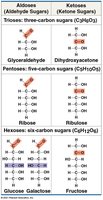
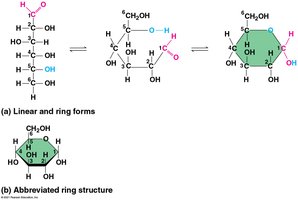
In aqueous solutions, many sugars form rings rather than linear structures.
Disaccharides and Glycosidic Linkages
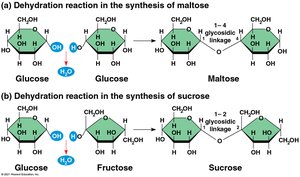
Disaccharides are formed when two monosaccharides are joined by a dehydration reaction, creating a covalent bond called a glycosidic linkage.
Examples: Sucrose (glucose + fructose), lactose (glucose + galactose), maltose (glucose + glucose).
Polysaccharides: Storage and Structural Roles
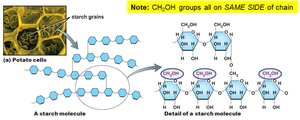
Polysaccharides are polymers of sugars with storage or structural functions. Their properties depend on the types of monomers and the positions of glycosidic linkages.
Starch: Storage polysaccharide in plants, composed of glucose monomers. Stored as granules in chloroplasts.
Glycogen: Storage polysaccharide in animals, mainly in liver and muscle cells.
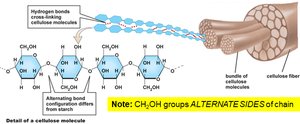
Cellulose: Structural polysaccharide in plant cell walls. Also a glucose polymer, but with different glycosidic linkages than starch, making it indigestible to most animals.
Lipids
Types and Properties of Lipids
Lipids are a diverse group of hydrophobic molecules that do not form true polymers. They are mainly composed of hydrocarbons and are insoluble in water. The three main types are fats, phospholipids, and steroids.
Fats
Constructed from glycerol and fatty acids.
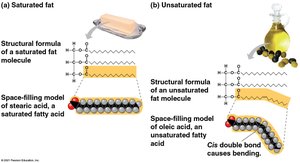
Fatty acids can be saturated (no double bonds, solid at room temperature) or unsaturated (one or more double bonds, liquid at room temperature).
Main function: energy storage, insulation, and protection.
Phospholipids
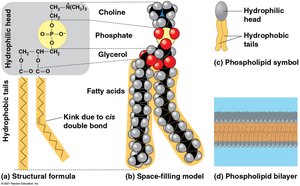
Composed of two fatty acids, a phosphate group, and glycerol.
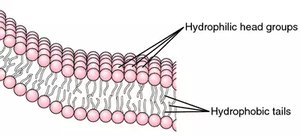
Form the phospholipid bilayer of cell membranes, with hydrophilic heads and hydrophobic tails.
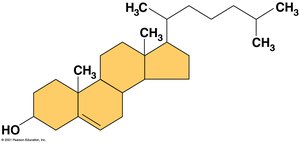
Steroids
Characterized by a carbon skeleton with four fused rings.
Cholesterol is a key steroid in animal cell membranes and a precursor for other steroids.
Proteins
Structure and Function of Proteins
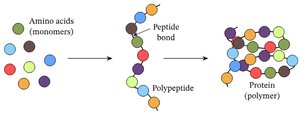
Proteins are polymers of amino acids and account for more than 50% of the dry mass of most cells. They perform a wide range of functions, including catalysis, defense, storage, transport, communication, movement, and structural support.
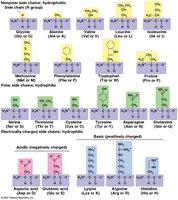
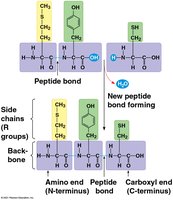
Amino acids: Organic molecules with amino and carboxyl groups, differing in their side chains (R groups).
Polypeptides: Unbranched polymers of amino acids linked by peptide bonds.
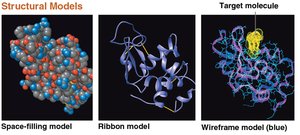
Protein: One or more polypeptides folded into a specific three-dimensional structure.
Levels of Protein Structure
Primary structure: Unique sequence of amino acids.
Secondary structure: Coils (α helix) and folds (β pleated sheet) due to hydrogen bonding.
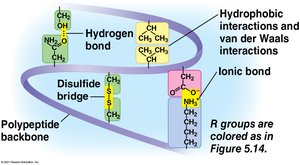
Tertiary structure: Overall shape due to interactions among R groups (hydrogen bonds, ionic bonds, hydrophobic interactions, van der Waals forces, disulfide bridges).
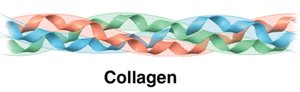
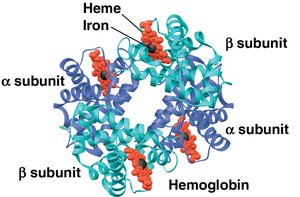
Quaternary structure: Association of multiple polypeptide chains.
Protein Denaturation
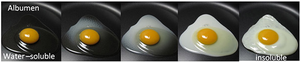
Protein function depends on its structure. Changes in pH, temperature, or other environmental factors can cause denaturation, the loss of native structure and function.
Nucleic Acids
DNA and RNA: Structure and Function
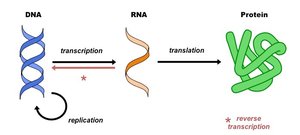
Nucleic acids store, transmit, and help express hereditary information. The two types are DNA (deoxyribonucleic acid) and RNA (ribonucleic acid).
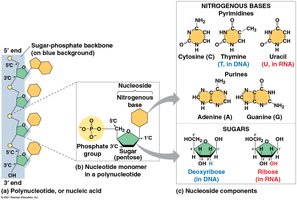
Nucleotide: Monomer consisting of a nitrogenous base, a pentose sugar, and one or more phosphate groups.
Polynucleotide: Polymer of nucleotides linked by phosphodiester bonds.
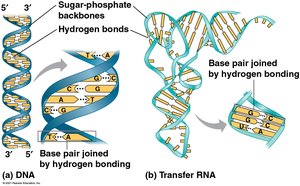
DNA: Double helix with antiparallel strands; bases pair A-T and G-C.
RNA: Single-stranded; bases pair A-U and G-C.
Metabolism and Energy
Thermodynamics in Biological Systems
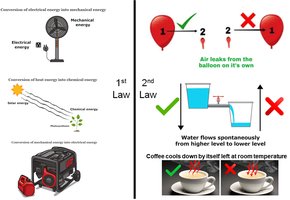
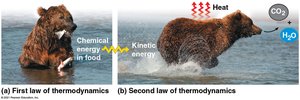
Metabolism is the sum of all chemical reactions in an organism. It is governed by the laws of thermodynamics:
First Law: Energy cannot be created or destroyed, only transformed (conservation of energy).
Second Law: Every energy transfer increases the entropy (disorder) of the universe.
Metabolic Pathways
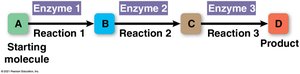
Metabolic pathways are series of chemical reactions, each catalyzed by a specific enzyme. Pathways can be catabolic (breaking down molecules, releasing energy) or anabolic (building molecules, consuming energy).
Free Energy and Spontaneity
Gibbs free energy (G) determines whether a reaction is spontaneous. The change in free energy is given by:
ΔG < 0: Spontaneous (exergonic) reaction.
ΔG > 0: Nonspontaneous (endergonic) reaction.
ATP: The Energy Currency of the Cell
ATP (adenosine triphosphate) powers cellular work by coupling exergonic and endergonic reactions. Hydrolysis of ATP releases energy used for cellular processes.
Enzymes and Catalysis
Enzymes are biological catalysts that speed up reactions by lowering activation energy. They are highly specific for their substrates and are not consumed in the reaction.
Active site: Region on the enzyme where the substrate binds.
Induced fit: Enzyme changes shape to better fit the substrate.
Optimal conditions: Each enzyme has optimal temperature and pH for activity.
Cofactors: Nonprotein helpers (inorganic or organic) required for enzyme activity.
Inhibitors: Competitive (bind active site) or noncompetitive (bind elsewhere, change enzyme shape).
Regulation of Metabolism
Cells regulate metabolism by controlling enzyme activity and gene expression. Allosteric regulation and feedback inhibition are key mechanisms for metabolic control.
