 뒤로
뒤로Macromolecules: Proteins, Nucleic Acids, and ATP
스터디 가이드 - 스마트 노트
 자료에 맞춘 맞춤형 노트, 핵심 정의, 예시, 맥락을 확장해 제공합니다.
Proteins
Structure and Composition of Proteins
Proteins are essential biological macromolecules composed of long chains of amino acids. There are 20 different amino acids used in human proteins, each with a central carbon atom bonded to an amino group (-NH2), a carboxyl group (-COOH), a hydrogen atom, and a variable side chain (R group). Of these, 11 can be synthesized by the human body, while 9 are essential and must be obtained from the diet.
Amino acids are the monomers of proteins.
Polypeptides are chains of 3–100 amino acids joined by peptide bonds via dehydration synthesis.
Chains longer than 100 amino acids are typically considered proteins, which fold into complex structures to perform diverse functions.
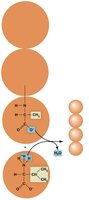
Functions of Proteins in Humans
Proteins serve a wide range of functions in the human body, including:
Structural support (e.g., collagen in connective tissues)
Muscle contraction (e.g., actin and myosin)
Cell membrane components (e.g., receptors, transporters)
Enzymes that regulate biochemical reactions
Enzymes
Role and Mechanism of Enzymes
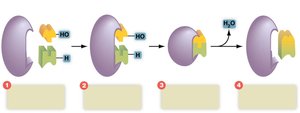
Enzymes are specialized proteins that act as biological catalysts, speeding up chemical reactions without being consumed or permanently altered. They are crucial for sustaining life, as many metabolic reactions would proceed too slowly without them.
Catalyst: A substance that increases the rate of a chemical reaction.
Enzymes lower the activation energy required for reactions.
Specificity: Each enzyme typically acts on a specific substrate.
Example: Humans can digest starch and glycogen due to specific enzymes, but lack the enzyme to digest cellulose.
Nucleic Acids
Types and Functions
Nucleic acids are macromolecules that store and transmit genetic information. The two main types are:
Deoxyribonucleic acid (DNA): Contains the genetic blueprint for the synthesis of proteins.
Ribonucleic acid (RNA): Involved in translating genetic information from DNA into proteins.
DNA provides instructions for making RNA, which in turn directs protein synthesis. Proteins then carry out most cellular functions.
Structure of Nucleic Acids
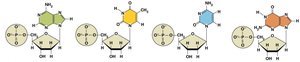
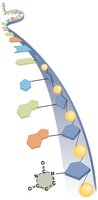
Nucleic acids are polymers of nucleotides. Each nucleotide consists of:
A five-carbon sugar (deoxyribose in DNA, ribose in RNA)
One or more phosphate groups
A nitrogenous base (single or double ring structure)
There are eight different nucleotides: four in DNA (adenine, thymine, cytosine, guanine) and four in RNA (adenine, uracil, cytosine, guanine).
DNA Structure
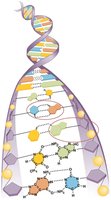
DNA is composed of two antiparallel strands forming a double helix. The strands are held together by hydrogen bonds between complementary bases:
Adenine (A) pairs with Thymine (T)
Cytosine (C) pairs with Guanine (G)
The backbone of each strand is formed by covalent bonds between the sugar and phosphate groups of adjacent nucleotides.
RNA Structure
RNA is typically single-stranded and contains ribose sugar. Uracil (U) replaces thymine as a base. RNA molecules are shorter than DNA and serve as templates for protein synthesis.
ATP (Adenosine Triphosphate)
Structure and Function
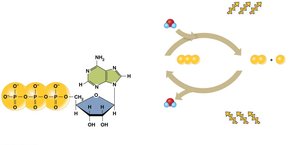
ATP is a nucleotide that serves as the universal energy currency of the cell. It consists of:
Adenine (a nitrogenous base)
Ribose (a five-carbon sugar)
Three phosphate groups
The bonds between the phosphate groups, especially the terminal phosphate bond, store significant potential energy. Hydrolysis of ATP (breaking the bond between the last two phosphates) releases energy for cellular processes:
ATP is regenerated from ADP and inorganic phosphate using energy derived from food or stored macromolecules.
Summary Table: Comparison of DNA, RNA, and ATP
Feature | DNA | RNA | ATP |
|---|---|---|---|
Sugar | Deoxyribose | Ribose | Ribose |
Strands | Double | Single | Single |
Bases | A, T, C, G | A, U, C, G | A |
Function | Genetic information storage | Protein synthesis | Energy transfer |
