 뒤로
뒤로Mendel and the Gene Idea: Foundations of Classical Genetics
스터디 가이드 - 스마트 노트
 자료에 맞춘 맞춤형 노트, 핵심 정의, 예시, 맥락을 확장해 제공합니다.
Chapter 11: Mendel and the Gene Idea
Introduction to Mendelian Genetics
Gregor Mendel's experiments with pea plants established the basic principles of heredity, forming the foundation of classical genetics. His work revealed how traits are transmitted from parents to offspring through discrete units now known as genes.
Concept 11.1: Mendel Used the Scientific Approach to Identify TwoLaws of Inheritance
Mendel’s Experimental, Quantitative Approach
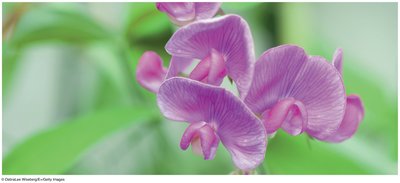
Model Organism: Mendel chose pea plants (Pisum sativum) due to their many varieties with distinct heritable features (characters), such as flower color, and the ability to strictly control their mating.
Traits: Character variants, such as purple or white flowers, are called traits.
True-Breeding: Mendel used varieties that, when self-pollinated, produced offspring identical to themselves.
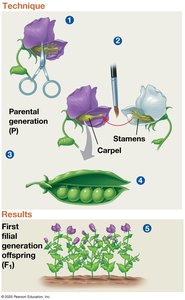
Hybridization: Crossing two contrasting, true-breeding varieties produced hybrid offspring.
Generations: The parental generation is the P generation, their hybrid offspring are the F1 generation, and the offspring of F1 self- or cross-pollination are the F2 generation.
The Law of Segregation
When Mendel crossed true-breeding purple and white flowered plants, all F1 hybrids were purple.
Self- or cross-pollination of F1 hybrids produced F2 plants with a 3:1 ratio of purple to white flowers.
Mendel concluded that the heritable factor for white flowers was not destroyed but masked in F1 hybrids, reappearing in F2.
The dominant trait (purple) masks the recessive trait (white).
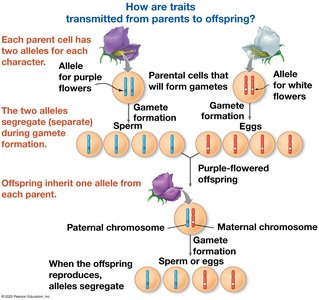
Each individual carries two factors (now called alleles) for each character, which segregate during gamete formation.


Mendel’s Model of Inheritance
Concept 1: Alternative versions of genes (alleles) account for variations in inherited characters.
Concept 2: For each character, an organism inherits two alleles, one from each parent.
Concept 3: If the alleles differ, the dominant allele determines the organism’s appearance; the recessive allele has no noticeable effect.
Concept 4 (Law of Segregation): The two alleles for a heritable character segregate during gamete formation and end up in different gametes.


Genetic Vocabulary
Homozygous: Two identical alleles for a gene (homozygote).
Heterozygous: Two different alleles for a gene (heterozygote).
Phenotype: Observable traits of an organism.
Genotype: Genetic makeup of an organism.

The Testcross
A testcross is used to determine the genotype of an individual with a dominant phenotype by crossing it with a homozygous recessive individual. If any offspring display the recessive phenotype, the unknown parent must be heterozygous.
R /
The Law of Independent Assortment
Mendel’s second law states that each pair of alleles segregates independently of other pairs during gamete formation.
This law applies to genes on different chromosomes or those far apart on the same chromosome.
Monohybrid crosses involve one character; dihybrid crosses involve two characters.

Concept 11.2: Probability Laws Govern Mendelian Inheritance
Probability in Genetics
Multiplication Rule: The probability that two or more independent events will occur together is the product of their individual probabilities.
Addition Rule: The probability that any one of two or more mutually exclusive events will occur is the sum of their individual probabilities.
These rules are used to predict the outcomes of genetic crosses, such as the probability of offspring genotypes and phenotypes.

Concept 11.3: Inheritance Patterns Are Often More Complex Than Predicted by Simple Mendelian Genetics
Extensions of Mendelian Genetics
Incomplete Dominance: The phenotype of F1 hybrids is intermediate between the parental varieties.
Codominance: Both alleles affect the phenotype in separate, distinguishable ways.
Multiple Alleles: Most genes exist in more than two allelic forms (e.g., ABO blood groups).
Pleiotropy: Most genes have multiple phenotypic effects (e.g., cystic fibrosis, sickle-cell disease).
Epistasis: A gene at one locus alters the phenotypic expression of a gene at a second locus (e.g., coat color in Labrador retrievers).
Polygenic Inheritance: Two or more genes have an additive effect on a single phenotype (e.g., human height, skin color).
Environmental Impact on Phenotype
Phenotype can be influenced by both genotype and environment, especially for polygenic traits (multifactorial characters).
Concept 11.4: Many Human Traits Follow Mendelian Patterns of Inheritance
Pedigree Analysis
A pedigree is a family tree that describes the inheritance of a trait across generations.
Pedigrees are used to predict the probability of future offspring inheriting specific traits, especially for genetic disorders.
Recessively Inherited Disorders
Disorders appear only in individuals homozygous for the recessive allele.
Carriers are heterozygous and phenotypically normal but can pass the allele to offspring.
Examples: Cystic fibrosis, sickle-cell disease, albinism.
Dominantly Inherited Disorders
Caused by dominant alleles; rare and often lethal if symptoms appear before reproductive age.
Examples: Achondroplasia (dwarfism), Huntington’s disease.
Multifactorial Disorders
Many diseases (e.g., heart disease, diabetes, cancer) are influenced by both genetic and environmental factors.
Lifestyle choices can significantly affect the risk of developing these conditions.
Genetic Counseling
Genetic counselors use Mendelian principles to advise prospective parents about the risks of inherited disorders.
Each child’s genotype is an independent event, unaffected by siblings’ genotypes.
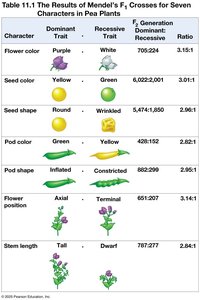
Table: The Results of Mendel’s F1 Crosses for Seven Characters in Pea Plants
Character | Dominant Trait | Recessive Trait | F2 Generation Dominant:Recessive | Ratio |
|---|---|---|---|---|
Flower color | Purple | White | 705:224 | 3.15:1 |
Seed color | Yellow | Green | 6,022:2,001 | 3.01:1 |
Seed shape | Round | Wrinkled | 5,474:1,850 | 2.96:1 |
Pod color | Green | Yellow | 428:152 | 2.82:1 |
Pod shape | Inflated | Constricted | 882:299 | 2.95:1 |
Flower position | Axial | Terminal | 651:207 | 3.14:1 |
Stem length | Tall | Dwarf | 787:277 | 2.84:1 |
Additional info: This summary covers the core principles of Mendelian genetics, including the laws of segregation and independent assortment, extensions to Mendelian inheritance, and the application of these principles to human genetics and genetic counseling.
