 뒤로
뒤로Mendel and the Gene Idea: Principles of Inheritance
스터디 가이드 - 스마트 노트
 자료에 맞춘 맞춤형 노트, 핵심 정의, 예시, 맥락을 확장해 제공합니다.
Chapter 11: Mendel and the Gene Idea
Introduction to Mendelian Genetics
Gregor Mendel's experiments with pea plants established the foundational principles of inheritance, demonstrating how traits are transmitted from parents to offspring. His work revealed the existence of discrete heritable factors, now known as genes, and introduced key concepts such as alleles, dominance, and segregation.
Advantages of Pea Plants for Genetic Study
Variety: Pea plants possess many distinct heritable features (characters), each with variations called traits.
Controlled Mating: Mating can be manipulated, allowing for cross-pollination between different plants.
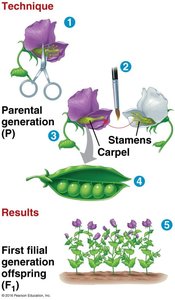
Reproductive Organs: Each plant contains both sperm-producing (stamens) and egg-producing (carpels) organs.
Cross-Pollination: Fertilization between different plants is achieved by transferring pollen manually.
Mendel's Experiments and Heritable Factors
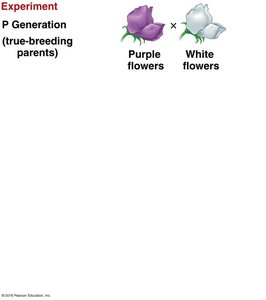
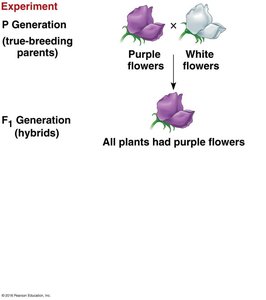
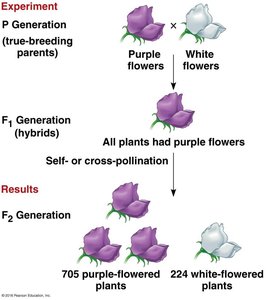
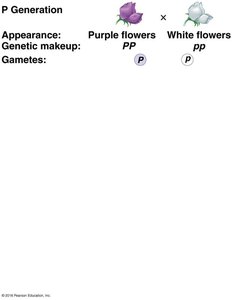
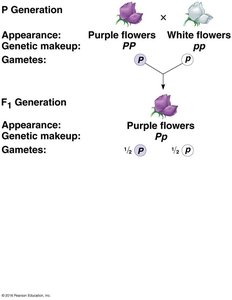
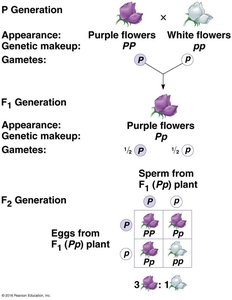
Mendel crossed true-breeding purple and white flowered pea plants. All F1 hybrids were purple, but the F2 generation showed a 3:1 ratio of purple to white flowers, indicating the segregation of heritable factors.
Mendel's Seven Characters in Pea Plants
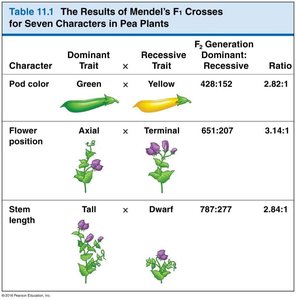
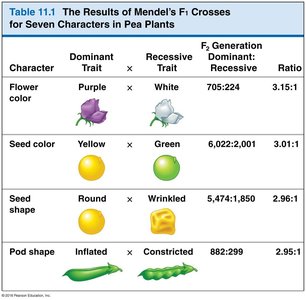
Mendel studied seven distinct characters, each with two contrasting traits. The results of his F1 crosses for these characters consistently showed dominant and recessive relationships.
Character | Dominant Trait | Recessive Trait | F2 Generation Ratio |
|---|---|---|---|
Pod color | Green | Yellow | 2.82:1 |
Flower position | Axial | Terminal | 3.14:1 |
Stem length | Tall | Dwarf | 2.84:1 |
Character | Dominant Trait | Recessive Trait | F2 Generation Ratio |
|---|---|---|---|
Flower color | Purple | White | 3.15:1 |
Seed color | Yellow | Green | 3.01:1 |
Seed shape | Round | Wrinkled | 2.96:1 |
Pod shape | Inflated | Constricted | 2.95:1 |
Alleles and Genetic Basis of Traits
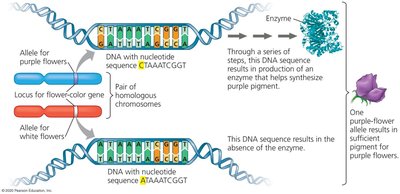
Alleles are alternative versions of a gene. For example, the allele for purple flowers produces sufficient pigment, while the allele for white flowers does not. The genetic basis of traits is determined by the DNA sequence at a specific locus on homologous chromosomes.
Law of Segregation
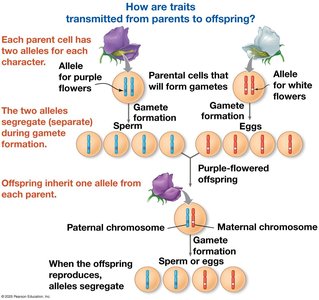
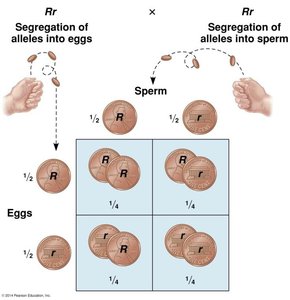
Mendel's Law of Segregation states that two alleles for a heritable character separate during gamete formation and end up in different gametes. Offspring inherit one allele from each parent. The process can be visualized using a Punnett square.
Genetic Vocabulary
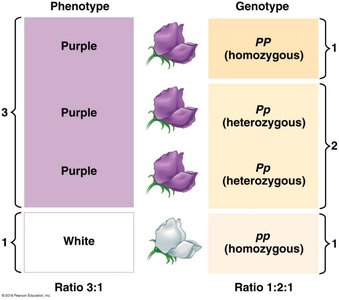
Phenotype: Physical appearance of an organism.
Genotype: Genetic makeup of an organism.
Homozygous: Two identical alleles for a gene (e.g., PP or pp).
Heterozygous: Two different alleles for a gene (e.g., Pp).
Dominant allele: Expressed in the phenotype when present.
Recessive allele: Expressed only when both alleles are recessive.
Testcross
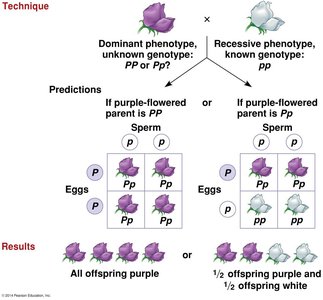
A testcross is used to determine the genotype of an individual with a dominant phenotype. The individual is crossed with a homozygous recessive plant. If any offspring display the recessive phenotype, the mystery parent is heterozygous.
Law of Independent Assortment
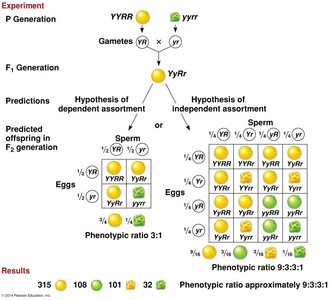
Mendel's second law states that genes for different characters are inherited independently. Crossing two true-breeding parents differing in two characters produces dihybrids, and a dihybrid cross can reveal whether traits are transmitted together or independently.
Probability in Genetics
Multiplication Rule: Probability that two independent events occur together is the product of their individual probabilities.
Addition Rule: Probability that any one of two or more mutually exclusive events occurs is the sum of their individual probabilities.
Solving Complex Genetics Problems
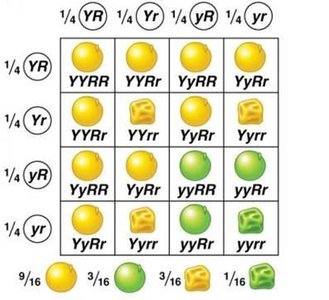
Complex genetic crosses, such as dihybrid crosses, can be solved using the rules of probability and Punnett squares. For example, the probability of a plant with genotype yyRR after a YyRr x YyRr cross is .
Beyond Simple Mendelian Genetics
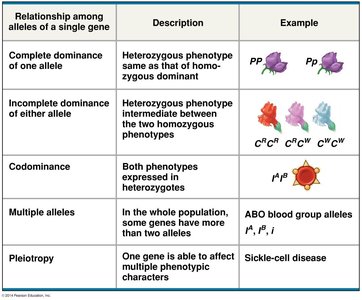
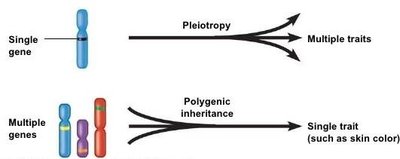
Inheritance can be more complex than simple dominance and recessiveness. Some genes have multiple alleles, show incomplete dominance or codominance, or affect multiple phenotypes (pleiotropy).
Relationship | Description | Example |
|---|---|---|
Complete dominance | Heterozygous phenotype same as homozygous dominant | PP, Pp |
Incomplete dominance | Heterozygous phenotype intermediate between two homozygotes | CRCR, CRCW, CWCW |
Codominance | Both phenotypes expressed in heterozygotes | IAIB |
Multiple alleles | More than two allelic forms in population | ABO blood group |
Pleiotropy | One gene affects multiple phenotypic characters | Sickle-cell disease |
Complex Genetics: Two or More Genes
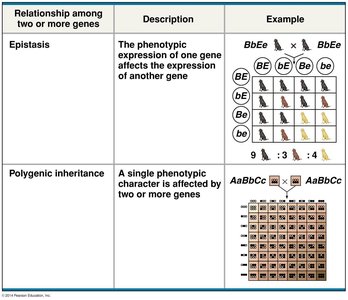
Some traits are influenced by interactions between multiple genes, such as epistasis and polygenic inheritance.
Relationship | Description | Example |
|---|---|---|
Epistasis | Phenotypic expression of one gene affects another | BbEe x BbEe |
Polygenic inheritance | Single phenotypic character affected by two or more genes | AaBbCc x AaBbCc |
Dominant vs. Recessive Alleles
Dominant alleles do not subdue recessive alleles; they are simply variations in a gene's nucleotide sequence. For example, the dominant allele for round seeds codes for an enzyme (SBEI) that converts starch to a branched form, resulting in round seeds. The recessive allele leads to wrinkled seeds due to a mutation in SBEI.
Relationship Between Dominance and Phenotype
The observed relationship between alleles depends on the level of phenotype examined. For example, Tay-Sachs disease is recessive at the organismal level, incompletely dominant at the biochemical level, and codominant at the molecular level.
Frequency of Dominant Alleles
Dominant alleles are not necessarily more common in populations. For example, the allele for extra fingers or toes is dominant, but the recessive allele for five digits is more prevalent.
Multiple Alleles: ABO Blood Groups
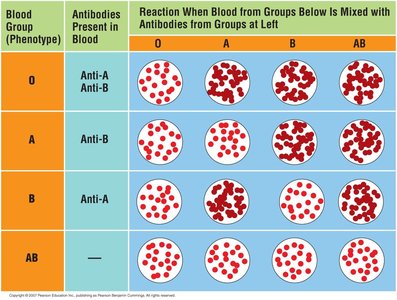
Most genes exist in more than two allelic forms. The ABO blood group system is determined by three alleles (IA, IB, i), resulting in six genotypes and four phenotypes.
Allele | Carbohydrate |
|---|---|
IA | A |
IB | B |
i | none |
Genotype | Phenotype (Blood Group) |
|---|---|
IAIA or IAi | A |
IBIB or IBi | B |
IAIB | AB |
ii | O |
Blood Transfusion Compatibility
The immune system produces antibodies that may cause clotting when blood cells of a different type enter the body. Blood group compatibility is crucial for safe transfusions.
Rh Factor: Positive or Negative Blood Types
The Rh factor (Rh D antigen) is another important blood group antigen. Individuals are either Rh positive (have the antigen) or Rh negative (lack the antigen). Possible genotypes include Rh+/Rh+, Rh+/Rh-, and Rh-/Rh-.
Pedigree Analysis
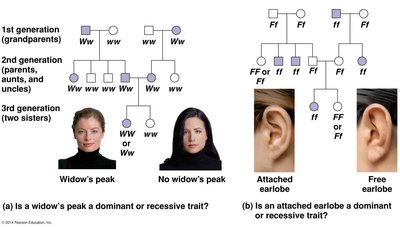
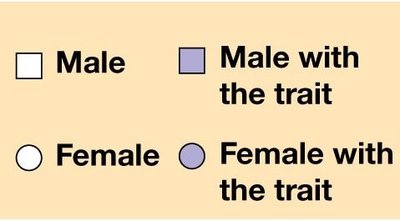
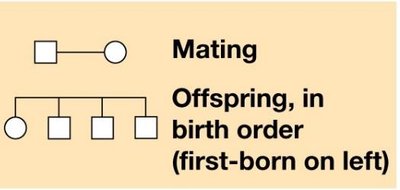
Pedigrees are diagrams that show the inheritance of traits across generations. They help identify dominant and recessive traits and track genetic conditions in families.
Autosomal Conditions
Autosomal recessive conditions appear only in individuals homozygous for the recessive allele. Carriers are heterozygous and have a typical phenotype. Inbreeding increases the probability of genetic disease by increasing the likelihood of homozygosity for harmful alleles.
Cystic Fibrosis (CF)
Cystic fibrosis is the most common lethal genetic disease in the US. The CF allele results in defective chloride transport channels, causing mucus buildup and altered nutrient absorption. Genotypes: CC (typical), Cc (carrier), cc (CF).
Sickle-Cell Disease (SCD)
Sickle-cell disease is caused by a mutation in the hemoglobin gene. Heterozygotes (Ss) have some resistance to malaria (heterozygote advantage). Genotypes: SS (typical), Ss (carrier), ss (SCD).
Autosomal Dominant Conditions
Some conditions are caused by dominant alleles, such as achondroplasia (dwarfism) and Huntington's disease. Homozygous dominant individuals often do not survive.
Multifactorial Diseases
Many diseases have both genetic and environmental components, including heart disease, cancer, diabetes, alcoholism, and mental illnesses. The genetic contribution to most multifactorial diseases is not fully understood.
Fetal Testing
Fetal testing methods include amniocentesis (testing amniotic fluid) and chorionic villus sampling (CVS, testing placental tissue). These tests can detect genetic abnormalities and provide karyotypes.
