뒤로
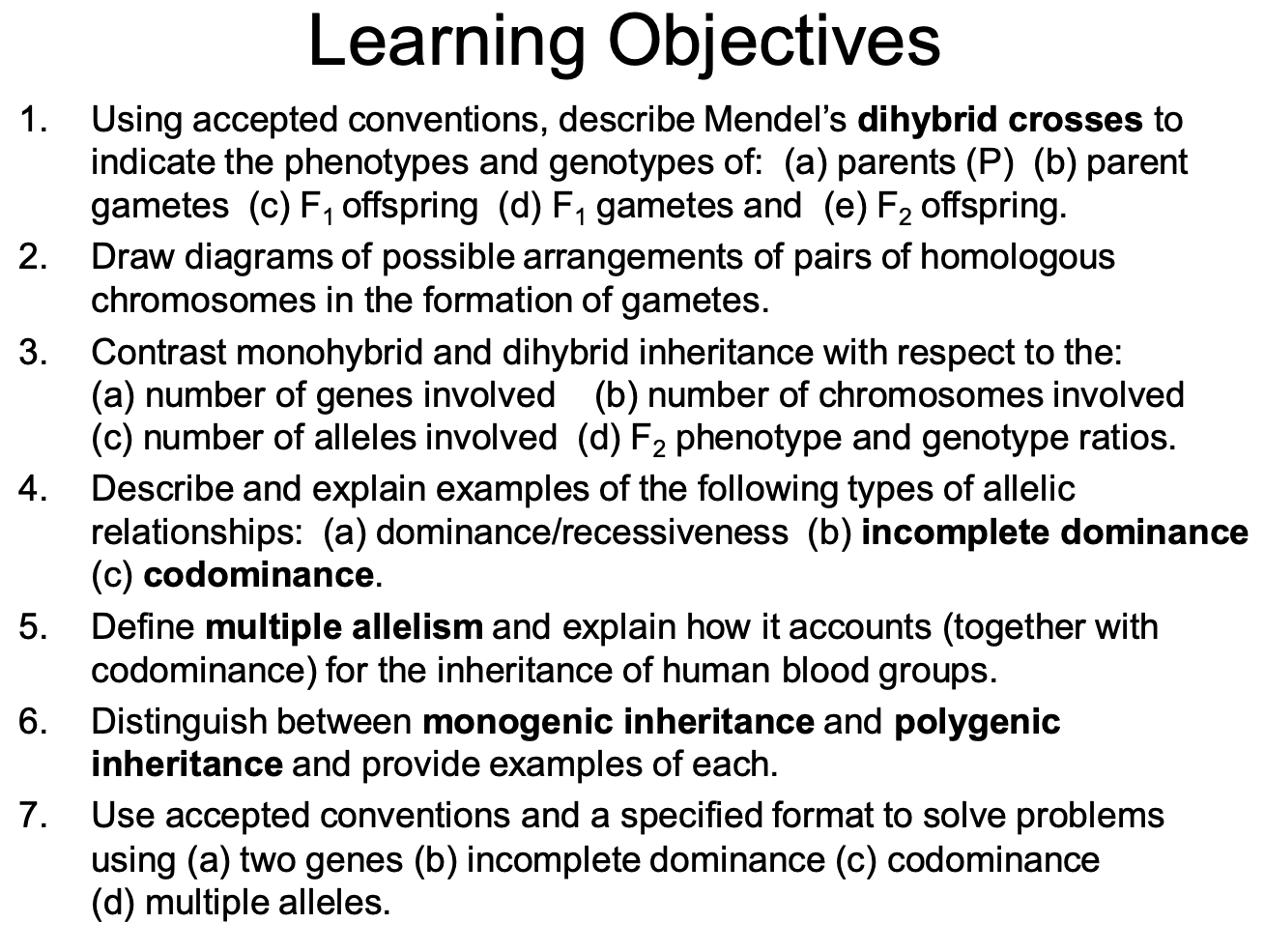
뒤로Mendelian Genetics: Dihybrid Crosses, Allelic Relationships, and Patterns of Inheritance
스터디 가이드 - 스마트 노트
 자료에 맞춘 맞춤형 노트, 핵심 정의, 예시, 맥락을 확장해 제공합니다.
Mendelian Genetics and Patterns of Inheritance
Dihybrid Crosses and Genetic Conventions
Mendel’s dihybrid crosses are fundamental experiments that illustrate the inheritance of two distinct traits, each controlled by a separate gene. Using accepted conventions, geneticists describe the phenotypes and genotypes of parents, gametes, and offspring across generations.
Parents (P): Typically homozygous for both traits (e.g., RRYY × rryy).
Parent Gametes: Each parent produces gametes with one allele from each gene (e.g., RY or ry).
F1 Offspring: All are heterozygous for both genes (e.g., RrYy), displaying dominant phenotypes.
F1 Gametes: Four possible combinations: RY, Ry, rY, ry.
F2 Offspring: Phenotypic ratio is 9:3:3:1 for two traits, reflecting independent assortment.
Homologous Chromosome Arrangements in Gamete Formation
During meiosis, homologous chromosomes pair and segregate, resulting in gametes with different combinations of alleles. Diagrams typically show chromosomes aligning and separating, illustrating independent assortment.
Monohybrid vs. Dihybrid Inheritance
Monohybrid and dihybrid crosses differ in complexity and the number of genetic elements involved.
Number of Genes: Monohybrid involves one gene; dihybrid involves two.
Number of Chromosomes: Monohybrid involves one chromosome pair; dihybrid involves two pairs.
Number of Alleles: Monohybrid involves two alleles; dihybrid involves four alleles (two per gene).
F2 Ratios: Monohybrid yields a 3:1 phenotypic ratio; dihybrid yields a 9:3:3:1 ratio.
Types of Allelic Relationships
Allelic relationships determine how traits are expressed in heterozygotes.
Dominance/Recessiveness: One allele masks the effect of another (e.g., Rr shows dominant phenotype).
Incomplete Dominance: Heterozygotes display an intermediate phenotype (e.g., red × white flowers yield pink).
Codominance: Both alleles are fully expressed (e.g., AB blood type).
Multiple Allelism and Human Blood Groups
Multiple allelism occurs when more than two alleles exist for a gene in a population. Human blood groups (ABO system) are a classic example, involving three alleles (IA, IB, i) and codominance.
Blood Group Inheritance: IA and IB are codominant; i is recessive.
Phenotypes: A, B, AB, and O blood types.
Monogenic vs. Polygenic Inheritance
Inheritance patterns can involve single genes (monogenic) or multiple genes (polygenic).
Monogenic Inheritance: Traits controlled by one gene (e.g., cystic fibrosis).
Polygenic Inheritance: Traits controlled by multiple genes, often showing continuous variation (e.g., skin color, height).
Solving Genetic Problems
Genetic problems can involve two genes, incomplete dominance, codominance, or multiple alleles. Accepted conventions include Punnett squares, genotype notation, and ratio calculations.
Punnett Squares: Used to predict offspring genotypes and phenotypes.
Genotype Notation: Standardized symbols (e.g., RrYy).
Ratio Calculations: Determining expected outcomes (e.g., 9:3:3:1 for dihybrid crosses).
Summary Table: Monohybrid vs. Dihybrid Crosses
Feature | Monohybrid | Dihybrid |
|---|---|---|
Genes Involved | 1 | 2 |
Chromosome Pairs | 1 | 2 |
Alleles | 2 | 4 |
F2 Phenotypic Ratio | 3:1 | 9:3:3:1 |
Key Equations
Probability of Independent Assortment: for each phenotype in a dihybrid cross.
Genotype Ratio (Monohybrid): (homozygous dominant : heterozygous : homozygous recessive).
Phenotype Ratio (Monohybrid): (dominant : recessive).
Examples
Dihybrid Cross Example: Crossing RrYy × RrYy yields 9:3:3:1 phenotypic ratio.
Incomplete Dominance Example: Red × White flowers yield Pink offspring.
Codominance Example: IAIB genotype yields AB blood type.
Additional info:
Polygenic traits often show a bell-shaped distribution in populations.
Multiple allelism increases genetic diversity within populations.