 뒤로
뒤로Metabolic Pathways and Cellular Respiration: Energy Production in Cells
스터디 가이드 - 스마트 노트
 자료에 맞춘 맞춤형 노트, 핵심 정의, 예시, 맥락을 확장해 제공합니다.
Metabolic Pathways
Introduction to Metabolism
Metabolism encompasses all chemical reactions occurring within an organism, enabling life-sustaining processes. These reactions are organized into metabolic pathways, which allow cells to efficiently manage thousands of reactions simultaneously.
Metabolism: The sum of all chemical reactions in an organism.
Metabolic pathways: Ordered sequences of reactions where the product of one reaction becomes the substrate for the next.
Types of Metabolic Pathways
Metabolic pathways can be classified as linear or cyclic, depending on their structure and function.
Linear pathways: The product of each reaction is the substrate for the next, forming a straight sequence.
Cyclic pathways: The pathway forms a cycle, with substrates entering and products exiting, but the core cycle repeats.
Anabolic and Catabolic Pathways
Metabolic pathways are further divided into anabolic and catabolic types, based on whether they build up or break down molecules.
Anabolic pathways: Assemble larger molecules from smaller ones; require energy input. Example: Protein synthesis from amino acids.
Catabolic pathways: Break down molecules into smaller, lower-energy products; release energy. Example: Breakdown of glucose into water, carbon dioxide, and energy.
Enzymes and Co-enzymes in Metabolism
Role of Enzymes and Co-enzymes
Enzymes and co-enzymes are essential for metabolic reactions, facilitating both anabolic and catabolic processes.
Enzymes: Protein catalysts that speed up reactions without being consumed.
Co-enzymes: Non-protein molecules that assist enzymes, often by transferring molecules or electrons. Key co-enzymes: NAD+ and FADH are crucial in energy production.
Energy Needs for Metabolic Activities
ATP: The Cell's Energy Currency
Cells require substantial energy for metabolic activities, primarily supplied by ATP.
ATP (Adenosine triphosphate): Energy is stored in phosphate bonds; removal of a phosphate releases energy for cellular work.
The reaction is reversible: ATP can be regenerated from ADP and inorganic phosphate (phosphorylation).
Sources of Energy for ATP Production
Cells utilize available resources to produce ATP, most commonly glucose, but also fats and proteins when glucose is scarce.
Glucose: Primary fuel for ATP production, obtained from food or stored glycogen.
Fats and proteins: Used as alternative energy sources when glucose is unavailable.
Cellular Respiration: Glucose to ATP
Overview of Cellular Respiration
Cellular respiration is a catabolic process requiring oxygen, converting glucose into ATP, carbon dioxide, and water.
One glucose molecule yields approximately 36 ATP molecules.
Multiple enzymes and co-enzymes are involved in the process.
Four Stages of ATP Production
Cellular respiration consists of four main stages:
Glycolysis (cytoplasm)
Preparatory step (mitochondria)
Citric acid cycle (mitochondria)
Electron transport system (mitochondria)
ATP is produced at three of these four stages.
Stage #1: Glycolysis
Process and Steps of Glycolysis
Glycolysis is the breakdown of glucose in the cytoplasm, divided into two phases:
Energy Investment Step: Two ATP molecules are used to split glucose into two 3-carbon molecules (G3P).
Energy Yielding Step: G3P is further broken down into two pyruvate molecules, producing four ATP (net gain of two ATP) and releasing H+ ions and electrons, which are picked up by NAD+.
Coenzyme NAD+ in Glycolysis
NAD+ (Nicotinamide adenine dinucleotide): Accepts one hydrogen ion and two electrons to become NADH.
Two NADH molecules are produced during glycolysis.
Summary of Glycolysis
ATP: 2 ATP invested, 4 ATP produced, net gain = 2 ATP.
Coenzyme activity: 2 NAD+ become 2 NADH.
Products: 2 pyruvate molecules proceed to the next stage.
Stage #2: Preparatory Step
Conversion of Pyruvate to Acetyl CoA
The preparatory step occurs in the mitochondria, where pyruvate is converted to acetyl CoA, enabling entry into the citric acid cycle.
Pyruvate crosses mitochondrial membranes.
Each pyruvate is converted into a 2-carbon acetyl group, carbon dioxide (waste), and NADH.
Coenzyme A picks up the acetyl group, forming acetyl CoA.
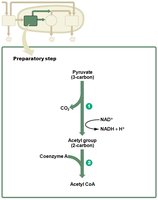
Summary of Preparatory Step
ATP: None produced.
Coenzyme activity: 2 NAD+ become 2 NADH; 2 Coenzyme A become acetyl CoA.
Products: 2 molecules of carbon dioxide (waste).
Key Equations
ATP Hydrolysis and Synthesis
ATP hydrolysis:
ATP synthesis (phosphorylation):
Summary Equation for Glycolysis
Additional info:
Further stages (citric acid cycle and electron transport system) continue the process of ATP production, utilizing acetyl CoA and NADH.
Oxygen is essential for aerobic respiration; without it, cells rely on less efficient anaerobic pathways.
