 뒤로
뒤로Molecular Biology: DNA Structure, Replication, Expression, and Evolution
스터디 가이드 - 스마트 노트
 자료에 맞춘 맞춤형 노트, 핵심 정의, 예시, 맥락을 확장해 제공합니다.
Chapter 12: Molecular Biology of the Gene
Transformation Experiments and the Discovery of DNA as Genetic Material
The identification of DNA as the hereditary material was a pivotal moment in biology, established through a series of classic experiments.
Griffith Experiment: Demonstrated transformation in bacteria using rough (non-virulent) and smooth (virulent) Streptococcus pneumoniae colonies. Mixing heat-killed smooth bacteria with live rough bacteria resulted in transformation of the rough into virulent forms.
Avery, MacLeod, and McCarty: Showed that DNA, not protein or RNA, was the transforming principle by selectively digesting biomolecules and observing transformation only when DNA was intact.
Hershey and Chase: Used bacteriophages labeled with radioactive isotopes to confirm that DNA, not protein, enters bacterial cells and directs viral replication.
Example: The use of tagged bacteriophage infection to trace the entry of DNA into host cells.
DNA Structure and Replication
DNA is a double helix composed of nucleotides, each containing a deoxyribose sugar, phosphate group, and a nitrogenous base (A, T, G, C). The strands are antiparallel (5’ to 3’ and 3’ to 5’).
Nucleotide Structure: Adenine pairs with Thymine, Guanine pairs with Cytosine via hydrogen bonds.
Backbone: Sugar-phosphate backbone forms the structural framework.
Origins of Replication: Specific sequences where DNA replication begins.
Helicase: Unwinds the DNA double helix.
Replication Bubble/Fork: The area where DNA is actively being unwound and replicated.
DNA Polymerase: Synthesizes new DNA in the 5’ to 3’ direction, requiring a template and primer.
Leading and Lagging Strands: Leading strand is synthesized continuously; lagging strand is synthesized in Okazaki fragments, later joined by ligase.
Equation:
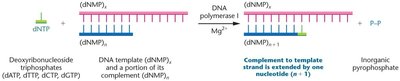
Example: DNA polymerase adds nucleotides to the 3’ end of a growing DNA strand, releasing inorganic pyrophosphate.
Central Dogma: Expression of Genetic Information
The central dogma describes the flow of genetic information: DNA → RNA → Protein.
Transcription: RNA polymerase binds to the promoter, synthesizes RNA from the DNA template, and stops at the terminator.
Post-Transcriptional Modifications (Eukaryotes): Includes splicing (removal of introns), addition of a 5’ cap, and a 3’ poly-A tail.
Translation: mRNA is decoded by ribosomes with the help of tRNA and rRNA. Translation begins at a start codon and ends at a stop codon.
Genetic Code: Triplet codons specify amino acids.
Example: tRNA molecules use their anticodon to match mRNA codons during translation.
Mutations and Horizontal Gene Transfer
Mutations are changes in DNA sequence, providing genetic variation. Horizontal gene transfer allows genetic material to move between organisms.
Transformation: Uptake of DNA from the environment.
Transduction: Transfer of DNA by viruses.
Conjugation: Direct transfer of DNA between bacteria via a pilus.
Chapter 11: Gene Expression and Regulation
Gene Expression in Prokaryotes
Prokaryotic gene expression is often regulated by operons, which include promoters, operators, and structural genes.
Operon Model: Allows coordinated regulation of gene clusters.
Promoters: DNA sequences where RNA polymerase binds to initiate transcription.
Operators: Sites where repressor proteins bind to block transcription.
Gene Expression in Eukaryotes
Eukaryotic gene expression is regulated at multiple levels, including chromatin structure and transcription factors.
Chromatin: DNA is wrapped around histone proteins for organization and regulation.
Transcription Factors: Proteins that bind DNA and influence transcription.
Splicing: Removal of introns from pre-mRNA.
Embryonic Development and Cell Differentiation
Development involves the specialization of cells from totipotent to pluripotent to differentiated states. Homeotic genes (e.g., Hox genes) control body plan development.
Totipotent Cells: Can give rise to all cell types.
Pluripotent Cells: Can give rise to many, but not all, cell types.
Homeotic Genes: Regulate the development of anatomical structures.
Chapter 12: DNA Technology and Genomics
DNA Cloning and Genetic Engineering
Modern biotechnology allows manipulation and analysis of DNA for research, medicine, and agriculture.
Restriction Enzymes: Cut DNA at specific sequences, producing sticky or blunt ends.
Plasmids: Small circular DNA molecules used as vectors in cloning.
Ligase: Enzyme that joins DNA fragments.
CRISPR: Genome editing tool for precise modifications.
Genetically Modified Organisms (GMOs): Organisms with foreign genes inserted.
Gene Therapy: Introduction of functional genes to treat genetic disorders.
PCR (Polymerase Chain Reaction): Amplifies DNA sequences rapidly.
Gel Electrophoresis: Separates DNA fragments by size for analysis.
DNA Fingerprinting and Genomics: Techniques for identifying individuals and studying genomes.
Chapter 13-15: Evolution, Speciation, and Earth’s History
Evolutionary Mechanisms
Evolution is driven by mutation, natural selection, genetic drift, and gene flow.
Mutation: Source of new alleles.
Natural Selection: Differential survival and reproduction of individuals best suited to their environment.
Artificial Selection: Human-directed breeding for desired traits.
Genetic Drift: Random changes in allele frequencies, especially in small populations (e.g., bottlenecks, founder effects).
Microevolution vs Macroevolution: Small-scale changes within populations vs large-scale changes leading to new species.
Speciation and Barriers
Speciation is the formation of new species, often through genetic isolation.
Species Concepts: Biological species are groups that can interbreed and produce viable offspring.
Prezygotic Barriers: Prevent mating or fertilization (e.g., temporal, ecological, behavioral, mechanical).
Postzygotic Barriers: Prevent hybrid offspring from surviving or reproducing.
Sympatric vs Allopatric Speciation: Speciation within the same area vs geographic separation.
Earth’s History and Evolutionary Patterns
Earth’s history is marked by abiogenesis, fossil formation, plate tectonics, mass extinctions, and adaptive radiations.
Fossils: Provide evidence of past life and evolutionary transitions.
Plate Tectonics: Movement of Earth’s plates influences species distribution and evolution.
Mass Extinctions: Periods of rapid species loss followed by adaptive radiation.
Body Plans and Hox Genes: Control the development of major anatomical features.
Phylogeny and Taxonomy: Classification based on evolutionary relationships; distinguishes ancestral vs derived traits, homology (shared ancestry), and analogy (convergent evolution).
Molecular Clocks: Use DNA sequence data to estimate evolutionary timelines.
Term | Definition |
|---|---|
Homologous Structures | Structures with shared ancestry (e.g., human and mouse eyes) |
Analogous Structures | Structures with similar function but independent origins |
Bottleneck Effect | Sharp reduction in population size and genetic diversity |
Adaptive Radiation | Rapid diversification into new ecological niches |
Stabilizing Selection | Favors intermediate phenotypes |
Directional Selection | Favors one extreme phenotype |
Disruptive Selection | Favors both extreme phenotypes |
Additional info: This guide integrates foundational experiments, molecular mechanisms, and evolutionary principles essential for understanding modern biology.
