 뒤로
뒤로Photosynthesis and Cellular Respiration: Structure, Function, and Pathways
스터디 가이드 - 스마트 노트
 자료에 맞춘 맞춤형 노트, 핵심 정의, 예시, 맥락을 확장해 제공합니다.
Photosynthesis: An Overview
Definition and Importance
Photosynthesis is the process by which plants, algae, and some bacteria convert light energy from the sun into chemical energy stored in glucose. This process is fundamental for life on Earth, as it provides the primary energy source for most organisms and releases oxygen as a byproduct.
Autotrophs are organisms that produce their own food using sunlight.
The chemical equation for photosynthesis is:
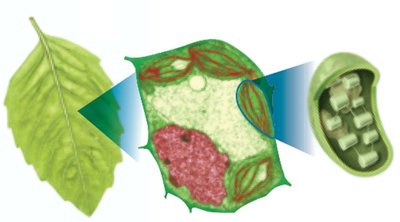
Photosynthesis occurs in the chloroplasts of plant cells.
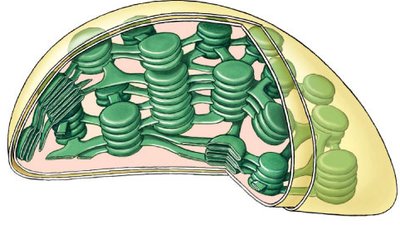
Chloroplast Structure
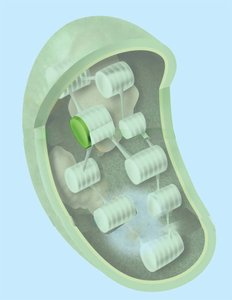
Chloroplasts are specialized organelles with a double membrane. Their internal structure is crucial for the photosynthetic process.
Thylakoids are membrane-bound compartments arranged in stacks called grana.
The stroma is the fluid-filled space surrounding the grana.
Light-dependent reactions occur in the thylakoid membranes, while light-independent reactions occur in the stroma.
Plant Pigments and Light Absorption
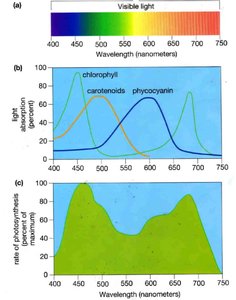
Plant pigments in chloroplasts absorb sunlight at specific wavelengths, enabling photosynthesis.
Chlorophyll a is the main pigment, absorbing blue and red light and reflecting green.
Accessory pigments (chlorophyll b, carotenoids, xanthophylls, carotene) absorb light closer to the green region, broadening the spectrum of usable light.
Absorbed wavelengths drive photosynthesis; reflected wavelengths determine plant color.
Stages of Photosynthesis
Photosynthesis occurs in two main stages:
Light-dependent reactions (energy-building): Require sunlight, produce ATP and NADPH, occur in thylakoid membranes.
Light-independent reactions (sugar-building, Calvin Cycle): Do not require sunlight, use ATP and NADPH to synthesize glucose, occur in the stroma.
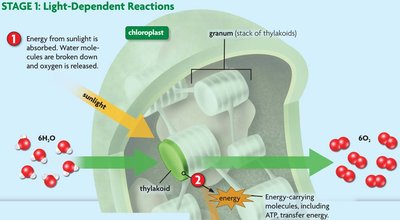
Light-Dependent Reactions
Photosystems and Electron Transport
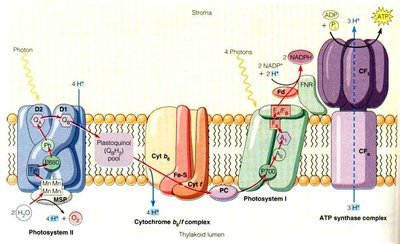
Light-dependent reactions utilize two photosystems:
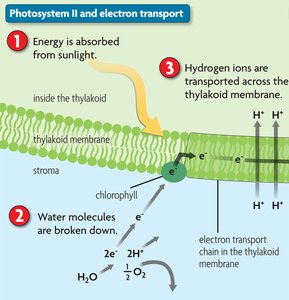
Photosystem II (PSII): Absorbs light at 680 nm (P680), splits water, releases O2, and energizes electrons.
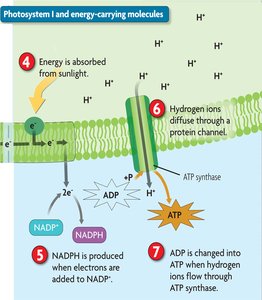
Photosystem I (PSI): Absorbs light at 700 nm (P700), uses energized electrons to produce NADPH.
Mechanism of Light-Dependent Reactions
PSII absorbs sunlight, splits water molecules, and releases O2.
Energized electrons enter the electron transport chain (ETC), and H+ ions are pumped across the thylakoid membrane.
PSI absorbs sunlight, further energizes electrons, which are used to reduce NADP+ to NADPH.
H+ ions flow through ATP synthase, converting ADP to ATP.
ATP and NADPH are sent to the stroma for the Calvin Cycle.
Light-Independent Reactions (Calvin Cycle)
Calvin Cycle Overview
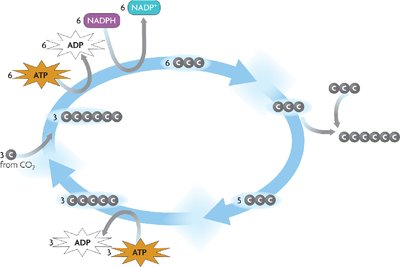
The Calvin Cycle, also known as carbon fixation, synthesizes glucose from CO2 using ATP and NADPH produced in the light-dependent reactions.
Occurs in the stroma of the chloroplast.
CO2 is incorporated into organic molecules.
ATP and NADPH provide energy and reducing power.
Six CO2 molecules are required to produce one glucose molecule.
Cellular Respiration: An Overview
Definition and Importance
Cellular respiration is the process by which cells break down glucose to produce ATP, the energy currency of the cell. It occurs in all living cells and is essential for energy production.
Chemical equation:
Occurs in the cytoplasm and mitochondria.
Includes aerobic (with oxygen) and anaerobic (without oxygen) pathways.
ATP: The Energy Molecule
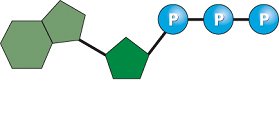
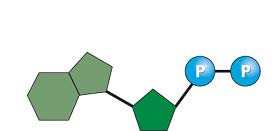
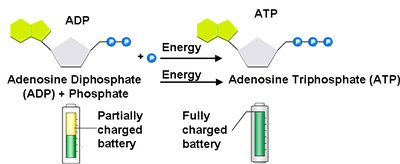
ATP (adenosine triphosphate) is the primary energy carrier in cells.
Composed of adenine, ribose, and three phosphate groups.
Energy is released when a phosphate group is removed (ATP → ADP).
Energy is stored when a phosphate group is added (ADP → ATP).
Stages of Cellular Respiration
Glycolysis
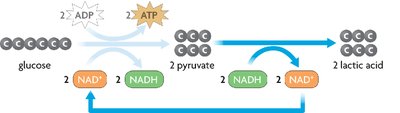
Glycolysis is the first step in cellular respiration, occurring in the cytoplasm.
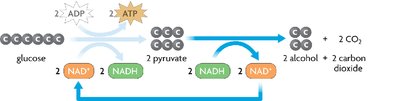
Glucose (6-C) is split into two pyruvate (3-C) molecules.
Produces 2 ATP (net) and 2 NADH.
Does not require oxygen (anaerobic).
Anaerobic Respiration (Fermentation)
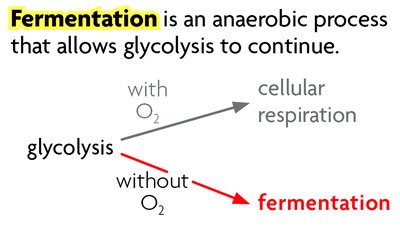
When oxygen is not available, cells undergo fermentation.
Alcohol fermentation: Pyruvate is converted to alcohol and CO2 (in yeast and bacteria).
Lactic acid fermentation: Pyruvate is converted to lactic acid (in muscle cells).
Both produce 2 ATP per glucose.
Aerobic Respiration
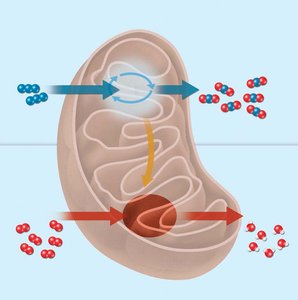
Aerobic respiration occurs when oxygen is available and is much more efficient than anaerobic respiration.
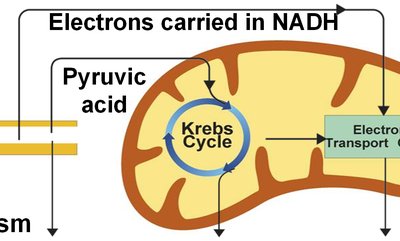
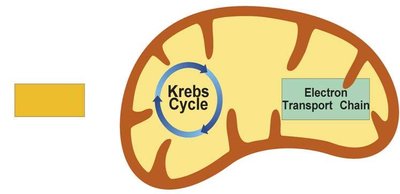
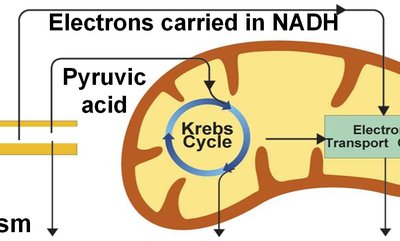
Pyruvate enters the mitochondrion.
Three main steps: Glycolysis, Krebs Cycle, Electron Transport Chain (ETC).
Produces approximately 36 ATP per glucose.
Krebs Cycle
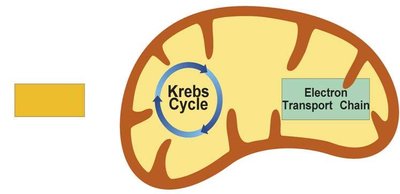
The Krebs Cycle occurs in the mitochondrial matrix.
2 pyruvates enter the cycle.
Produces 2 ATP, 8 NADH, 2 FADH2, and CO2 (waste).
NADH and FADH2 carry electrons to the ETC.
Electron Transport Chain (ETC)
The ETC is located in the inner mitochondrial membrane.
NADH and FADH2 are converted to ATP.
O2 acts as the final electron acceptor, forming H2O.
Produces 32 ATP per glucose.
Summary Table: ATP Production per Glucose
Stage | ATP Produced |
|---|---|
Glycolysis | 2 ATP |
Krebs Cycle | 2 ATP |
Electron Transport Chain | 32 ATP |
Total | 36 ATP |
Comparing Photosynthesis and Cellular Respiration
Key Differences and Similarities
Photosynthesis occurs only in plant cells in the presence of light; cellular respiration occurs in all cells, with or without light.
Photosynthesis stores energy in glucose; cellular respiration releases energy from glucose to form ATP.
CO2 and H2O are raw materials for photosynthesis; they are products of cellular respiration.
Glucose and O2 are products of photosynthesis; they are raw materials for cellular respiration.
Both processes involve electron transport systems and double-membrane organelles (chloroplasts and mitochondria).
Summary Table: Photosynthesis vs. Cellular Respiration
Feature | Photosynthesis | Cellular Respiration |
|---|---|---|
Location | Chloroplast | Mitochondrion |
Light Requirement | Requires light | Does not require light |
Energy Flow | Stores energy | Releases energy |
Raw Materials | CO2, H2O | Glucose, O2 |
Products | Glucose, O2 | CO2, H2O, ATP |
Additional info: Academic context was added to clarify the mechanisms, structures, and comparisons for exam preparation.
