뒤로
뒤로Phylogeny and the Tree of Life: Study Notes
스터디 가이드 - 스마트 노트
 자료에 맞춘 맞춤형 노트, 핵심 정의, 예시, 맥락을 확장해 제공합니다.
Phylogeny and the Tree of Life
Introduction to Phylogeny and Systematics
Phylogeny is the evolutionary history of a species or group of related species. Systematics is the scientific discipline focused on classifying organisms and determining their evolutionary relationships. Understanding phylogeny helps biologists reconstruct the evolutionary pathways that have led to the diversity of life on Earth.
Phylogeny: The evolutionary history and relationships among species or groups.
Systematics: The study of biological diversity in an evolutionary context, encompassing taxonomy and phylogenetics.
Binomial Nomenclature and Hierarchical Classification
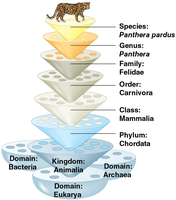
Modern taxonomy, established by Carolus Linnaeus, uses a hierarchical system to classify organisms. Each species is assigned a two-part scientific name (binomial nomenclature) and placed within a series of increasingly broad categories.
Binomial Name: Consists of the genus (capitalized) and the specific epithet (lowercase), e.g., Panthera pardus.
Taxonomic Hierarchy: Domain, Kingdom, Phylum, Class, Order, Family, Genus, Species.
Taxon: Any named group at any level of the hierarchy.
Understanding Phylogenetic Trees
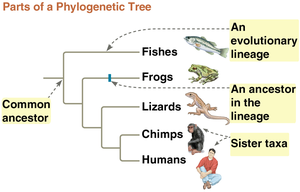
Phylogenetic trees are diagrams that represent evolutionary relationships among organisms. They are constructed based on shared characteristics and genetic data, and each branch point (node) represents a divergence from a common ancestor.
Branch Point: Represents the divergence of two evolutionary lineages from a common ancestor.
Sister Taxa: Groups that share an immediate common ancestor.
Rooted Tree: Includes the most recent common ancestor of all taxa in the tree.
Basal Taxon: A lineage that diverges early and remains unbranched.
Inferring Phylogenies: Morphological and Molecular Data
Systematists use morphological traits, genetic sequences, and biochemical data to infer evolutionary relationships. Only features resulting from common ancestry (homologies) are useful for constructing phylogenies.
Morphological Data: Physical characteristics of organisms.
Molecular Data: DNA, RNA, and protein sequences.
Homology: Similarity due to shared ancestry.
Analogy: Similarity due to convergent evolution, not common ancestry.
Sorting Homology from Analogy
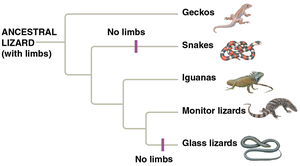
Distinguishing between homology and analogy is crucial in phylogenetic analysis. Homologous traits arise from a common ancestor, while analogous traits result from convergent evolution in unrelated lineages.
Convergent Evolution: Independent evolution of similar features in different lineages due to similar environmental pressures.
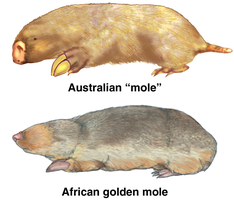
Cladistics and Clades
Cladistics is a method of classification based on common ancestry. Organisms are grouped into clades, which include an ancestor and all its descendants. Clades can be monophyletic, paraphyletic, or polyphyletic.
Monophyletic Group (Clade): Includes an ancestor and all its descendants.
Paraphyletic Group: Includes an ancestor and some, but not all, descendants.
Polyphyletic Group: Includes distantly related species but not their most recent common ancestor.
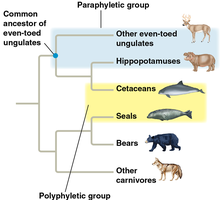
Shared Ancestral and Shared Derived Characters
Characters used in phylogenetic analysis can be ancestral (present in the ancestor of the group) or derived (unique to a particular clade). The distinction is context-dependent.
Shared Ancestral Character: Originated in an ancestor of the taxon.
Shared Derived Character: An evolutionary novelty unique to a clade.
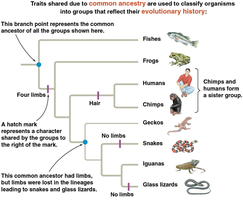
Principles of Maximum Parsimony and Maximum Likelihood
To select the best phylogenetic tree, systematists use the principles of maximum parsimony (fewest evolutionary changes) and maximum likelihood (most probable tree given specific models of DNA change).
Maximum Parsimony: The simplest explanation (fewest changes) is preferred.
Maximum Likelihood: The tree most likely to have produced the observed data, based on probability models.
Phylogenetic Trees as Hypotheses
Phylogenetic trees are hypotheses about evolutionary relationships. They can be tested by making predictions, such as the presence of shared features in ancestors and descendants (phylogenetic bracketing).
Phylogenetic Bracketing: Predicts that features shared by two closely related groups were present in their common ancestor and all descendants.
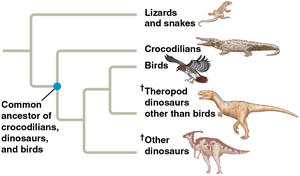
Genomes and Evolutionary History
The evolutionary history of organisms is recorded in their genomes. Molecular comparisons can reveal relationships even among morphologically dissimilar groups or those poorly represented in the fossil record.
Slowly Evolving Genes: Useful for studying ancient relationships (e.g., ribosomal RNA genes).
Rapidly Evolving Genes: Useful for recent evolutionary events (e.g., mitochondrial DNA).
Gene Duplications and Gene Families
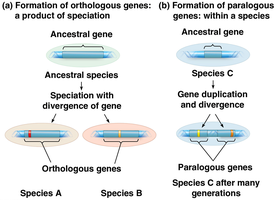
Gene duplication events increase the number of genes in a genome, leading to gene families. Homology among genes can result from speciation (orthologous genes) or gene duplication (paralogous genes).
Orthologous Genes: Homologous genes found in different species due to speciation.
Paralogous Genes: Homologous genes within a species due to gene duplication.
Molecular Clocks
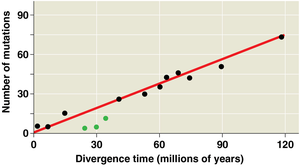
Molecular clocks estimate the timing of evolutionary events based on the assumption that some genes evolve at a relatively constant rate. The number of genetic differences can be used to estimate divergence times.
Molecular Clock: A method for estimating the absolute time of evolutionary change based on genetic data.
Assumption: The number of nucleotide substitutions is proportional to the time since divergence.
The Tree of Life: Domains and Kingdoms
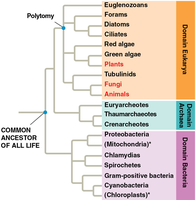
Our understanding of the tree of life has evolved with new data. The three-domain system (Bacteria, Archaea, Eukarya) replaced earlier two- and five-kingdom systems. Eukarya includes Plantae, Fungi, and Animalia, while prokaryotes are divided into Bacteria and Archaea.
Domain Bacteria: Most known prokaryotes.
Domain Archaea: Diverse prokaryotes, often in extreme environments.
Domain Eukarya: Organisms with true nuclei, including plants, fungi, and animals.
Protista: No longer a kingdom; its members are more closely related to plants, fungi, or animals than to each other.