 뒤로
뒤로Plant Structure, Growth, and Development: Study Notes for General Biology
스터디 가이드 - 스마트 노트
 자료에 맞춘 맞춤형 노트, 핵심 정의, 예시, 맥락을 확장해 제공합니다.
Plant Structure, Growth, and Development
The Three Basic Plant Organs: Roots, Stems, and Leaves
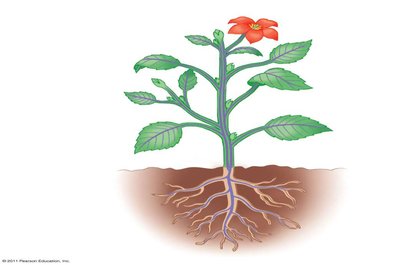
Plants are composed of three primary organs—roots, stems, and leaves—which are organized into a root system and a shoot system. These organs work together to support the plant's survival and growth.
Roots: Anchor the plant, absorb minerals and water, and store carbohydrates.
Stems: Support leaves and flowers, transport nutrients, and may be modified for storage or reproduction.
Leaves: Main photosynthetic organ, responsible for gas exchange and energy capture.
Monocots vs. Eudicots: The two major groups of angiosperms differ in root and leaf structure.
Root Structure and Types
Roots are specialized for anchoring, absorption, and storage. Their structure varies between plant groups.
Taproot System: Main vertical root with lateral roots; typical of eudicots and gymnosperms.
Fibrous Root System: Many similarly sized roots; typical of monocots.
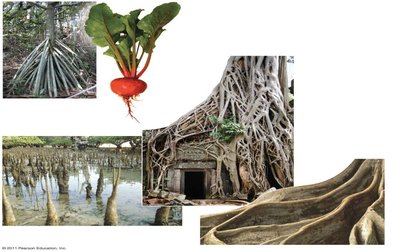
Adventitious Roots: Roots that arise from stems or leaves.
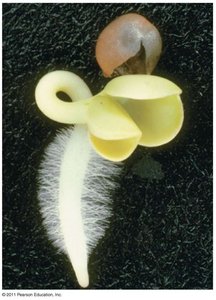
Root Hairs: Increase surface area for absorption.
Stem Structure and Modifications
Stems consist of nodes (where leaves attach) and internodes (segments between nodes). Buds are sites of growth and branching.
Axillary Bud: Can form lateral shoots or branches.
Apical Bud: Located at the tip, responsible for elongation.
Apical Dominance: Suppresses growth of axillary buds.
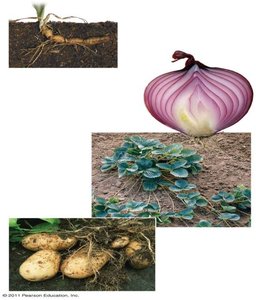
Modified Stems: Include rhizomes, bulbs, stolons, and tubers, each adapted for storage or reproduction.
Leaf Structure and Modifications
Leaves are the main site of photosynthesis and are attached to stems via petioles. Their morphology is important for classification.
Blade: Flattened portion of the leaf.
Petiole: Stalk joining leaf to stem.
Vein Arrangement: Monocots have parallel veins; eudicots have branching veins.
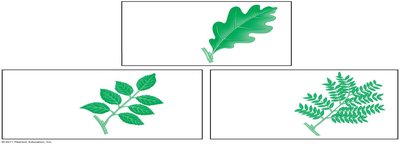
Leaf Types: Simple, compound, and doubly compound leaves.
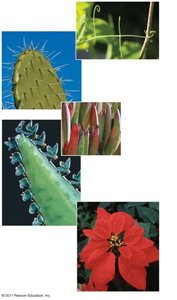
Modified Leaves: Tendrils, spines, storage leaves, reproductive leaves, and bracts.
Plant Tissue Systems
Dermal, Vascular, and Ground Tissues
Plants have three main tissue systems that are continuous throughout their organs.
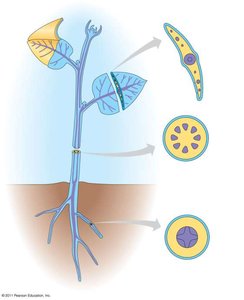
Dermal Tissue: Protective outer layer; in nonwoody plants, consists of the epidermis and cuticle; in woody plants, periderm replaces epidermis.
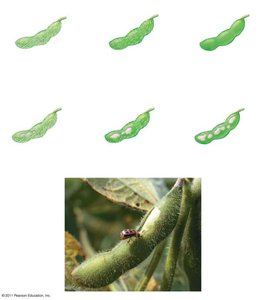
Trichomes: Outgrowths of the epidermis that help defend against insects.
Vascular Tissue: Xylem (transports water/minerals) and phloem (transports organic nutrients).
Stele: Central vascular cylinder in roots; vascular bundles in stems/leaves.
Ground Tissue: Functions in storage, photosynthesis, and support; includes pith (internal) and cortex (external).
Cell Types in Plant Tissues
Different cell types contribute to plant structure and function.
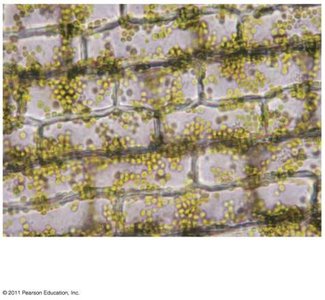
Parenchyma Cells: Thin, flexible walls; most metabolic functions; can divide and differentiate.
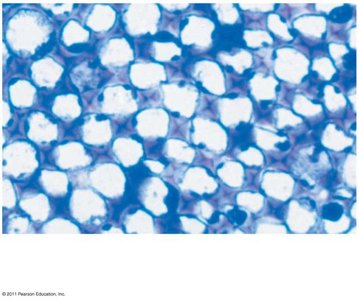
Collenchyma Cells: Thicker, uneven walls; support young shoots; flexible support.
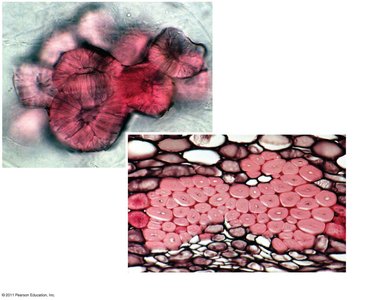
Sclerenchyma Cells: Thick, lignified walls; rigid; dead at maturity; include sclereids and fibers.
Water-Conducting Cells of the Xylem
Xylem contains specialized cells for water transport.
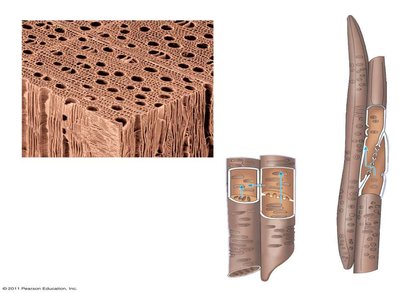
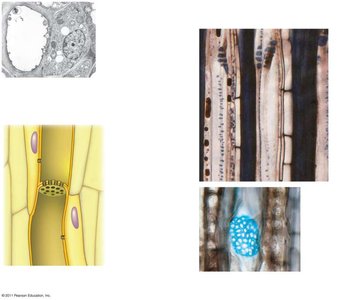
Tracheids: Found in all vascular plants; long, tapered cells.
Vessel Elements: Found in most angiosperms; align end-to-end to form vessels.
Vessels: Micropipes for efficient water transport.
Sugar-Conducting Cells of the Phloem
Phloem transports organic nutrients using specialized cells.
Sieve-Tube Elements: Alive at maturity; lack organelles; transport sugars.
Sieve Plates: Porous end walls for fluid flow.
Companion Cells: Support sieve-tube elements; share nucleus and ribosomes.
Plant Growth: Meristems and Development
Meristems and Growth Types
Meristems are regions of undifferentiated cells that enable plant growth.
Indeterminate Growth: Plants grow throughout their life.
Determinate Growth: Some organs stop growing at a certain size.
Apical Meristems: Located at tips of roots and shoots; responsible for primary growth (elongation).
Lateral Meristems: Vascular cambium and cork cambium; responsible for secondary growth (thickening).
Plant Life Cycles: Annuals (1 year), biennials (2 years), perennials (many years).
Primary Growth in Roots
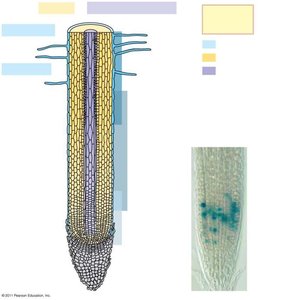
Primary growth produces new root and shoot tissues. The root tip is protected by a root cap, and growth occurs in three zones.
Zone of Cell Division: Includes apical meristem; cells actively divide.
Zone of Elongation: Cells elongate, pushing root through soil.
Zone of Differentiation: Cells mature into specialized types.
Root Tissue Organization
Root tissues are organized for efficient absorption and transport.
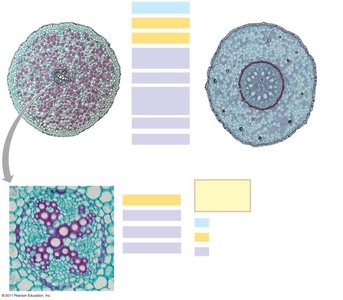
Ground Tissue (Cortex): Parenchyma cells fill the cortex.
Endodermis: Innermost layer of cortex; regulates passage into vascular cylinder.
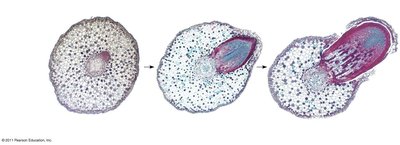
Pericycle: Outermost layer of vascular cylinder; site of lateral root formation.
Primary Growth of Shoots
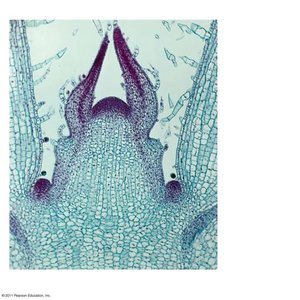
Shoot apical meristem produces new leaves and stems. Vascular bundle arrangement differs between eudicots and monocots.
Leaf Primordia: Develop along sides of apical meristem.
Axillary Buds: Develop from meristematic cells at leaf bases.
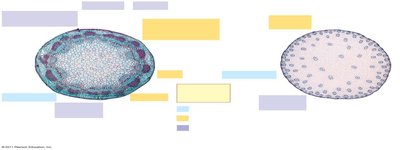
Vascular Bundles: Eudicots: arranged in a ring; monocots: scattered.
Tissue Organization of Leaves
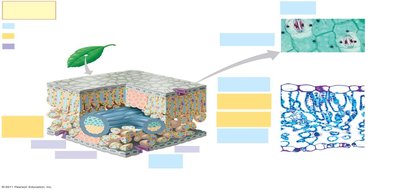
Leaf tissues are specialized for photosynthesis and gas exchange.
Stomata: Pores for gas exchange; regulated by guard cells.
Mesophyll: Ground tissue; palisade mesophyll (upper), spongy mesophyll (lower).
Veins: Contain xylem and phloem; surrounded by bundle-sheath cells.
Secondary Growth: Increasing Plant Diameter
Secondary Growth in Stems and Roots
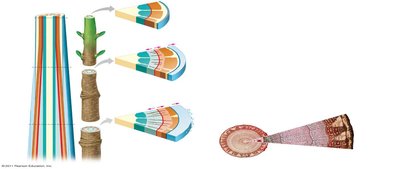
Secondary growth adds thickness to woody plants via lateral meristems.
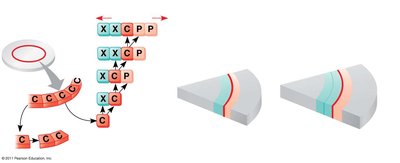
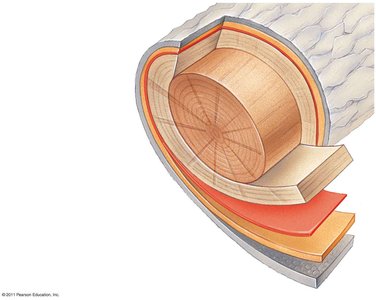
Vascular Cambium: Produces secondary xylem (wood) and secondary phloem.
Cork Cambium: Produces periderm, replacing epidermis in older regions.
Characteristic of: Gymnosperms and many eudicots; rare in monocots.
The Vascular Cambium and Secondary Vascular Tissue
The vascular cambium is a cylinder of meristematic cells that produces new vascular tissues.
Secondary Xylem: Accumulates as wood; includes tracheids, vessel elements, and fibers.
Early Wood: Formed in spring; thin cell walls for water delivery.
Late Wood: Formed in late summer; thick-walled cells for support.
Tree Rings: Formed by alternating early and late wood; used to estimate tree age.
Heartwood: Older, nonfunctional xylem.
Sapwood: Functional xylem for water transport.
Cork Cambium and Periderm
Cork cambium produces protective tissues in woody plants.
Phelloderm: Parenchyma cells formed to the interior of cork cambium.
Cork Cells: Formed to the exterior; deposit suberin and die.
Periderm: Includes cork cambium, phelloderm, and cork cells.
Lenticels: Allow gas exchange through periderm.
Bark: All tissues external to vascular cambium, including secondary phloem and periderm.
Summary Table: Plant Tissue Systems
Tissue System | Main Function | Key Cell Types |
|---|---|---|
Dermal | Protection, water retention | Epidermis, trichomes, cork cells |
Vascular | Transport of water, minerals, and nutrients | Xylem (tracheids, vessel elements), phloem (sieve-tube elements, companion cells) |
Ground | Storage, photosynthesis, support | Parenchyma, collenchyma, sclerenchyma |
Key Equations and Concepts
Photosynthesis: $6CO_2 + 6H_2O \rightarrow C_6H_{12}O_6 + 6O_2$
Water Transport (Xylem): Driven by transpiration and cohesion-tension mechanism.
Growth Ring Formation: Annual rings reflect environmental conditions and growth rates.
Additional info:
Some details about cell types and tissue functions were expanded for clarity.
Table summarizing tissue systems was inferred for completeness.
