 뒤로
뒤로Study Guide: Bacteria and Archaea (Prokaryotes) – Structure, Diversity, and Classification
스터디 가이드 - 스마트 노트
 자료에 맞춘 맞춤형 노트, 핵심 정의, 예시, 맥락을 확장해 제공합니다.
Bacteria and Archaea: Prokaryotes
Introduction to Prokaryotes
Prokaryotes are a structurally and metabolically diverse group of single-celled organisms that have dominated the biosphere for over 3.5 billion years. They are found in nearly every environment on Earth, including extreme habitats where eukaryotes cannot survive. - Prokaryotes include both Bacteria and Archaea. - Most prokaryotes are essential to life, with only a minority causing disease. - They thrive in environments that are too cold, hot, salty, acidic, or alkaline for eukaryotes. 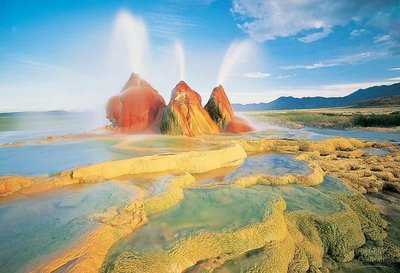
Importance of Prokaryotes
Prokaryotes play critical roles in ecosystems and human health. - Some prokaryotes are pathogens, causing diseases such as tuberculosis, cholera, and food poisoning. - Most prokaryotes are benign or beneficial, producing vitamins in the human gut and recycling nutrients. - Prokaryotes participate in symbiotic relationships with eukaryotes, including the evolutionary origins of mitochondria and chloroplasts. 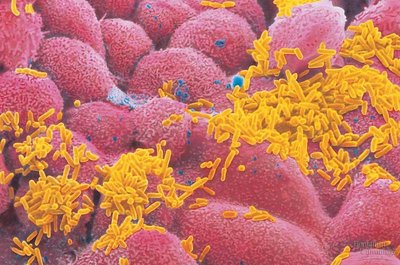
Classification of Prokaryotes
Modern classification recognizes two major branches: Bacteria and Archaea. - Molecular evidence shows prokaryotes are not a single kingdom. - Archaea inhabit extreme environments and differ from bacteria in structural, biochemical, and physiological traits. 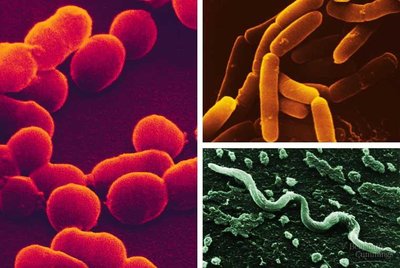
Characteristics of Prokaryotes
Cell Structure and Morphology
Most prokaryotes are unicellular, though some form colonies. They exhibit diverse shapes: - Cocci: Spherical - Bacilli: Rod-shaped - Spirilli: Helical 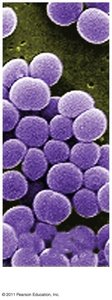
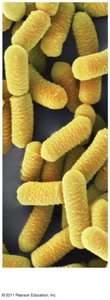
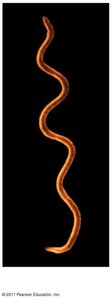 - Nearly all prokaryotes have a cell wall external to the plasma membrane. - Prokaryotic cells lack a nucleus and membrane-bound organelles. - Typical diameters: 1–5 μm (much smaller than eukaryotic cells).
Cell Wall Structure: Gram Stain
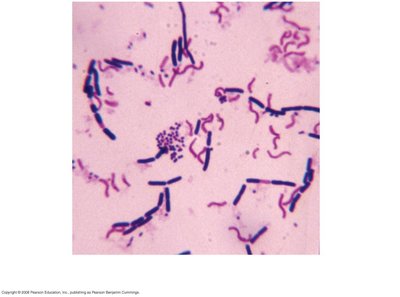
The Gram stain differentiates bacteria based on cell wall structure: - Gram-positive bacteria: Thick peptidoglycan layer, simple cell wall. - Gram-negative bacteria: Thin peptidoglycan layer, complex cell wall with an outer membrane containing lipopolysaccharides. 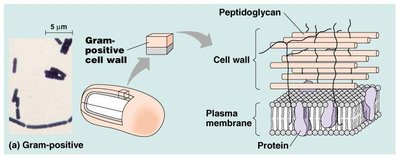
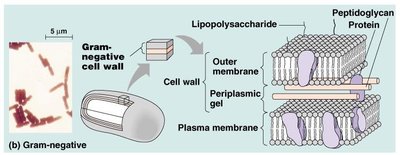
Surface Structures
- Capsule: Sticky protective layer outside the cell wall. - Fimbriae: Surface appendages for attachment. - Sex pili: Specialized for DNA transfer during conjugation. 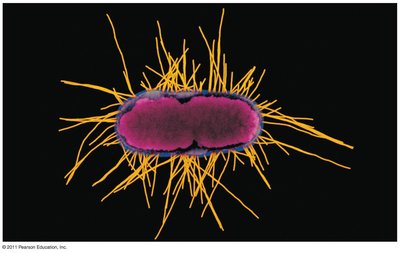
Motility
Many prokaryotes are motile, using flagella for movement (taxis). - Flagella may be scattered or concentrated at cell ends. - Spirochetes move via helical filaments under the cell wall. - Some secrete slimy threads for gliding motility. 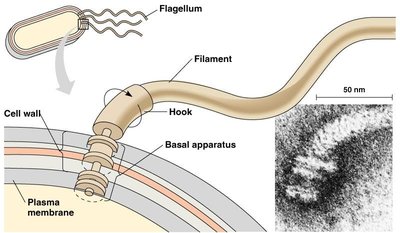
Endospores
Some bacteria form resistant cells called endospores, which survive harsh conditions by dehydrating and forming a thick protective wall. 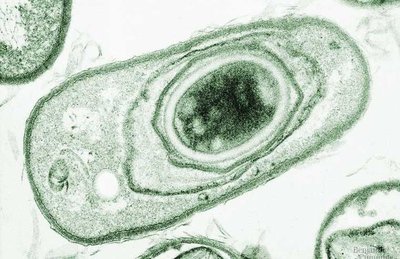
Genetic Material
- Prokaryotes have smaller, simpler genomes than eukaryotes. - DNA is typically a single circular chromosome located in the nucleoid region. 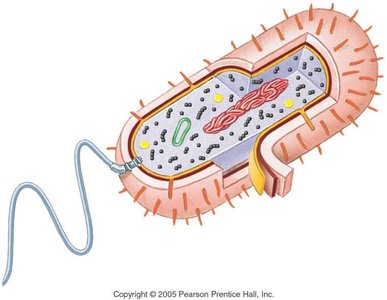 - Plasmids: Small rings of DNA carrying special genes (e.g., antibiotic resistance), replicating independently and transferable during conjugation.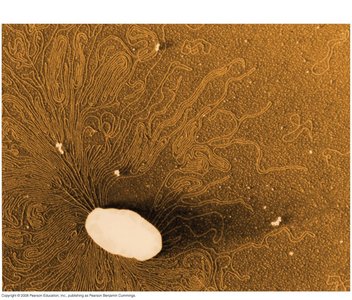
Reproduction and Genetic Variation
- Prokaryotes reproduce asexually by binary fission. - Mutation is the primary source of genetic variation. - Genetic recombination occurs via transformation, conjugation, and transduction.
Conjugation
Genes are transferred directly between cells via sex pili.
Transduction
Viruses (phages) transfer genes between prokaryotes.
Metabolic Functions
Prokaryotes use infolded plasma membrane regions for metabolic functions such as cellular respiration and photosynthesis. 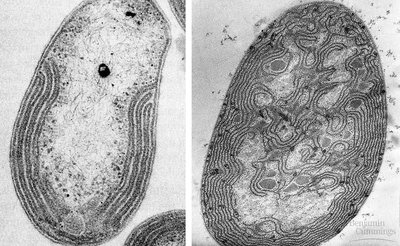
Metabolic Diversity of Prokaryotes
Major Nutritional Modes
Prokaryotes are classified by how they obtain energy and carbon:
Mode | Energy Source | Carbon Source | Types of Organisms |
|---|---|---|---|
Photoautotroph | Light | CO2, HCO3-, or related compound | Photosynthetic prokaryotes (e.g., cyanobacteria); plants; certain protists |
Chemoautotroph | Inorganic chemicals (e.g., H2S, NH3, Fe2+) | CO2, HCO3-, or related compound | Certain prokaryotes (e.g., Sulfolobus) |
Photoheterotroph | Light | Organic compounds | Certain aquatic and salt-loving prokaryotes (e.g., Rhodobacter, Chlorohydrus) |
Chemoheterotroph | Organic compounds | Organic compounds | Many prokaryotes (e.g., Clostridium); protists; fungi; animals; some plants |
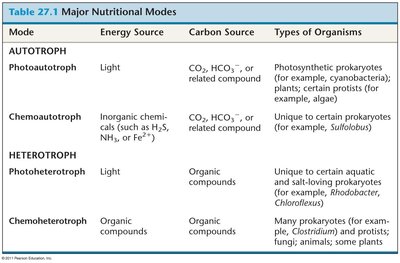
Oxygen Requirements
- Obligate aerobes: Require O2 for respiration. - Facultative anaerobes: Use O2 if present, or ferment anaerobically. - Obligate anaerobes: Poisoned by O2, use fermentation or anaerobic respiration.
Nitrogen Metabolism
Prokaryotes metabolize nitrogen in various ways, including nitrogen fixation (conversion of N2 to NH3). - Cyanobacteria (e.g., Anabaena) have specialized cells (heterocytes) for nitrogen fixation. 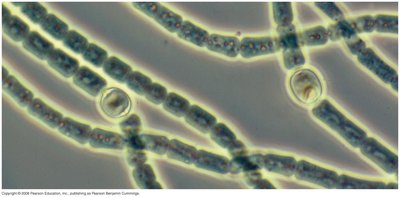 - Rhizobium forms root nodules in legumes and fixes atmospheric nitrogen.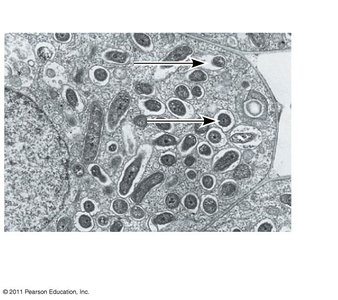
Classification and Domains
Three Domains of Life
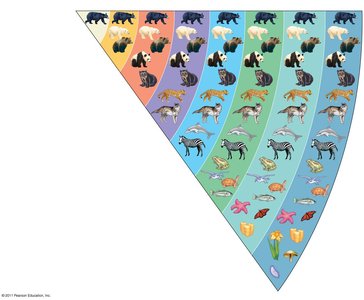
Current taxonomy recognizes three domains: Bacteria, Archaea, and Eukarya. - A domain is a taxonomic level above kingdom. 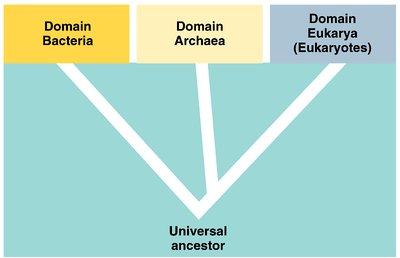
Bacteria
- Most familiar prokaryotes. - Cell walls contain peptidoglycan. 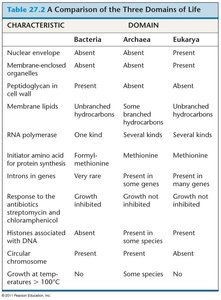
Archaea
- Share traits with both bacteria and eukaryotes. - Cell walls lack peptidoglycan; contain polysaccharides and proteins. - Many are extremophiles (e.g., halophiles, thermophiles).
Comparison of Domains
Characteristic | Bacteria | Archaea | Eukarya |
|---|---|---|---|
Nuclear envelope | Absent | Absent | Present |
Membrane-enclosed organelles | Absent | Absent | Present |
Peptidoglycan in cell wall | Present | Absent | Absent |
Membrane lipids | Unbranched hydrocarbons | Some branched hydrocarbons | Unbranched hydrocarbons |
RNA polymerase | One kind | Several kinds | Several kinds |
Growth at >100°C | No | Some species | No |
Major Clades of Bacteria
Cyanobacteria
- Photoautotrophs that generate O2. - Plant chloroplasts likely evolved from cyanobacteria via endosymbiosis.
Proteobacteria
- Gram-negative bacteria with diverse metabolic types. - Includes photoautotrophs, chemoautotrophs, and heterotrophs. - Some are aerobic, others anaerobic.
Spirochetes
- Helical heterotrophic bacteria. - Some are parasites causing diseases such as syphilis and Lyme disease.
Gram-Positive Bacteria
- Includes actinomycetes (decompose soil), Bacillus anthracis (anthrax), Clostridium botulinum (botulism), Staphylococcus and Streptococcus (pathogens), and mycoplasms (smallest known cells).
Chlamydias
- Parasitic bacteria living within animal cells.
Summary
Prokaryotes are fundamental to life on Earth, exhibiting remarkable structural, metabolic, and ecological diversity. Understanding their classification, cell structure, metabolic strategies, and ecological roles is essential for studying biology at the college level. Key concepts: - Prokaryotes include Bacteria and Archaea, each with unique characteristics. - Cell wall structure is critical for classification and function. - Prokaryotes display diverse nutritional modes and metabolic pathways. - They play essential roles in nutrient cycling, symbiosis, and disease.
