 뒤로
뒤로The Cell Cycle and Mitosis (8/16/26)
스터디 가이드 - 스마트 노트
 자료에 맞춘 맞춤형 노트, 핵심 정의, 예시, 맥락을 확장해 제공합니다.
Q1. What are the three key roles of cell division? State each function and give an example.
Background
Topic: Cell Division and Its Functions
This question tests your understanding of why cell division is essential for living organisms, including its roles in reproduction, growth, and tissue repair.
Key Terms:
Cell division: The process by which a parent cell divides into two daughter cells. (without having a partner, they would turn into their offspring)
Asexual reproduction: Producing offspring without the fusion of gametes. (no partner at all)
Growth and development: Increase in size and complexity of an organism. (growing child)
Tissue renewal and repair: Replacement of damaged or old cells. (deadpool)
Step-by-Step Guidance
Identify the three main functions of cell division: asexual reproduction, growth and development, and tissue renewal/repair.
For each function, think of a biological example. For instance, asexual reproduction occurs in single-celled organisms like amoebas.
Growth and development can be illustrated by the division of cells in a developing embryo.
Tissue renewal and repair is seen in the replacement of blood cells from bone marrow.
Try solving on your own before revealing the answer!
Final Answer:
Asexual reproduction: Example: An amoeba dividing to form two new organisms.
Growth and development: Example: A sand-dollar embryo dividing after fertilization.
Tissue renewal and repair: Example: Bone marrow cells dividing to produce new blood cells.
These functions ensure the continuity of life, organismal growth, and maintenance of tissues.
Q2. What is the meaning of genome?
Background
Topic: Genetic Information
This question is about understanding what constitutes the genetic material of a cell.
Key Terms:
Genome: The complete set of genetic information in a cell. (which is like part of your DNA)
DNA: Deoxyribonucleic acid, the molecule that carries genetic instructions. (instructions fo rwho you are)
Step-by-Step Guidance
Recall that the genome includes all the DNA present in a cell.
Think about how the genome is organized in chromosomes.
Consider the difference between the genome of a single cell and that of an entire organism.
Try solving on your own before revealing the answer!
Final Answer:
The genome is the complete set of genetic information (DNA) contained within an organism's cell.
This includes all the genes and non-coding sequences present in the cell.
Q3. What is chromatin?
Background
Topic: Chromosome Structure
This question tests your understanding of the material that makes up chromosomes.
Key Terms:
Chromatin: The complex of DNA and proteins that forms chromosomes.
Histones: Proteins that help package DNA into chromatin. (the prequel to chromatin)
Step-by-Step Guidance
Recall that chromatin is the combination of DNA and proteins found in the nucleus.
Think about how chromatin condenses to form chromosomes during cell division.
Consider the difference between chromatin and chromosomes in terms of structure and function.
Try solving on your own before revealing the answer!
Final Answer:
Chromatin is the entire complex of DNA and proteins that is the building material of chromosomes.
It is found in the nucleus and condenses to form chromosomes during cell division.
Q4. How many chromosomes are in a human somatic cell? Name two types of somatic cells in your body.
Background
Topic: Chromosome Number and Cell Types
This question is about the number of chromosomes in typical body cells and examples of those cells.
Key Terms:
Somatic cell: Any cell in the body except gametes.
Chromosome: A structure carrying genetic material. (any structure carrying part of your DNA)
Step-by-Step Guidance
Recall the diploid chromosome number for humans.
Think of examples of somatic cells, such as those found in skin or muscle.
Consider how somatic cells differ from gametes in chromosome number.
Try solving on your own before revealing the answer!
Final Answer:
Human somatic cells have 46 chromosomes. Two types of somatic cells are skin cells and muscle cells.
Somatic cells are diploid, containing two sets of chromosomes.
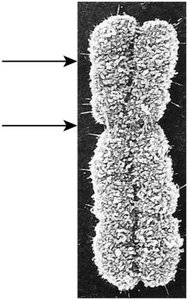
Q5. Label the indicated areas of the figure and define chromosome, chromatid, centromere, and chromatin.
Background
Topic: Chromosome Structure and Terminology
This question tests your ability to identify and define key parts of a chromosome and related terms.
Key Terms:
Chromosome: Tightly coiled package of DNA carrying genes. (it's an Amazon with a bunch of different things inside)
Chromatid: One of two identical copies of a duplicated chromosome. (backup chromosome)
Centromere: Region where two sister chromatids are attached. (cojoined twins)
Chromatin: Loose, uncoiled form of DNA before cell division. (before being separated)
Step-by-Step Guidance
Examine the figure and identify the two main parts indicated by arrows.
Label the top arrow as pointing to a chromatid and the bottom arrow as pointing to the centromere.
Recall that a chromosome consists of two sister chromatids joined at the centromere.
Define each term based on its role and structure in the chromosome.
Try solving on your own before revealing the answer!
Final Answer:
Chromosome: A tightly coiled package of DNA that carries genes.
Chromatid: One of two identical copies of a duplicated chromosome.
Centromere: The region where two sister chromatids are attached.
Chromatin: The loose, uncoiled form of DNA found in the nucleus before cell division.
The arrows in the figure indicate the sister chromatids and the centromere.
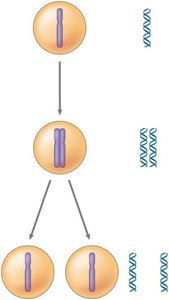
Q6. Summarize what occurs at the DNA level in each stage: unduplicated, duplicated, and separation.
Background
Topic: Chromosome Duplication and Separation
This question is about the changes in DNA and chromosome structure during the cell cycle.
Key Terms:
Unduplicated chromosome: Single DNA molecule. (one)
Duplicated chromosome: Two sister chromatids joined at the centromere. (two)
Separation: Sister chromatids split into individual chromosomes. (between one and two)
Step-by-Step Guidance
Identify the three stages: unduplicated, duplicated, and separation.
In the unduplicated stage, each chromosome consists of a single DNA molecule.
During duplication, each chromosome is copied, resulting in two sister chromatids.
During separation, the sister chromatids are pulled apart to become individual chromosomes in daughter cells.
Try solving on your own before revealing the answer!
Final Answer:
Unduplicated: Each chromosome is a single DNA molecule.
Duplicated: Each chromosome consists of two sister chromatids (two DNA molecules).
Separation: Sister chromatids are separated into two chromosomes, each with one DNA molecule.
This process ensures each daughter cell receives an identical set of genetic information.
Q7. What is considered to be the cell cycle?
Background
Topic: Cell Cycle
This question tests your understanding of the sequence of events in the life of a cell.
Key Terms:
Cell cycle: Ordered sequence of events from cell formation to division. (everything from birth to go to college)
Interphase: Period of growth and DNA replication. (growing up)
M phase: Period of mitosis and cytokinesis.
Step-by-Step Guidance
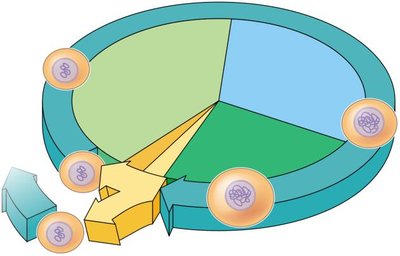
Recall that the cell cycle includes interphase and the M phase.
Interphase consists of G1, S, and G2 phases.
The M phase includes mitosis and cytokinesis.
Think about how the cell cycle allows for growth, DNA replication, and division.
Try solving on your own before revealing the answer!
Final Answer:
The cell cycle is the ordered sequence of events in the life of a cell, from its origin in the division of a parent cell until its own division into two.
It includes interphase (G1, S, G2) and the M phase (mitosis and cytokinesis).
