 뒤로
뒤로The Evolution of Populations: Mechanisms and Patterns
스터디 가이드 - 스마트 노트
 자료에 맞춘 맞춤형 노트, 핵심 정의, 예시, 맥락을 확장해 제공합니다.
The Evolution of Populations
Introduction to Population Evolution
Evolution at its smallest scale occurs within populations, not individuals. This process, known as microevolution, involves changes in allele frequencies in a population over generations. Understanding how genetic variation arises and is maintained is fundamental to evolutionary biology.
Genetic Variation in Populations
Sources of Genetic Variation
Genetic variation arises from mutations and sexual reproduction, which together produce the diversity observed in gene pools. This variation is essential for evolution, as it provides the raw material upon which natural selection can act.
Mutation: Changes in the nucleotide sequence of DNA; the only source of new genes and alleles.
Sexual Reproduction: Shuffles existing alleles into new combinations through mechanisms such as crossing over and independent assortment.
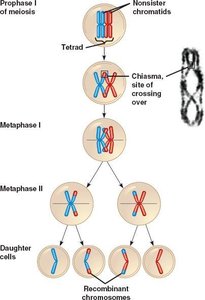
Types of Genetic Variation
Variation can be classified as discrete (either-or traits, e.g., flower color) or quantitative (traits that vary along a continuum, e.g., height). Not all phenotypic variation is heritable; only genetic variation can be acted upon by natural selection.
Measuring Genetic Variation
Polymorphism: The presence of two or more variants (alleles) at a locus within a population.
Heterozygosity: The average percent of loci that are heterozygous in a population.
Nucleotide Variability: Measured by comparing DNA sequences of individuals.
Geographic Variation
Populations may differ genetically due to geographic separation, leading to clines—graded changes in a trait along a geographic axis.
Mutation and Its Effects
Types of Mutations
Mutations can affect single nucleotides (point mutations) or larger chromosomal segments. Most mutations in noncoding regions are harmless, while those in genes may be neutral, harmful, or occasionally beneficial.
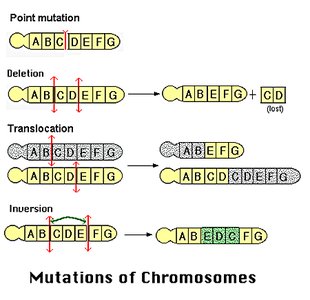
Point Mutation: Change in a single base pair.
Deletion, Duplication, Translocation, Inversion: Larger chromosomal changes that can disrupt gene function.
Mutation rates are generally low in eukaryotes but can be higher in prokaryotes and viruses, especially RNA viruses.
Gene Pools and Allele Frequencies
Population and Gene Pool
A population is a group of individuals of the same species that interbreed and produce fertile offspring. The gene pool consists of all alleles at all loci in the population. If all individuals are homozygous for the same allele at a locus, that allele is said to be fixed.
Calculating Allele Frequencies
For a gene with two alleles, the frequencies are represented as p and q.
The sum of allele frequencies at a locus:
The Hardy-Weinberg Principle
The Hardy-Weinberg equilibrium describes a non-evolving population where allele and genotype frequencies remain constant from generation to generation, provided certain conditions are met:
No mutations
Random mating
No natural selection
Extremely large population size
No gene flow
The genotype frequencies can be calculated using:
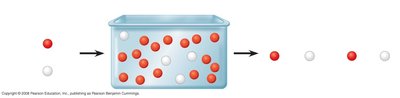
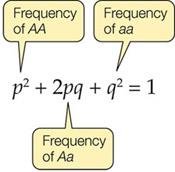
Applying Hardy-Weinberg
For example, if the frequency of a recessive disease (q2) is 0.0001, then q = 0.01, p = 0.99, and the frequency of carriers (2pq) is approximately 2%.
Mechanisms of Evolutionary Change
Natural Selection
Natural selection increases the frequency of alleles that enhance survival and reproductive success. It is not simply 'survival of the fittest,' but differential reproductive success based on heritable traits.
Genetic Drift
Genetic drift refers to random changes in allele frequencies, especially in small populations. It can lead to the loss of genetic variation and fixation of alleles.
Founder Effect: When a few individuals establish a new population, their allele frequencies may differ from the original population.
Bottleneck Effect: A sudden reduction in population size due to environmental change can drastically alter allele frequencies.
Gene Flow
Gene flow is the movement of alleles between populations through migration of individuals or gametes. It tends to reduce genetic differences between populations and can either increase or decrease fitness depending on the context.
Modes of Selection
Directional, Disruptive, and Stabilizing Selection
Natural selection can take different forms:
Directional Selection: Favors individuals at one end of the phenotypic range.
Disruptive Selection: Favors individuals at both extremes of the phenotypic range.
Stabilizing Selection: Favors intermediate variants and acts against extreme phenotypes.
Sexual Selection
Types of Sexual Selection
Sexual selection is natural selection for mating success and can result in sexual dimorphism (differences between sexes in secondary sexual characteristics).
Intrasexual Selection: Competition among individuals of one sex for mates.
Intersexual Selection (Mate Choice): Individuals of one sex (usually females) are choosy in selecting mates.
Maintenance of Genetic Variation
Mechanisms Preserving Variation
Diploidy: Maintains genetic variation in the form of hidden recessive alleles.
Balancing Selection: Maintains stable frequencies of two or more phenotypes.
Heterozygote Advantage: Heterozygotes have higher fitness than either homozygote (e.g., sickle-cell allele and malaria resistance).
Frequency-Dependent Selection: The fitness of a phenotype declines if it becomes too common.
Neutral Variation: Genetic variation that does not confer a selective advantage or disadvantage.
Limits of Natural Selection
Why Perfect Organisms Do Not Exist
Selection can only act on existing variation.
Evolution is limited by historical constraints.
Adaptations are often compromises.
Chance, natural selection, and the environment interact; the environment is always changing.
Key Terms and Concepts
Population: Group of individuals of the same species in a given area.
Species: Group of populations whose members can interbreed and produce fertile offspring.
Gene Pool: All alleles at all loci in a population.
Relative Fitness: Contribution of a genotype to the next generation compared to others.
Neutral Variation: Genetic variation with no selective advantage or disadvantage.
Practice and Application
List the five conditions for Hardy-Weinberg equilibrium.
Apply the Hardy-Weinberg equation to solve population genetics problems.
Distinguish between directional, disruptive, and stabilizing selection; intrasexual and intersexual selection.
Explain why natural selection is the only mechanism that consistently produces adaptive change.
List four reasons why natural selection cannot produce perfect organisms.
