 뒤로
뒤로The Molecules of Life: Biochemistry and Biological Macromolecules
스터디 가이드 - 스마트 노트
 자료에 맞춘 맞춤형 노트, 핵심 정의, 예시, 맥락을 확장해 제공합니다.
Chapter 3: The Molecules of Life (Biochemistry)
Introduction to Biochemistry
Biochemistry is the study of the chemical processes and substances that occur within living organisms. It is closely related to organic chemistry, which focuses on carbon-containing compounds. The versatility of carbon allows for the formation of a vast array of molecules essential for life.

Organic chemistry: The study of carbon compounds, which are the foundation of all living things.
Carbon atoms have four valence electrons, allowing them to form four covalent bonds and a variety of structures, including chains, branches, and rings.
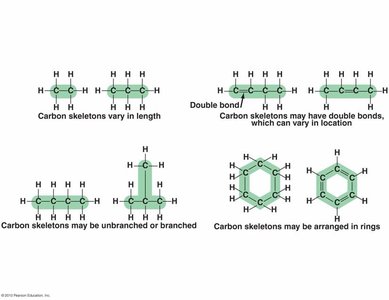
Key Point: The diversity of carbon skeletons and the presence of functional groups give organic molecules their unique properties and functions.
Elements Essential for Life
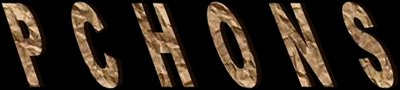
Six elements make up the majority of living matter: phosphorus (P), carbon (C), hydrogen (H), oxygen (O), nitrogen (N), and sulfur (S). These are often remembered by the acronym PCHONS.
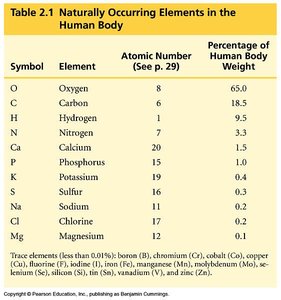



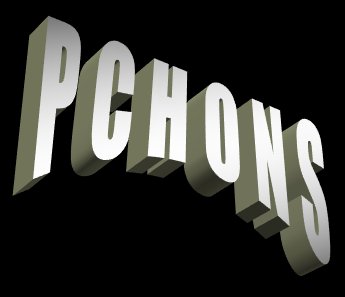
Example: Oxygen and carbon are the most abundant elements in the human body by weight.
Functional Groups in Organic Molecules
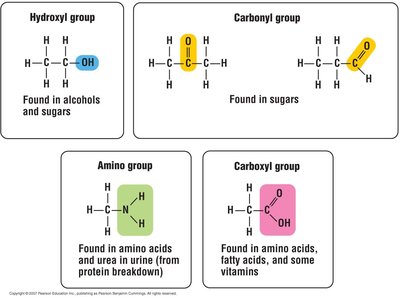
Functional groups are specific groups of atoms within molecules that determine the chemical properties of those molecules. The four main functional groups to memorize are:
Hydroxyl group (-OH): Found in alcohols and sugars.
Carbonyl group (C=O): Found in sugars.
Amino group (-NH2): Found in amino acids and proteins.
Carboxyl group (-COOH): Found in amino acids, fatty acids, and some vitamins.
Macromolecules: Structure and Function
Macromolecules are large molecules essential for life, built from smaller subunits called monomers. The four major classes are carbohydrates, lipids, proteins, and nucleic acids.
Monomer: A small subunit or building block of a polymer.
Polymer: A large molecule made of many monomers joined together.
Macromolecule: A giant molecule formed by the joining of smaller molecules.
Hydrocarbon: Organic molecules containing only carbon and hydrogen.
Note: To be considered organic, a molecule must contain both carbon and hydrogen. For example, CO2 is not organic because it lacks hydrogen.
Building and Breaking Polymers
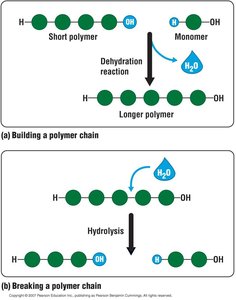
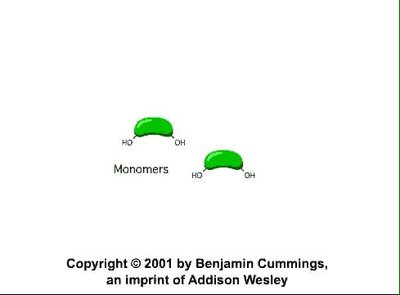
Polymers are assembled and disassembled by two main types of reactions:
Dehydration reaction (synthesis): Joins monomers by removing a molecule of water.
Hydrolysis: Breaks polymers into monomers by adding a molecule of water.

Carbohydrates
Structure and Function
Carbohydrates are composed of carbon, hydrogen, and oxygen in a 1:2:1 ratio (C:H2:O). They serve as a major energy source and structural material in living organisms.
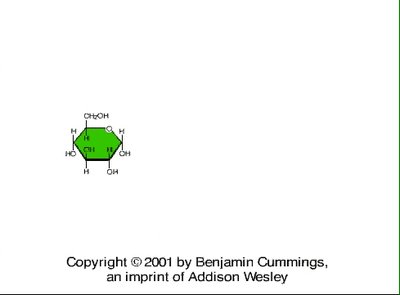
Monosaccharides: Simple sugars (e.g., glucose, fructose, ribose) that serve as immediate energy sources.
Disaccharides: Two monosaccharides joined by a dehydration reaction (e.g., maltose, sucrose, lactose).
Polysaccharides: Long chains of monosaccharides used for energy storage (starch, glycogen) or structure (cellulose, chitin).
Isomers
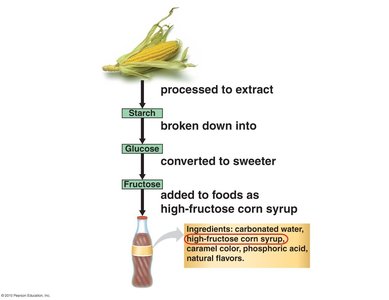
Isomers are molecules with the same molecular formula but different structures, resulting in different properties. For example, glucose and fructose are both C6H12O6 but differ in structure.

Formation of Disaccharides
Disaccharides are formed by joining two monosaccharides via a dehydration reaction, producing water as a byproduct.
Glucose + Glucose = Maltose + H2O
Glucose + Fructose = Sucrose + H2O
Glucose + Galactose = Lactose + H2O
Polysaccharides: Storage and Structure
Polysaccharides are hydrophilic and serve as energy storage or structural components:
Starch: Storage polysaccharide in plants.
Glycogen: Storage polysaccharide in animals (liver and muscle cells).
Cellulose: Structural component of plant cell walls.
Chitin: Structural component in arthropod exoskeletons and fungal cell walls.
Lipids
Structure and Function
Lipids are a diverse group of hydrophobic molecules that include fats, oils, and steroids. They are primarily composed of carbon, hydrogen, and oxygen, but not in a fixed ratio.
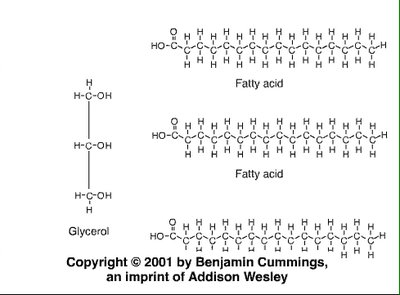
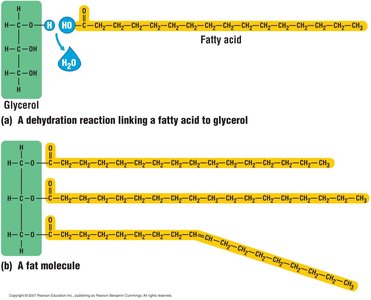
Fats (triglycerides): Long-term energy storage molecules composed of glycerol and three fatty acids.
Steroids: Structural components of cell membranes and hormones (e.g., cholesterol, estrogen, testosterone).

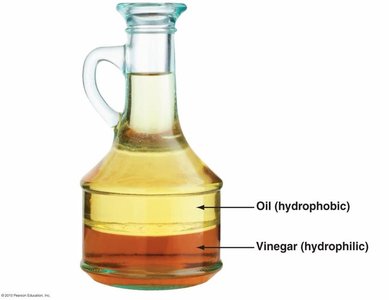
Lipids are nonpolar and do not dissolve in water, making them hydrophobic ("water hating").




Structure of Fats
Fats are formed by joining three fatty acids to a glycerol molecule via dehydration reactions, resulting in a triglyceride.





Saturated vs. Unsaturated Fatty Acids
Saturated fatty acids: Have only single bonds between carbon atoms; solid at room temperature (e.g., butter).
Unsaturated fatty acids: Have one or more double bonds; liquid at room temperature (e.g., olive oil).

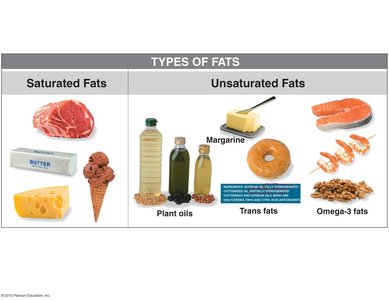
Example: Saturated fats are found in animal products, while unsaturated fats are common in plant oils and fish.
Steroids
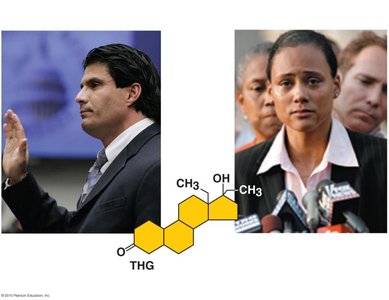
Steroids are lipids with a structure of four interconnected carbon rings. They function as hormones and structural components of cell membranes.
Examples: Cholesterol, estrogen, testosterone.
Summary Table: Macromolecules
The following table summarizes the four major classes of biological macromolecules, their monomers, elements, and functions:
Macromolecule | Monomer | Elements | Main Functions |
|---|---|---|---|
Carbohydrates | Monosaccharides | C, H, O | Energy, structure |
Lipids | Glycerol + Fatty acids | C, H, O | Energy storage, membranes, hormones |
Proteins | Amino acids | C, H, O, N (S) | Structure, enzymes, transport, movement |
Nucleic Acids | Nucleotides | P, C, H, O, N | Genetic information |
