 뒤로
뒤로The Origin of Species: Mechanisms and Patterns of Speciation
스터디 가이드 - 스마트 노트
 자료에 맞춘 맞춤형 노트, 핵심 정의, 예시, 맥락을 확장해 제공합니다.
Chapter 24: The Origin of Species
Introduction to Speciation
Speciation is the evolutionary process by which one species splits into two or more distinct species. This process is fundamental to understanding the diversity and unity of life, as it explains how new species arise and why related species share many characteristics. Speciation forms a conceptual bridge between microevolution (changes in allele frequency within populations) and macroevolution (broad evolutionary changes above the species level).
The Biological Species Concept
Definition and Importance
The biological species concept defines a species as a group of populations whose members have the potential to interbreed in nature and produce viable, fertile offspring, but do not produce viable, fertile offspring with members of other such groups. This concept emphasizes reproductive compatibility rather than physical similarity.
Gene flow (the transfer of alleles between populations) maintains genetic cohesion within a species.
Reduction or absence of gene flow can lead to the formation of new species.
Reproductive Isolation
Reproductive isolation consists of biological barriers that prevent members of different species from interbreeding and producing viable, fertile offspring. These barriers limit the formation of hybrids (offspring from interspecific mating) and can be classified as prezygotic or postzygotic.
Prezygotic Barriers
Prezygotic barriers block fertilization from occurring by:
Impeding different species from attempting to mate
Preventing the successful completion of mating
Hindering fertilization if mating is successful
Types of Prezygotic Barriers
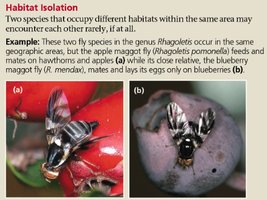
Habitat Isolation: Species occupy different habitats within the same area and rarely encounter each other. Example: Apple maggot flies (Rhagoletis pomonella) mate and lay eggs on apples, while blueberry maggot flies (R. mendax) use blueberries.
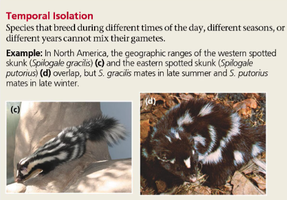
Temporal Isolation: Species breed at different times (day, season, or year), preventing gamete mixing. Example: Western spotted skunk (Spilogale gracilis) mates in late summer, while eastern spotted skunk (S. putorius) mates in late winter.
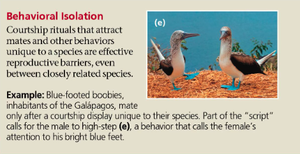
Behavioral Isolation: Unique courtship rituals and behaviors prevent interbreeding between closely related species. Example: Blue-footed boobies in the Galápagos mate only after a specific courtship display.
Postzygotic Barriers
Postzygotic barriers prevent hybrid zygotes from developing into viable, fertile adults. These include:
Reduced hybrid viability: Hybrids fail to develop or are frail.
Reduced hybrid fertility: Hybrids are sterile (e.g., mule).
Hybrid breakdown: First-generation hybrids are viable and fertile, but their offspring are weak or sterile.
Limitations of the Biological Species Concept
Cannot be applied to fossils or asexual organisms (e.g., prokaryotes).
Gene flow can occur between distinct species (e.g., grizzly and polar bears producing 'grolar bears').
Other Species Concepts
Morphological species concept: Distinguishes species by structural features; applies to sexual and asexual species but is subjective.
Ecological species concept: Defines species by ecological niche; applies to sexual and asexual species and emphasizes disruptive selection.
Modes of Speciation
Allopatric Speciation
Allopatric speciation occurs when populations are geographically isolated, interrupting gene flow. Over time, genetic divergence leads to reproductive isolation.
Geographic barriers (e.g., lakes, mountains) separate populations.
Genetic divergence occurs via mutation, natural selection, and genetic drift.
Evidence: Laboratory experiments (e.g., fruit flies on different diets) and natural examples (e.g., snapping shrimp separated by the Isthmus of Panama).
Sympatric Speciation
Sympatric speciation occurs in populations that live in the same geographic area. It is less common and typically results from reduced gene flow due to polyploidy, sexual selection, or habitat differentiation.
Polyploidy: Extra sets of chromosomes due to errors in cell division; common in plants.
Autopolyploid: Chromosome sets from a single species.
Allopolyploid: Chromosome sets from different species.
Sexual selection: Mate choice based on specific traits (e.g., cichlid fish coloration).
Habitat differentiation: Exploitation of new habitats or resources (e.g., apple maggot flies on apples vs. hawthorns).
Hybrid Zones and Speciation Outcomes
Hybrid Zones
A hybrid zone is a region where members of different species meet and mate, producing hybrids. These zones provide insight into the mechanisms of reproductive isolation and speciation.
Hybrids often have reduced fitness compared to parent species.
Hybrid zones can shift or change in response to environmental changes (e.g., climate change).
Outcomes for Hybrid Zones
Reinforcement: Strengthening of reproductive barriers; hybrids are less fit, so selection favors prezygotic barriers.
Fusion: Weakening of reproductive barriers; gene flow increases, and species may merge.
Stability: Continued production of hybrids; gene flow persists, but species remain distinct.
Tempo and Genetics of Speciation
Rates of Speciation
Speciation can occur rapidly or slowly, depending on the group and environmental conditions. The fossil record shows both punctuated equilibria (periods of stasis punctuated by rapid change) and gradual change.
Speciation intervals range from thousands to millions of years.
Genetic changes required for speciation can involve one or many genes.
From Speciation to Macroevolution
Successive speciation events lead to the accumulation of differences, resulting in the formation of new groups of organisms. Macroevolution is the cumulative effect of many speciation and extinction events over time.
