 뒤로
뒤로Bio 100 LEC Chapter 17 Module 2-3
스터디 가이드 - 스마트 노트
 자료에 맞춘 맞춤형 노트, 핵심 정의, 예시, 맥락을 확장해 제공합니다.
Overview of Transcription
Transcription is the process by which the genetic information encoded in DNA is copied into RNA. This process is fundamental to gene expression and occurs in three main stages: initiation, elongation, and termination. In eukaryotes, transcription is followed by extensive RNA processing before the RNA can be translated into protein.
Template Strand: Only one of the two DNA strands serves as the template for RNA synthesis. The other, called the coding strand, has a sequence nearly identical to the resulting RNA (except for uracil replacing thymine).
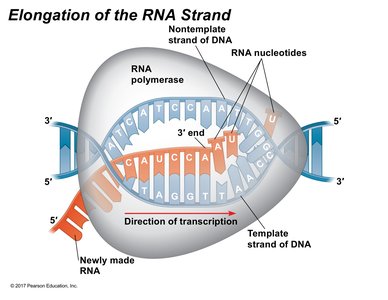
Directionality: RNA is synthesized in the 5' to 3' direction, using the DNA template strand read in the 3' to 5' direction.
Enzyme: RNA polymerase catalyzes the synthesis of RNA without the need for a primer.
Stages of Transcription
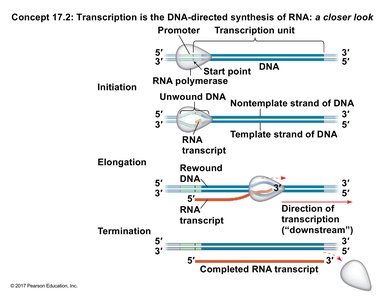
Initiation: RNA polymerase binds to a specific DNA sequence called the promoter, which signals the start point for transcription. The DNA strands are unwound, and the polymerase begins RNA synthesis.
Elongation: RNA polymerase moves along the template strand, adding complementary RNA nucleotides to the growing transcript. The enzyme unwinds the DNA ahead of it and rewinds it behind.
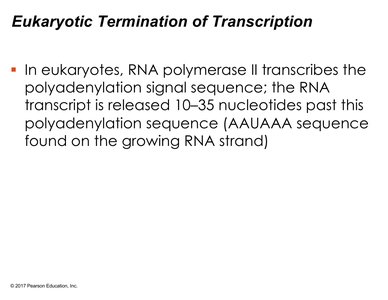
Termination: In eukaryotes, transcription ends when RNA polymerase transcribes a polyadenylation signal sequence (AAUAAA), after which the RNA transcript is released.
Promoters and Transcription Factors
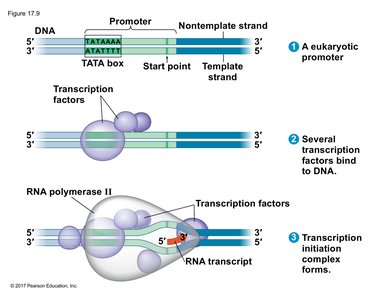
Promoters are DNA sequences upstream of the transcription start site that direct the binding of RNA polymerase and transcription factors. In eukaryotes, the TATA box is a common promoter element. General transcription factors are required for the assembly of the transcription initiation complex, which includes RNA polymerase II (responsible for mRNA synthesis).
RNA Polymerase I: Synthesizes ribosomal RNA (rRNA).
RNA Polymerase II: Synthesizes messenger RNA (mRNA) and some small nuclear RNAs (snRNAs).
RNA Polymerase III: Synthesizes transfer RNA (tRNA) and some rRNA components.
RNA Processing in Eukaryotes
Overview of RNA Processing
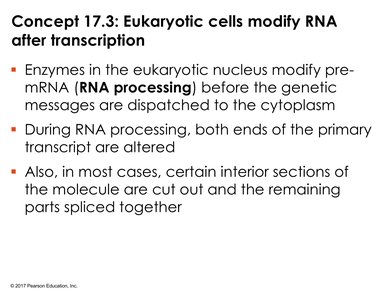
In eukaryotic cells, the primary RNA transcript (pre-mRNA) undergoes several modifications before becoming mature mRNA capable of being translated. These modifications include capping, polyadenylation, and splicing.
Location: RNA processing occurs in the nucleus.
Purpose: Processing increases mRNA stability, facilitates export from the nucleus, and ensures proper translation.
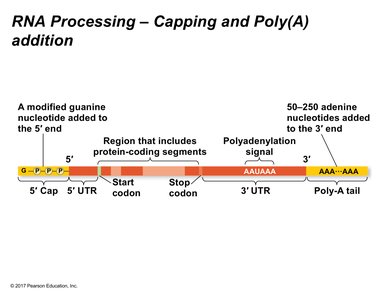
5' Capping and 3' Polyadenylation
5' Cap: A modified guanine nucleotide is added to the 5' end of the transcript via a 5'-5' linkage. This cap protects the mRNA from degradation and assists in ribosome binding during translation.
3' Poly(A) Tail: After transcription, a polyadenylation signal triggers the addition of 50–250 adenine nucleotides to the 3' end. The poly(A) tail enhances mRNA stability and aids in export from the nucleus.
RNA Splicing: Removal of Introns
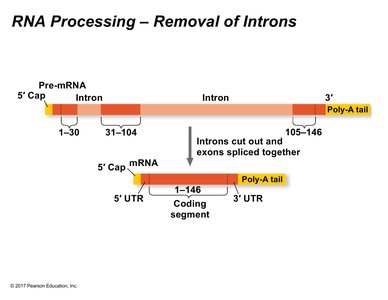
Most eukaryotic genes contain noncoding sequences called introns, which are removed from the pre-mRNA during processing. The remaining coding sequences, exons, are joined together to form the mature mRNA.
Introns: Intervening sequences that do not code for protein and are removed during splicing.
Exons: Expressed sequences that remain in the mature mRNA and are translated into protein.
UTRs (Untranslated Regions): Regions at the 5' and 3' ends of the mRNA that are not translated but play regulatory roles.
Spliceosome and Catalysis of Splicing
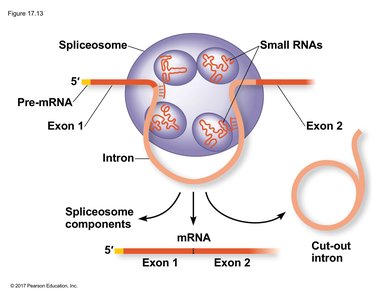
Splicing is catalyzed by a large complex called the spliceosome, which is composed of proteins and small nuclear RNAs (snRNAs). The spliceosome recognizes specific sequences at the intron-exon boundaries and removes introns, joining exons together. The catalytic activity is primarily due to the RNA components of the spliceosome.
Alternative Splicing and Functional Diversity
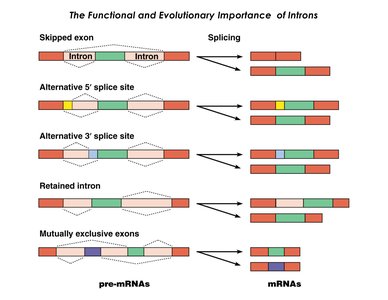
Alternative splicing allows a single gene to produce multiple mRNA variants by including or excluding different exons. This process increases the diversity of proteins that an organism can produce and plays a significant role in evolution and adaptation.
Skipped Exon: An exon may be included or skipped in the final mRNA.
Alternative Splice Sites: Different 5' or 3' splice sites can be used, altering the mRNA sequence.
Retained Intron: Occasionally, an intron may be retained in the mature mRNA.
Mutually Exclusive Exons: Only one of several possible exons is included in the mature mRNA.
Exon Shuffling and Protein Domains
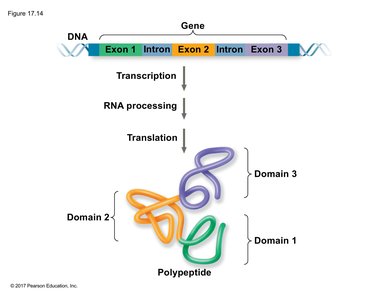
Exons often correspond to functional domains in proteins. Through alternative splicing and exon shuffling, new combinations of protein domains can evolve, contributing to the functional complexity of proteins in eukaryotes.
Summary Table: Key Steps in Eukaryotic Transcription and RNA Processing
Step | Main Events | Key Molecules |
|---|---|---|
Initiation | RNA polymerase binds promoter; DNA unwinds | RNA polymerase II, transcription factors, promoter (TATA box) |
Elongation | RNA strand synthesized 5' to 3' | RNA polymerase II, ribonucleotides |
Termination | Polyadenylation signal transcribed; RNA released | RNA polymerase II, polyadenylation signal (AAUAAA) |
5' Capping | Modified guanine added to 5' end | 5' cap, capping enzymes |
3' Polyadenylation | Poly(A) tail added to 3' end | Poly(A) polymerase, poly(A) tail |
Splicing | Introns removed, exons joined | Spliceosome, snRNAs |
Alternative Splicing | Different combinations of exons joined | Spliceosome, regulatory proteins |
