 뒤로
뒤로Bio 100 LEC Chapter 17 Module 4-5
스터디 가이드 - 스마트 노트
 자료에 맞춘 맞춤형 노트, 핵심 정의, 예시, 맥락을 확장해 제공합니다.
Translation: The RNA-Directed Synthesis of a Polypeptide
Overview of Translation
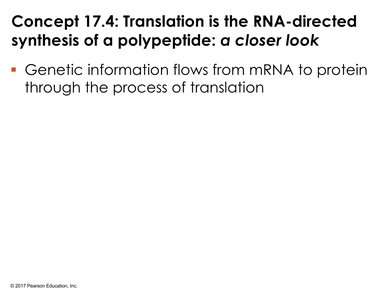
Translation is the process by which genetic information encoded in messenger RNA (mRNA) is used to assemble a specific sequence of amino acids, forming a polypeptide. This process is a fundamental step in gene expression, linking the nucleotide sequence of genes to the functional molecules of the cell—proteins.
Translation converts the nucleotide language of mRNA into the amino acid language of proteins.
Occurs in the cytoplasm of eukaryotic cells, using mature mRNA transcripts.
Key Components of Translation
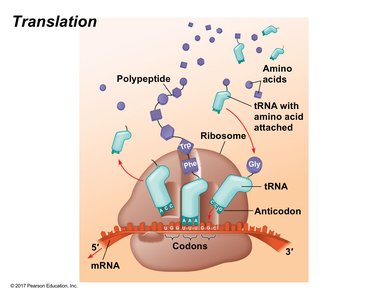
mRNA: Provides the codon sequence that determines the amino acid order.
Ribosome: The molecular machine that facilitates the decoding of mRNA and the formation of peptide bonds.
tRNA (transfer RNA): Serves as the adaptor molecule, matching amino acids to their corresponding codons in the mRNA via its anticodon region.
Amino acids: The building blocks of proteins, recruited from the cytoplasmic pool.
Transfer RNA (tRNA): The Translator
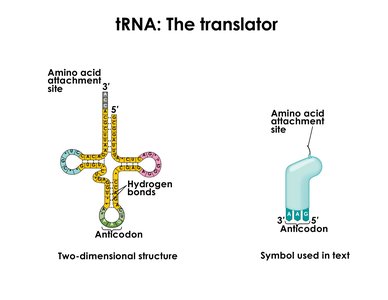
tRNA molecules are essential for translating the codon sequence of mRNA into the amino acid sequence of proteins. Each tRNA has a specific structure and function:
Amino acid attachment site at the 3' end (always ACC sequence).
Anticodon loop that base-pairs with the complementary mRNA codon (anticodon is read 3' to 5').
tRNAs can recognize more than one codon due to the wobble hypothesis, which allows flexibility at the third codon position.
Charging tRNA: Aminoacyl-tRNA Synthetases
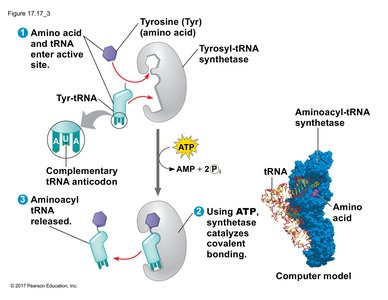
Before translation, tRNAs must be linked to their correct amino acids by enzymes called aminoacyl-tRNA synthetases. This process is called "charging" the tRNA.
A specific amino acid and its corresponding tRNA enter the active site of the synthetase.
Using ATP, the enzyme catalyzes the covalent attachment of the amino acid to the tRNA, forming aminoacyl-tRNA (charged tRNA).
The enzyme proofreads the product, ensuring accuracy. Incorrectly charged tRNAs are hydrolyzed and corrected.
Equation:
Ribosome Structure and Function
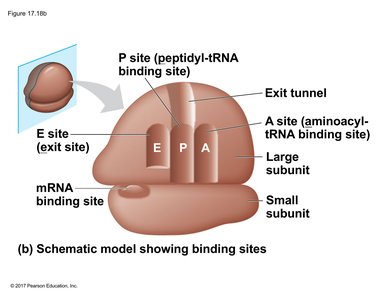
Ribosomes are composed of ribosomal RNA (rRNA) and proteins, forming two subunits (large and small). They provide the site for mRNA decoding and peptide bond formation.
mRNA binding site (on small subunit): Where mRNA threads through the ribosome.
A site (Aminoacyl-tRNA site): Binds incoming charged tRNA.
P site (Peptidyl-tRNA site): Holds the tRNA with the growing polypeptide chain.
E site (Exit site): Where uncharged tRNAs exit the ribosome.
Exit tunnel: Pathway for the emerging polypeptide.
Translation Process: Initiation, Elongation, and Termination
Initiation
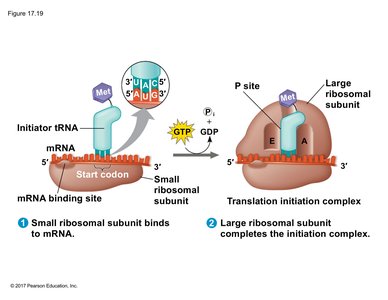
Translation initiation involves the assembly of the translation machinery at the start codon (AUG) of the mRNA.
Small ribosomal subunit binds to mRNA.
Initiator tRNA (carrying methionine) pairs with the start codon at the P site.
Large ribosomal subunit joins, forming the complete initiation complex.
Initiation factors and GTP hydrolysis drive complex assembly.
Elongation
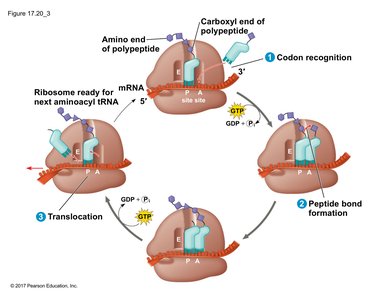
During elongation, amino acids are sequentially added to the growing polypeptide chain. The cycle involves three main steps:
Codon recognition: Incoming aminoacyl-tRNA pairs with the codon in the A site.
Peptide bond formation: Peptidyl transferase catalyzes the formation of a peptide bond between the amino group of the new amino acid and the carboxyl group of the growing chain.
Translocation: The ribosome shifts, moving the tRNA with the polypeptide to the P site and the empty tRNA to the E site, which then exits.
Elongation factors and GTP hydrolysis facilitate these steps.
Termination
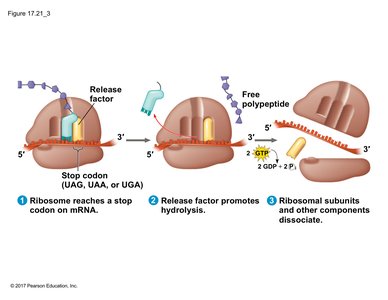
Termination occurs when a stop codon (UAA, UAG, or UGA) enters the A site. These codons are not recognized by tRNAs but by release factors.
Release factor binds to the stop codon, promoting hydrolysis of the bond between the polypeptide and tRNA.
The completed polypeptide is released, and the ribosomal subunits dissociate.
GTP hydrolysis is required for disassembly.
Targeting Proteins to Specific Cellular Locations
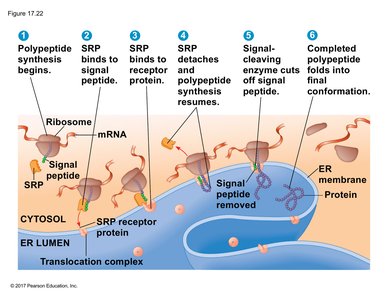
Some proteins contain a signal peptide that directs their synthesis to the endoplasmic reticulum (ER). The signal recognition particle (SRP) binds the signal peptide and directs the ribosome to the ER membrane, where translation resumes and the polypeptide is translocated into the ER lumen.
Polypeptide synthesis begins in the cytosol.
SRP binds to the signal peptide.
SRP-ribosome complex docks at the SRP receptor on the ER membrane.
SRP detaches, and translation resumes, threading the polypeptide into the ER.
Signal-cleaving enzyme removes the signal peptide.
Polypeptide folds into its final conformation in the ER lumen.
Polyribosomes and Efficiency of Protein Synthesis
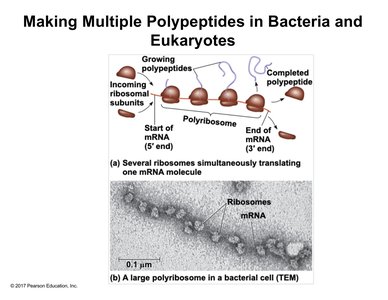
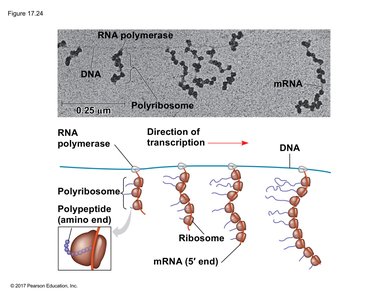
Multiple ribosomes can simultaneously translate a single mRNA molecule, forming a structure called a polyribosome or polysome. This increases the efficiency of protein synthesis, allowing many copies of a polypeptide to be made rapidly.
Occurs in both prokaryotes and eukaryotes.
In prokaryotes, transcription and translation can be coupled; in eukaryotes, they are separated by the nuclear envelope.
Summary of Transcription and Translation in Eukaryotes
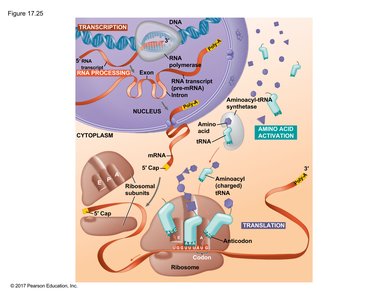
In eukaryotic cells, transcription occurs in the nucleus, producing a pre-mRNA that undergoes processing (capping, polyadenylation, and splicing) to become mature mRNA. The mature mRNA is exported to the cytoplasm, where translation occurs. Aminoacyl-tRNA synthetases charge tRNAs, which then participate in translation at the ribosome, producing a polypeptide.
Mutations: Effects on Protein Structure and Function
Types of Mutations
Mutations are changes in the DNA sequence that can affect gene expression and protein function. They can occur in somatic cells (affecting only the individual) or germline cells (heritable). The impact of a mutation depends on its type and location within the gene.
Substitution: Replacement of one nucleotide with another.
Insertion: Addition of one or more nucleotides.
Deletion: Loss of one or more nucleotides.
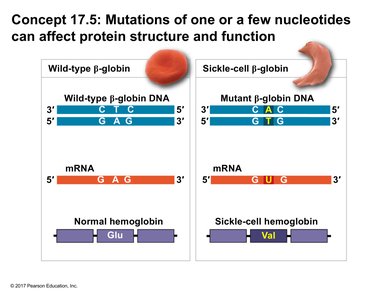
Substitution Mutations
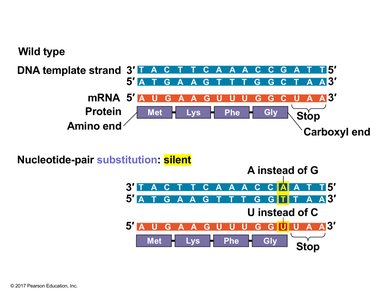
Silent mutation: Alters a codon but does not change the amino acid due to redundancy in the genetic code.
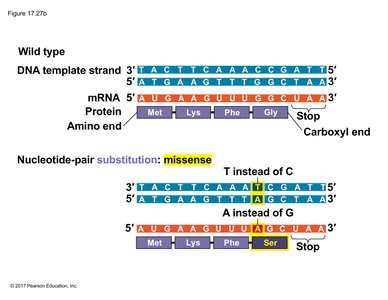
Missense mutation: Changes a codon, resulting in a different amino acid. May or may not affect protein function.
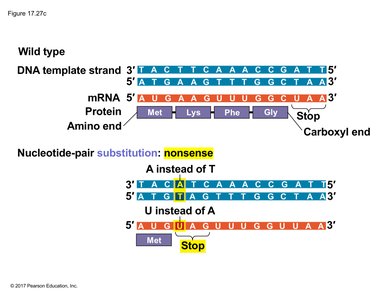
Nonsense mutation: Converts a codon into a stop codon, leading to premature termination of translation and usually a nonfunctional protein.
Frameshift Mutations
Frameshift mutation: Insertion or deletion of nucleotides not in multiples of three, altering the reading frame and usually resulting in extensive missense or nonsense (premature stop codon).
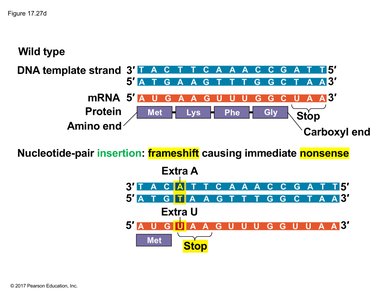
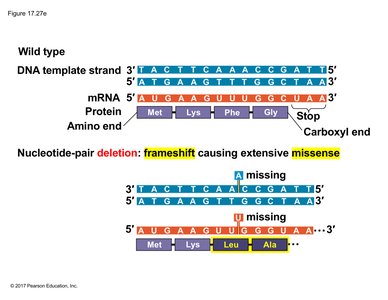
Three-Nucleotide Pair Deletions
Deletion of three nucleotides removes one amino acid but does not shift the reading frame. The effect depends on the role of the missing amino acid in protein structure and function.
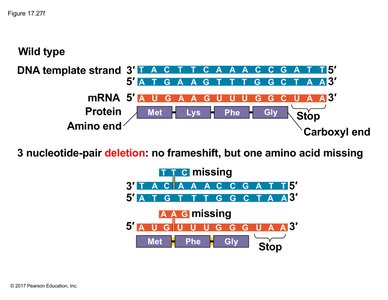
Summary Table: Types of Point Mutations and Their Effects
Mutation Type | DNA Change | Effect on Protein | Example |
|---|---|---|---|
Silent | Substitution | No amino acid change | GGC → GGU (both code for Gly) |
Missense | Substitution | One amino acid replaced by another | Sickle-cell anemia (Glu → Val) |
Nonsense | Substitution | Premature stop codon | UAC (Tyr) → UAA (Stop) |
Frameshift | Insertion/Deletion (not multiple of 3) | Alters reading frame, extensive missense or nonsense | Insertion of A in coding sequence |
In-frame Deletion | Deletion (multiple of 3) | Removes one or more amino acids, reading frame preserved | Deletion of AAA (Lys) |
