 뒤로
뒤로Water and Life: Properties, Functions, and Biological Importance
스터디 가이드 - 스마트 노트
 자료에 맞춘 맞춤형 노트, 핵심 정의, 예시, 맥락을 확장해 제공합니다.
Water and Life
Introduction
Water is essential for all known forms of life. Its unique chemical and physical properties make it indispensable for biological processes, from cellular structure to ecosystem regulation. This chapter explores the molecular structure of water, its interactions, and its critical roles in living systems.
Properties of Water
Polarity and Hydrogen Bonding
Polar Molecule: Water (H2O) is a polar molecule due to the difference in electronegativity between oxygen and hydrogen atoms. Oxygen is more electronegative, creating a partial negative charge (δ–) near the oxygen and a partial positive charge (δ+) near the hydrogens.
Hydrogen Bonds: The polarity of water allows it to form hydrogen bonds with other water molecules and with other polar or charged substances. These bonds are responsible for many of water's unique properties.
Example: Water molecules are attracted to each other via hydrogen bonds, which are weaker than covalent bonds but collectively strong enough to give water its cohesion and surface tension.
Cohesion, Adhesion, and Surface Tension
Cohesion: The attraction between water molecules due to hydrogen bonding. Cohesion helps transport water against gravity in plants.
Adhesion: The attraction between water molecules and other substances, such as plant cell walls, aiding in capillary action.
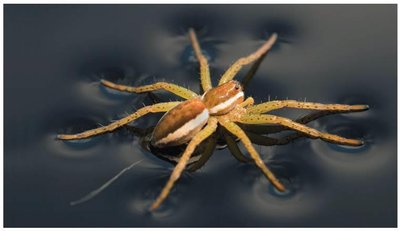
Surface Tension: Water has a high surface tension, making it difficult to break the surface. This is due to hydrogen bonds at the air-water interface.
Example: Some insects can walk on water due to its high surface tension.
Temperature Regulation
High Specific Heat: Water can absorb or release a large amount of heat with only a slight change in its own temperature. This property stabilizes temperatures in organisms and environments.
Heat Capacity: The specific heat of water is 1 cal/(g·°C), meaning it takes 1 calorie to raise 1 gram of water by 1°C.
Evaporative Cooling: As water evaporates, it removes heat from surfaces, cooling organisms and environments.
Example: Coastal climates are moderated by the ocean's high heat capacity.

Floating of Ice on Liquid Water
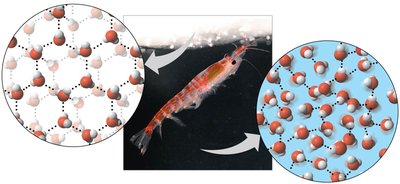
Density of Ice: Ice is less dense than liquid water because hydrogen bonds in ice are more ordered, creating an open lattice structure.
Biological Importance: If ice sank, bodies of water would freeze solid, making life impossible in aquatic environments.
Example: Aquatic life survives under the insulating layer of ice during winter.
Water as the Universal Solvent
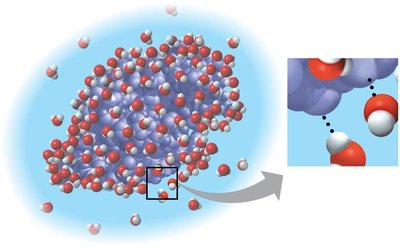
Solvent Properties: Water dissolves more substances than any other liquid due to its polarity, making it the universal solvent.
Hydration Shells: Water molecules surround ions and polar molecules, separating and shielding them in solution.
Hydrophilic vs. Hydrophobic: Hydrophilic substances have an affinity for water; hydrophobic substances do not. Amphipathic molecules have both hydrophilic and hydrophobic regions.
Example: Salt (NaCl) dissolves in water as Na+ and Cl– ions are surrounded by hydration shells.
Concentration and Molarity
Molecular Mass: The sum of the masses of all atoms in a molecule.
Mole: 1 mole (mol) = molecules (Avogadro's number).
Molarity (M): Number of moles of solute per liter of solution.
Example: To make a 1 M NaCl solution, dissolve 58.44 g (molecular mass of NaCl) in 1 L of water.
Acids, Bases, and pH
Dissociation of Water
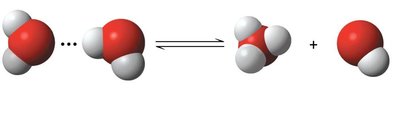
Ionization: A hydrogen atom in a water molecule can shift to another water molecule, forming a hydronium ion (H3O+) and a hydroxide ion (OH–).
Dynamic Equilibrium: In pure water, the concentrations of H+ and OH– are equal.
Acids and Bases
Acid: Increases the H+ concentration of a solution.
Base: Reduces the H+ concentration, often by accepting H+ or releasing OH–.
Strong vs. Weak: Strong acids/bases dissociate completely; weak acids/bases dissociate partially and reversibly.
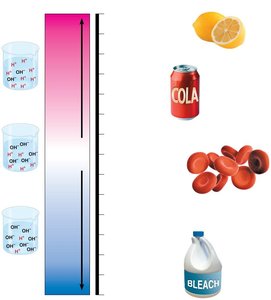
The pH Scale
Definition: pH = –log [H+]
Neutral Solution: [H+] = M, so pH = 7.
Acidic Solutions: pH < 7; Basic Solutions: pH > 7.
Biological Range: Most biological fluids have pH values between 6 and 8.
Buffers
Definition: Buffers are substances that minimize changes in concentrations of H+ and OH– in a solution.
Mechanism: Most buffers consist of a weak acid and its corresponding base, which combine reversibly with H+ ions.
Biological Importance: Buffers maintain the internal pH of cells near neutrality (pH ≈ 7).
Ocean Acidification
Human Impact and Chemical Reactions
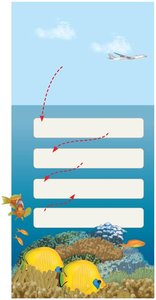
CO2 Absorption: About 25% of human-generated CO2 is absorbed by the oceans.
Formation of Carbonic Acid: CO2 reacts with water to form carbonic acid (H2CO3), which dissociates to release H+ ions, lowering ocean pH.
Impact on Marine Life: Increased H+ reduces carbonate ion (CO32–) concentration, threatening organisms that build shells from calcium carbonate (CaCO3).
Key Reactions:
Summary Table: Key Properties of Water
Property | Description | Biological Importance |
|---|---|---|
Polarity | Unequal sharing of electrons creates partial charges | Allows hydrogen bonding and solvent abilities |
Cohesion | Water molecules stick together | Enables water transport in plants |
Adhesion | Water molecules stick to other substances | Assists capillary action in plants |
High Specific Heat | Resists temperature changes | Stabilizes organism and environmental temperatures |
Ice Floats | Solid water is less dense than liquid | Insulates aquatic habitats |
Universal Solvent | Dissolves many substances | Facilitates chemical reactions in cells |
