 뒤로
뒤로Water: Structure, Properties, and Biological Importance
스터디 가이드 - 스마트 노트
 자료에 맞춘 맞춤형 노트, 핵심 정의, 예시, 맥락을 확장해 제공합니다.
Water: Structure, Properties, and Biological Importance
Introduction to Water
Water is a small, polar molecule essential for life. Its unique chemical and physical properties arise from its molecular structure and the hydrogen bonds it forms. Understanding water's behavior is fundamental to biology, as it influences cellular processes, organismal physiology, and environmental systems.
Structure and Polarity of Water
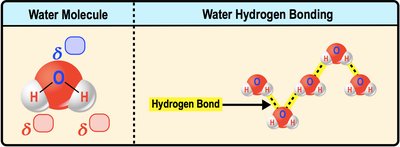
Water Molecule: Composed of two hydrogen atoms covalently bonded to one oxygen atom (H2O).
Polarity: Oxygen is more electronegative than hydrogen, creating a partial negative charge (δ-) near the oxygen and partial positive charges (δ+) near the hydrogens.
Hydrogen Bonds: Weak attractions form between the δ+ hydrogen of one water molecule and the δ- oxygen of another, resulting in hydrogen bonding.
Emergent Properties of Water
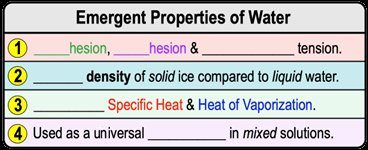
Hydrogen bonding gives water several emergent properties critical for life:
Cohesion: Water molecules stick to each other due to hydrogen bonds.
Adhesion: Water molecules stick to other polar or charged substances.
Surface Tension: The cohesive forces at the surface of water create a 'film' that resists external force.
Lower Density of Ice: Solid ice is less dense than liquid water due to the stable lattice of hydrogen bonds, causing ice to float.
High Specific Heat and Heat of Vaporization: Water resists temperature changes and requires significant energy to evaporate.
Universal Solvent: Water dissolves many substances, facilitating chemical reactions in cells.
Properties of Water
Cohesion, Adhesion, and Surface Tension
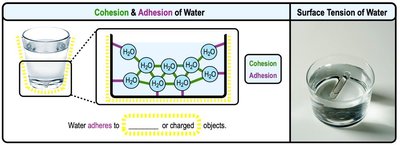
Cohesion and adhesion are responsible for many of water's unique behaviors in biological systems.
Cohesion: Water molecules stick together, enabling phenomena like water transport in plants.
Adhesion: Water molecules stick to other polar or charged surfaces, aiding capillary action.
Surface Tension: The measure of how difficult it is to break the surface of a liquid; water's surface tension is high due to hydrogen bonding.
Density: Liquid Water vs. Solid Ice
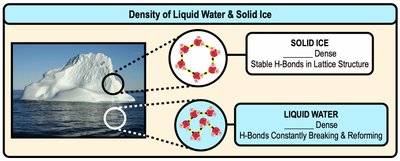
Water exhibits unusual density behavior compared to most substances.
Liquid Water: Molecules are closely packed, with hydrogen bonds constantly forming and breaking.
Solid Ice: Molecules are arranged in a stable lattice, making ice less dense than liquid water.
Biological Importance: Ice floats, insulating aquatic environments and allowing life to persist beneath frozen surfaces.
Thermal Properties of Water
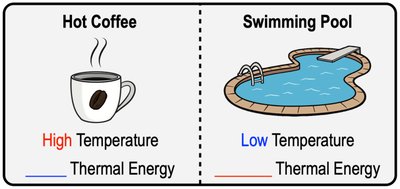
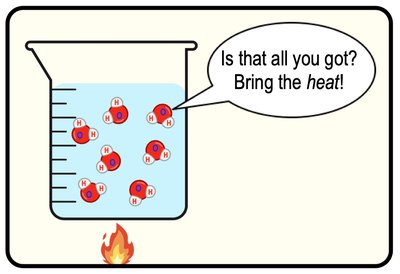
Water's thermal properties help regulate temperature in organisms and environments.
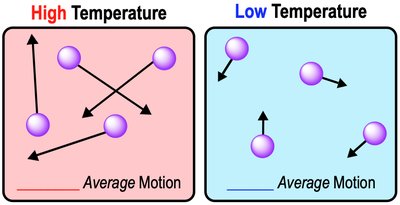
Kinetic Energy: The energy of motion; temperature measures the average kinetic energy of molecules.
Specific Heat: The amount of heat required to raise the temperature of 1 gram of a substance by 1°C. Water's high specific heat allows it to buffer temperature changes.
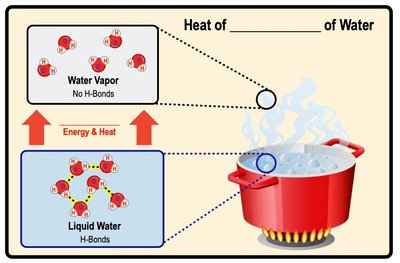
Heat of Vaporization: The amount of energy needed to convert 1 gram of liquid water to vapor. Water's high heat of vaporization enables evaporative cooling (e.g., sweating).
Water as the Universal Solvent
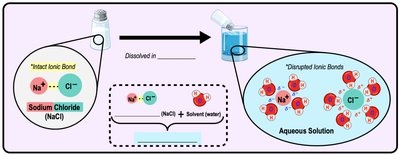
Water's polarity allows it to dissolve a wide variety of substances, making it the 'universal solvent.'
Solvent: The substance that dissolves another (water in biological systems).
Solute: The substance dissolved in the solvent (e.g., salt).
Solution: A homogeneous mixture of solute and solvent.
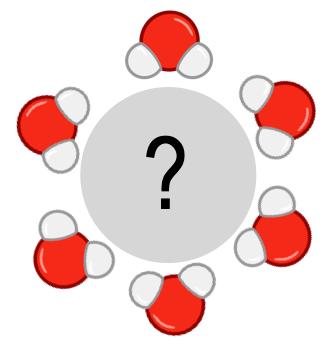
Hydration Shell: Water molecules surround and isolate ions or polar molecules, facilitating dissolution.
Types of Solutions: Homogeneous vs. Heterogeneous
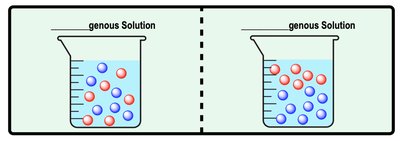
Homogeneous Solution: Uniformly mixed; all parts are equally distributed (e.g., saltwater).
Heterogeneous Solution: Not uniformly mixed; components are unevenly distributed (e.g., oil and water).
Hydrophilic vs. Hydrophobic Substances
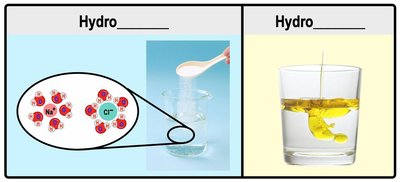
Hydrophilic: 'Water-loving' substances that dissolve easily in water (e.g., salts, ions, polar molecules).
Hydrophobic: 'Water-fearing' substances that do not dissolve in water (e.g., fats, oils, nonpolar molecules).
Acids, Bases, and pH
Acids and Bases
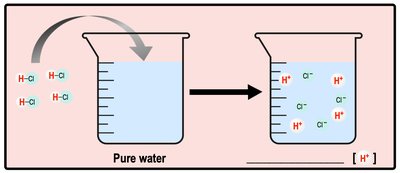
Acid: A substance that increases the concentration of H+ ions in solution (proton donor).
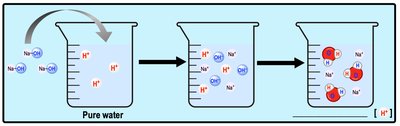
Base: A substance that decreases the concentration of H+ ions, often by accepting H+ or releasing OH- ions (proton acceptor).
Example: HCl (hydrochloric acid) dissociates in water to release H+ and Cl-; NaOH (sodium hydroxide) dissociates to release OH- and Na+.
The pH Scale
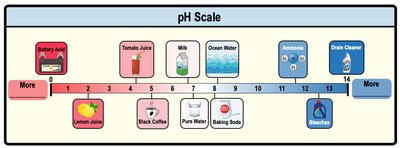
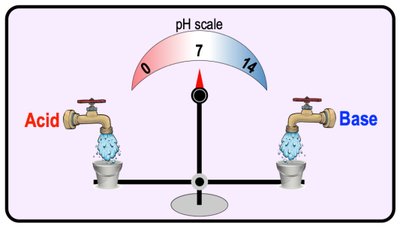
The pH scale measures the concentration of hydrogen ions in a solution, indicating its acidity or basicity.
pH: Defined as
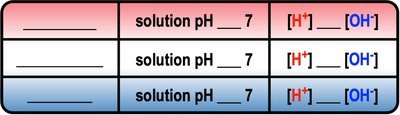
Scale: Ranges from 0 (most acidic) to 14 (most basic); pH 7 is neutral.
Relationship: As [H+] increases, pH decreases (more acidic); as [OH-] increases, pH increases (more basic).
Buffers and Biological pH Regulation
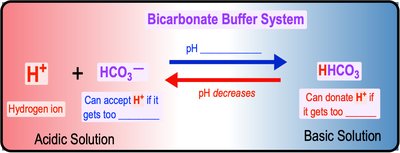
Buffers are substances that minimize changes in pH by accepting or donating H+ ions. They are vital for maintaining homeostasis in biological systems.
Buffer: A solution that resists changes in pH when acids or bases are added.
Bicarbonate Buffer System: In blood, the bicarbonate buffer system maintains pH by reversible reactions involving H+, HCO3-, and H2CO3.
Homeostasis: Organisms rely on buffers to keep internal pH stable, typically near neutral (pH ~7).
Summary Table: Key Properties of Water
Property | Description | Biological Importance |
|---|---|---|
Cohesion & Surface Tension | Water molecules stick together via hydrogen bonds | Enables transport in plants, supports small organisms on water surface |
Adhesion | Water sticks to other polar/charged substances | Capillary action in plant vessels |
Lower Density of Ice | Ice floats on liquid water | Insulates aquatic life in winter |
High Specific Heat | Resists temperature changes | Stabilizes organism and environmental temperatures |
High Heat of Vaporization | Requires much energy to evaporate | Evaporative cooling (sweating, transpiration) |
Universal Solvent | Dissolves many substances | Facilitates biochemical reactions |
Additional info: This guide expands on the provided notes with definitions, examples, and academic context to ensure a comprehensive understanding of water's role in biology.
