
Ch. 11 - Cell Communication
Campbell - Campbell Biology 12th Edition
Urry12th EditionCampbell BiologyISBN: 9785794169850당신이 사용하는 게 아니라요?교과서 변경
11장, 문제 4

Consider this pathway: epinephrine → G protein-coupled receptor → G protein → adenylyl cyclase → cAMP. Identify the second messenger.
a. cAMP
b. G protein
c. GTP
d. Adenylyl cyclase

검증된 단계별 안내
1
Understand the concept of a second messenger: In cell signaling, a second messenger is a molecule that relays signals received at receptors on the cell surface to target molecules inside the cell, creating a cascade effect.
Identify the components of the signaling pathway: The pathway given is epinephrine → G protein-coupled receptor → G protein → adenylyl cyclase → cAMP.
Recognize the role of each component: Epinephrine is the first messenger that binds to the G protein-coupled receptor, activating the G protein. The G protein then activates adenylyl cyclase.
Determine the function of adenylyl cyclase: Adenylyl cyclase is an enzyme that converts ATP to cyclic AMP (cAMP), which acts as a second messenger.
Identify the second messenger: In this pathway, cAMP is the molecule that acts as the second messenger, relaying the signal inside the cell.

비슷한 문제에 대한 검증된 영상 답변:

이 영상 해법은 위 문제에 도움이 된다고 튜터들이 추천한 것입니다.
영상 길이:
2m
도움이 되었나요?

주요 개념

질문에 올바르게 답하기 위해 반드시 이해해야 하는 핵심 개념들은 다음과 같습니다.

Signal Transduction Pathway

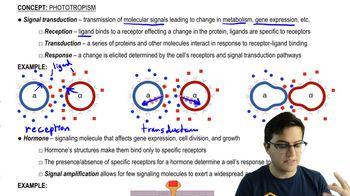
Signal transduction pathways are processes by which a cell converts an extracellular signal into a functional response. In this pathway, epinephrine binds to a G protein-coupled receptor, activating a cascade that leads to the production of cAMP, a second messenger that amplifies the signal within the cell.
추천 영상:
가이드 코스
06:56
Signal Transduction and Response

Second Messenger

Second messengers are molecules that relay signals received at receptors on the cell surface to target molecules inside the cell. In this pathway, cAMP acts as the second messenger, transmitting the signal from adenylyl cyclase to other cellular components, thereby facilitating the cellular response to epinephrine.
추천 영상:
가이드 코스
02:53
Second Law of Thermodynamics

cAMP (Cyclic Adenosine Monophosphate)

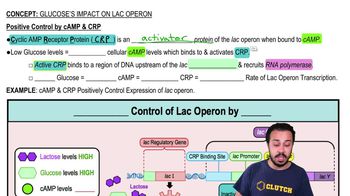
cAMP is a crucial second messenger in many biological processes, including the epinephrine signaling pathway. It is synthesized from ATP by the enzyme adenylyl cyclase and plays a key role in regulating various cellular activities by activating protein kinase A, which phosphorylates target proteins to elicit specific cellular responses.
추천 영상:
가이드 코스
08:32
Positive Control by cAMP & CRP
관련 실천
교과서 질문

Lipid-soluble signaling molecules, such as aldosterone, cross the membranes of all cells but affect only target cells because

a. Only target cells retain the appropriate DNA segments.

b. Intracellular receptors are present only in target cells.

c. Only target cells have enzymes that break down aldosterone.

d. Only in target cells is aldosterone able to initiate the phosphorylation cascade that turns genes on.

1983
views
교과서 질문

The activation of receptor tyrosine kinases is characterized by

a. Dimerization and phosphorylation

b. Dimerization and IP3 binding.

c. A phosphorylation cascade

d. GTP hydrolysis

1781
views
교과서 질문

Which observation suggested to Sutherland the involvement of a second messenger in epinephrine's effect on liver cells?

a. Enzymatic activity was proportional to the amount of calcium added to a cell-free extract.

b. Receptor studies indicated that epinephrine was a ligand.

c. Glycogen breakdown was observed only when epinephrine was administered to intact cells.

d. Glycogen breakdown was observed only when epinephrine and glycogen phosphorylase were mixed.

1425
views
교과서 질문

Binding of a signaling molecule to which type of receptor leads directly to a change in the distribution of substances on opposite sides of the membrane?

a. Intracellular receptor

b. G protein-coupled receptor

c. Phosphorylated receptor tyrosine kinase dimer

d. Ligand-gated ion channel

1590
views
교과서 질문

Apoptosis involves all but which of the following?

a. Fragmentation of the DNA

b. Cell-signaling pathways

c. Lysis of the cell

d. Digestion of cellular contents by scavenger cells

2392
views