Ch. 11 - Cell Communication
Campbell - Campbell Biology 12th Edition
Urry12th EditionCampbell BiologyISBN: 9785794169850당신이 사용하는 게 아니라요?교과서 변경
11장, 문제 2

The activation of receptor tyrosine kinases is characterized by
a. Dimerization and phosphorylation
b. Dimerization and IP3 binding.
c. A phosphorylation cascade
d. GTP hydrolysis

검증된 단계별 안내
1
Understand the role of receptor tyrosine kinases (RTKs) in cell signaling. RTKs are a type of cell surface receptor that, when activated, initiate a signaling cascade within the cell.
Recognize that the activation of RTKs typically involves two key processes: dimerization and phosphorylation. Dimerization refers to the pairing of two receptor molecules, which is often necessary for their activation.
Phosphorylation is the addition of a phosphate group to a molecule, in this case, the receptor itself. This process is crucial for the activation of the receptor and subsequent signaling events.
Consider the options provided in the problem. Option a mentions dimerization and phosphorylation, which are directly related to the activation mechanism of RTKs.
Evaluate the other options: IP3 binding, phosphorylation cascade, and GTP hydrolysis. These processes are associated with different signaling pathways and mechanisms, not specifically the activation of RTKs.

비슷한 문제에 대한 검증된 영상 답변:

이 영상 해법은 위 문제에 도움이 된다고 튜터들이 추천한 것입니다.
영상 길이:
1m
도움이 되었나요?

주요 개념

질문에 올바르게 답하기 위해 반드시 이해해야 하는 핵심 개념들은 다음과 같습니다.

Receptor Tyrosine Kinases (RTKs)

Receptor tyrosine kinases are a class of cell surface receptors that, upon binding with a ligand, undergo dimerization and autophosphorylation. This phosphorylation activates the receptor, allowing it to initiate a cascade of downstream signaling pathways that regulate various cellular processes such as growth, differentiation, and metabolism.
추천 영상:
가이드 코스
03:16
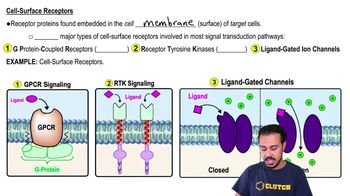
Cell-Surface Receptors

Dimerization

Dimerization refers to the process where two receptor molecules pair up, often as a result of ligand binding. In the context of RTKs, dimerization is crucial as it brings the intracellular kinase domains into proximity, enabling them to phosphorylate each other and activate the receptor, which is essential for signal transduction.

Phosphorylation Cascade

A phosphorylation cascade is a series of events where one kinase activates another through phosphorylation, leading to a chain reaction that amplifies the signal within the cell. This cascade is a common mechanism in cellular signaling pathways, allowing for the regulation of complex biological processes by modulating protein activity and function.
추천 영상:
가이드 코스
02:35
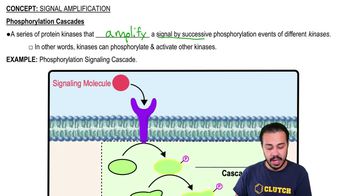
Phosphorylation Cascades