Ch. 29 - Plant Diversity I: How Plants Colonized Land
Campbell - Campbell Biology 12th Edition
Urry12th EditionCampbell BiologyISBN: 9785794169850당신이 사용하는 게 아니라요?교과서 변경
29장, 문제 3

In angiosperms, which of the following is correctly paired with its chromosome count?
a. Microspore—n
b. Zygote—n
c. Egg—2n
d. Megaspore—2n

검증된 단계별 안내
1
Understand the life cycle of angiosperms, which includes alternation of generations between a diploid sporophyte and a haploid gametophyte.
Recall that in angiosperms, the microspore is a haploid cell (n) that develops into the male gametophyte or pollen grain.
Recognize that the zygote is formed by the fusion of two haploid gametes (egg and sperm), resulting in a diploid cell (2n).
Remember that the egg cell is a haploid cell (n) produced by the female gametophyte.
Identify that the megaspore is a haploid cell (n) that develops into the female gametophyte, not diploid (2n).

비슷한 문제에 대한 검증된 영상 답변:

이 영상 해법은 위 문제에 도움이 된다고 튜터들이 추천한 것입니다.
영상 길이:
1m

주요 개념

질문에 올바르게 답하기 위해 반드시 이해해야 하는 핵심 개념들은 다음과 같습니다.

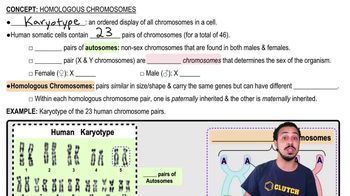
Chromosome Count in Angiosperms

In angiosperms, the chromosome count varies between different stages of the plant's reproductive cycle. Haploid cells, denoted as 'n', contain a single set of chromosomes, while diploid cells, denoted as '2n', contain two sets. Understanding which cells are haploid or diploid is crucial for determining the correct chromosome count in various reproductive structures.
추천 영상:
08:09
Homologous Chromosomes

Microspore and Megaspore Development

Microspores and megaspores are part of the plant's reproductive process. Microspores are haploid (n) and develop into male gametophytes, while megaspores are also haploid (n) and develop into female gametophytes. These spores are produced through meiosis, which reduces the chromosome number from diploid to haploid.
추천 영상:
06:02
Embryonic Plant Development

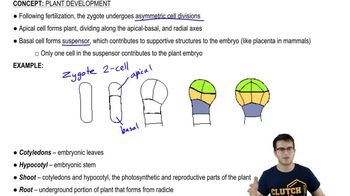
Zygote Formation in Angiosperms

A zygote is formed when two haploid gametes, an egg and a sperm, fuse during fertilization. This fusion results in a diploid cell (2n), which will develop into a new organism. Understanding the transition from haploid gametes to a diploid zygote is essential for comprehending the reproductive cycle of angiosperms.
추천 영상:
03:08
Formation & Breakdown of Polysaccharides