
Ch. 29 - Plant Diversity I: How Plants Colonized Land
Campbell - Campbell Biology 12th Edition
Urry12th EditionCampbell BiologyISBN: 9785794169850당신이 사용하는 게 아니라요?교과서 변경
29장, 문제 4

Microphylls are found in which plant group?
a. Lycophytes
b. Liverworts
c. Ferns
d. Hornworts

검증된 단계별 안내
1
Understand the term 'microphylls': Microphylls are a type of leaf characterized by having a single, unbranched vein. They are typically small and simple in structure.
Identify the plant groups listed in the options: The options given are lycophytes, liverworts, ferns, and hornworts.
Recall the characteristics of lycophytes: Lycophytes are a group of seedless vascular plants that include club mosses, spike mosses, and quillworts. They are known for having microphylls.
Consider the characteristics of liverworts, ferns, and hornworts: Liverworts and hornworts are non-vascular plants, while ferns are vascular plants with larger, more complex leaves called megaphylls.
Conclude which plant group has microphylls: Based on the characteristics, lycophytes are the plant group known for having microphylls.

비슷한 문제에 대한 검증된 영상 답변:

이 영상 해법은 위 문제에 도움이 된다고 튜터들이 추천한 것입니다.
영상 길이:
26s
도움이 되었나요?

주요 개념

질문에 올바르게 답하기 위해 반드시 이해해야 하는 핵심 개념들은 다음과 같습니다.

Microphylls

Microphylls are small, simple leaves with a single, unbranched vein, typically found in certain plant groups. They are characteristic of lycophytes, a group of seedless vascular plants. Unlike megaphylls, microphylls do not have a complex network of veins, which is a key distinguishing feature.
추천 영상:
04:08
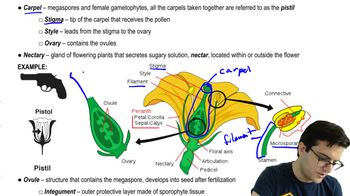
Flower Anatomy

Lycophytes

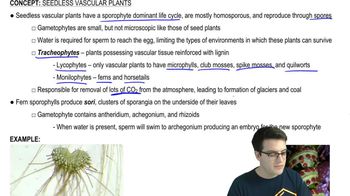
Lycophytes are an ancient group of vascular plants that include club mosses, spike mosses, and quillworts. They are characterized by having microphylls and reproduce via spores rather than seeds. Lycophytes are among the earliest vascular plants, and their simple leaf structure is a defining trait.
추천 영상:
06:08
Seedless Vascular Plants

Plant Groups

Understanding plant groups is essential for identifying characteristics like leaf structure. Lycophytes, liverworts, ferns, and hornworts are distinct groups with unique features. For example, liverworts and hornworts are non-vascular, while ferns have complex leaves called fronds, unlike the microphylls of lycophytes.
추천 영상:
06:04
Functional Groups
관련 실천
교과서 질문

Three of the following are evidence that charophytes are the closest algal relatives of plants. Select the exception.

a. Similar sperm structure

b. The presence of chloroplasts

c. Similarities in cell wall formation during cell division

d. Genetic similarities in chloroplasts

1603
views
교과서 질문

Draw a phylogenetic tree that represents our current understanding of evolutionary relationships between a moss, a gymnosperm, a lycophyte, and a fern. Use a charophyte alga as the outgroup. (See Figure 26.5 to review phylogenetic trees.) Label each branch point of the phylogeny with at least one derived character unique to the clade descended from the common ancestor represented by the branch point.

1818
views
교과서 질문

Suppose an efficient conducting system evolved in a moss that could transport water and other materials as high as a tall tree. Which of the following statements about “trees” of such a species would be true?


a. Spore dispersal distances would probably decrease.

b. Females could produce only one archegonium.

c. Unless its body parts were strengthened, such a “tree” would probably flop over.

d. Individuals would probably compete less effectively for access to light.

308
views
교과서 질문

Which of the following characteristics of plants is absent in their closest relatives, the charophyte algae?

a. Chlorophyll b

b. Cellulose in cell walls

c. Sexual reproduction

d. Alternation of multicellular generations

1753
views
교과서 질문

Identify each of the following structures as haploid or diploid.

a. Sporophyte

b. Spore

c. Gametophyte

d. Zygote

1243
views
교과서 질문

In angiosperms, which of the following is correctly paired with its chromosome count?

a. Microspore—n

b. Zygote—n

c. Egg—2n

d. Megaspore—2n

1177
views