Ch. 23 - Evolutionary Processes
Freeman - Biological Science 8th Edition
Freeman8th EditionBiological ScienceISBN: 9780138276263당신이 사용하는 게 아니라요?교과서 변경
23장, 문제 6

In the 1700s and 1800s, royalty in Europe often married their close relatives; furthermore, recessive genetic diseases such as hemophilia showed up much more often among royals than in the general population. Explain the likely connection.

검증된 단계별 안내
1
Identify the key concept: The problem mentions that royalty often married their close relatives and that recessive genetic diseases like hemophilia were more common among royals. This suggests a connection to the principles of genetics, specifically the inheritance of recessive traits.
Understand recessive traits: Recessive genetic diseases, such as hemophilia, are expressed phenotypically only when an individual has two copies of the recessive allele (homozygous recessive).
Explain the impact of inbreeding: When close relatives reproduce, there is a higher chance that both parents carry the same recessive alleles, as they share a significant amount of their genetic material. This increases the probability of their offspring inheriting two copies of the recessive allele, thus expressing the recessive trait.
Connect to royal families: In the context of European royalty, the practice of marrying within the family (inbreeding) would increase the likelihood of recessive genetic disorders manifesting in their children, as seen with diseases like hemophilia.
Conclude with the genetic principle: The increased occurrence of diseases like hemophilia among royal families can be attributed to the higher probability of inheriting recessive alleles due to inbreeding, demonstrating a direct application of Mendelian genetics.

비슷한 문제에 대한 검증된 영상 답변:

이 영상 해법은 위 문제에 도움이 된다고 튜터들이 추천한 것입니다.
영상 길이:
1m
도움이 되었나요?

주요 개념

질문에 올바르게 답하기 위해 반드시 이해해야 하는 핵심 개념들은 다음과 같습니다.

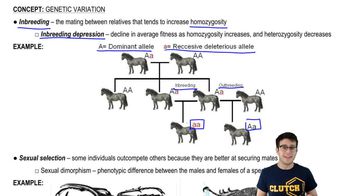
Inbreeding

Inbreeding refers to the mating of individuals who are closely related genetically. This practice increases the likelihood of offspring inheriting identical alleles from both parents, which can lead to a higher incidence of recessive genetic disorders. In the context of European royalty, frequent intermarriage among relatives resulted in a greater expression of genetic diseases like hemophilia.
추천 영상:
07:31
Inbreeding and Sexual Selection

Recessive Genetic Disorders

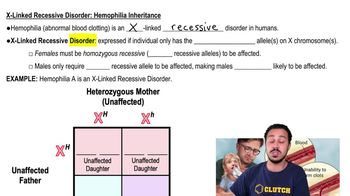
Recessive genetic disorders occur when an individual inherits two copies of a mutated gene, one from each parent. For a recessive trait to manifest, both alleles must be defective. In populations where inbreeding is common, the probability of two carriers mating increases, leading to a higher prevalence of these disorders, as seen with hemophilia among royals.
추천 영상:
04:37
X-Linked Recessive Disorder: Hemophilia Inheritance

Genetic Drift

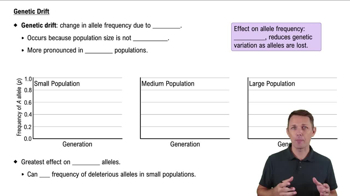
Genetic drift is a mechanism of evolution that refers to random changes in allele frequencies within a population, particularly in small populations. In royal families, where the gene pool is limited due to inbreeding, genetic drift can exacerbate the effects of recessive disorders, making certain genetic traits, including diseases, more common over generations.
추천 영상: