Ch. 23 - Evolutionary Processes
Freeman - Biological Science 8th Edition
Freeman8th EditionBiological ScienceISBN: 9780138276263당신이 사용하는 게 아니라요?교과서 변경
23장, 문제 5

In a population of 2500, how many babies would you expect to have cystic fibrosis, a homozygous recessive condition, if the frequency of the dominant allele is 0.9 and the population is at Hardy–Weinberg equilibrium?
a. 0.9 × 2500 = 2250
b. 2 × 0.9 × 0.1 × 2500 = 450
c. 0.9 × 0.1 × 2500 = 225
d. 0.1 x 0.1 x 2500 = 25

검증된 단계별 안내
1
Understand that cystic fibrosis is a homozygous recessive condition, which means individuals with the condition have two recessive alleles (cc).
Recall the Hardy-Weinberg principle, which states that allele and genotype frequencies in a population will remain constant from generation to generation in the absence of evolutionary influences.
Identify the frequency of the recessive allele (c) using the given frequency of the dominant allele (C). If the frequency of the dominant allele (C) is 0.9, then the frequency of the recessive allele (c) is 1 - 0.9 = 0.1.
Calculate the expected frequency of individuals with cystic fibrosis (cc) using the formula for homozygous recessive genotype frequency: \( q^2 \), where \( q \) is the frequency of the recessive allele. Thus, \( q^2 = 0.1^2 \).
Multiply the frequency of the homozygous recessive genotype (\( q^2 \)) by the total population size to find the expected number of individuals with cystic fibrosis: \( 0.1^2 \times 2500 \).

비슷한 문제에 대한 검증된 영상 답변:

이 영상 해법은 위 문제에 도움이 된다고 튜터들이 추천한 것입니다.
영상 길이:
2m
도움이 되었나요?

주요 개념

질문에 올바르게 답하기 위해 반드시 이해해야 하는 핵심 개념들은 다음과 같습니다.

Hardy-Weinberg Equilibrium

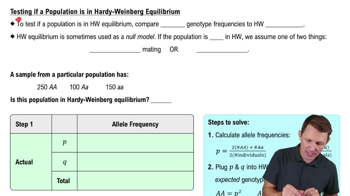
The Hardy-Weinberg equilibrium is a principle that describes a stable genetic state in a population where allele and genotype frequencies remain constant across generations, provided no evolutionary influences occur. It assumes random mating, no mutation, migration, or selection, and large population size. This model helps predict genotype frequencies using allele frequencies.
추천 영상:
가이드 코스
08:26
Testing if a Population is in Hardy-Weinberg Equilibrium

Allele Frequency

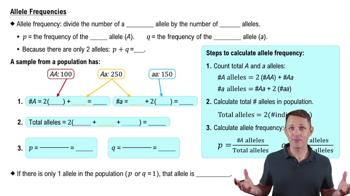
Allele frequency refers to how often an allele appears in a population's gene pool. It is expressed as a proportion or percentage of the total alleles for a particular gene. In the context of Hardy-Weinberg equilibrium, allele frequencies are used to calculate expected genotype frequencies, such as homozygous recessive conditions like cystic fibrosis.
추천 영상:
가이드 코스
06:36
Allele Frequencies

Homozygous Recessive Condition

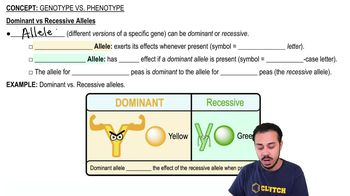
A homozygous recessive condition occurs when an individual has two copies of a recessive allele, resulting in the expression of a recessive trait or disorder. For cystic fibrosis, individuals must inherit two recessive alleles (cc) to exhibit the condition. Calculating the frequency of such individuals involves squaring the frequency of the recessive allele under Hardy-Weinberg equilibrium.
추천 영상:
03:39
Dominant vs. Recessive Alleles