Ch. 23 - Evolutionary Processes
Freeman - Biological Science 8th Edition
Freeman8th EditionBiological ScienceISBN: 9780138276263당신이 사용하는 게 아니라요?교과서 변경
23장, 문제 4

True or false? Gene flow can either increase or decrease the average fitness of a population. Explain.

검증된 단계별 안내
1
True. Gene flow refers to the transfer of genetic material (alleles) between populations of the same species. It can occur through various means such as migration of individuals or gametes (e.g., pollen).
Gene flow can increase the average fitness of a population by introducing new alleles that may confer advantageous traits, which can help the population adapt to environmental changes or resist diseases.
Conversely, gene flow can decrease the average fitness of a population if the incoming alleles are maladaptive in the new environment, leading to a reduction in survival or reproduction rates of the population.
The overall effect of gene flow on fitness depends on the context, such as the specific traits of the incoming alleles and the environmental conditions of the population receiving these alleles.
Therefore, gene flow is a critical mechanism in evolution and biodiversity, influencing the genetic diversity and adaptability of populations.

비슷한 문제에 대한 검증된 영상 답변:

이 영상 해법은 위 문제에 도움이 된다고 튜터들이 추천한 것입니다.
영상 길이:
2m
도움이 되었나요?

주요 개념

질문에 올바르게 답하기 위해 반드시 이해해야 하는 핵심 개념들은 다음과 같습니다.

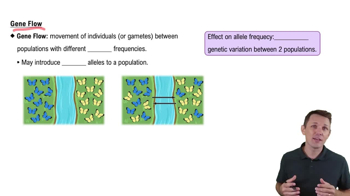
Gene Flow

Gene flow refers to the transfer of genetic material between populations through migration of individuals or gametes. This process can introduce new alleles into a population, potentially altering its genetic diversity. It plays a crucial role in evolution by affecting the genetic structure of populations and can influence traits that contribute to fitness.
추천 영상:
01:43
Gene Flow

Average Fitness

Average fitness is a measure of how well a population can survive and reproduce in its environment. It is determined by the reproductive success of individuals and the traits they possess. Changes in average fitness can result from various factors, including natural selection, genetic drift, and gene flow, which can either enhance or diminish the population's adaptability.
추천 영상:
가이드 코스
02:57
Adaptation Improves Fitness

Impact of Gene Flow on Fitness

Gene flow can have varying effects on the average fitness of a population. It can increase fitness by introducing beneficial alleles that enhance survival and reproduction. Conversely, it may decrease fitness if maladaptive traits are introduced, leading to a dilution of local adaptations. Thus, the overall impact of gene flow on fitness is context-dependent, influenced by the specific traits involved and the environmental conditions.
추천 영상:
01:43
Gene Flow
관련 실천
교과서 질문

Determine what is incorrect in the following statement: Deer mice living on beaches mutated their genes so that they could have white fur color, providing better camouflage to survive on beaches.

391
views

교과서 질문

In a population of 2500, how many babies would you expect to have cystic fibrosis, a homozygous recessive condition, if the frequency of the dominant allele is 0.9 and the population is at Hardy–Weinberg equilibrium?

a. 0.9 × 2500 = 2250

b. 2 × 0.9 × 0.1 × 2500 = 450

c. 0.9 × 0.1 × 2500 = 225

d. 0.1 x 0.1 x 2500 = 25

1197
views
교과서 질문

Why is genetic drift aptly named? Select True or False for each statement.

T/F It causes allele frequencies to drift up or down randomly.

T/F It occurs when alleles from one population drift into another.

T/F It occurs when mutations drift into a genome.

942
views
교과서 질문

In the 1700s and 1800s, royalty in Europe often married their close relatives; furthermore, recessive genetic diseases such as hemophilia showed up much more often among royals than in the general population. Explain the likely connection.

645
views
교과서 질문

Why isn't inbreeding considered an evolutionary process?

a. It does not change genotype frequencies.

b. It does not change allele frequencies.

c. It does not occur often enough to be important in evolution.

d. It does not violate the assumptions of the Hardy–Weinberg principle.

1136
views
교과서 질문

In what sense is the Hardy–Weinberg principle a null hypothesis?

1107
views