Ch. 23 - Evolutionary Processes
Freeman - Biological Science 8th Edition
Freeman8th EditionBiological ScienceISBN: 9780138276263당신이 사용하는 게 아니라요?교과서 변경
23장, 문제 1

In what sense is the Hardy–Weinberg principle a null hypothesis?

검증된 단계별 안내
1
The Hardy-Weinberg principle is considered a null hypothesis because it predicts what will happen in a population if no evolutionary forces are acting upon it. In other words, it provides a baseline or 'null' expectation for the genetic makeup of a population over time if no mutation, migration, genetic drift, selection, or non-random mating occurs.
The principle states that allele and genotype frequencies in a population will remain constant from generation to generation in the absence of other evolutionary influences. These constant frequencies are known as Hardy-Weinberg equilibrium.
When we observe changes in the genetic makeup of a population over time, we can compare these changes to the predictions of the Hardy-Weinberg principle. If the observed changes differ significantly from the predictions, we can reject the null hypothesis and infer that some form of evolutionary force is at work.
In this way, the Hardy-Weinberg principle serves as a fundamental tool in the study of population genetics, allowing scientists to test hypotheses about the forces driving evolution in real populations.
So, the Hardy-Weinberg principle is a null hypothesis in the sense that it predicts no change in the genetic structure of a population over time, assuming no evolutionary forces are acting. Any deviation from this prediction suggests that one or more evolutionary forces are at play.

비슷한 문제에 대한 검증된 영상 답변:

이 영상 해법은 위 문제에 도움이 된다고 튜터들이 추천한 것입니다.
영상 길이:
3m
도움이 되었나요?

주요 개념

질문에 올바르게 답하기 위해 반드시 이해해야 하는 핵심 개념들은 다음과 같습니다.

Hardy-Weinberg Principle

The Hardy-Weinberg principle is a fundamental concept in population genetics that describes how allele and genotype frequencies remain constant from generation to generation in a large, randomly mating population, provided that certain conditions are met. These conditions include no mutations, no gene flow, random mating, infinite population size, and no selection. It serves as a baseline to compare actual genetic variation in populations.
추천 영상:
07:10
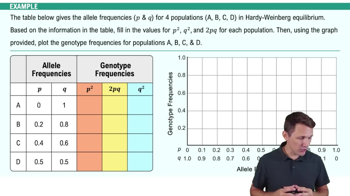
The Hardy-Weinberg Principle Example 1

Null Hypothesis

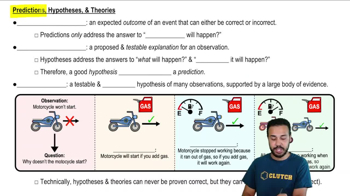
A null hypothesis is a statement that assumes no effect or no difference in a given situation, serving as a starting point for statistical testing. In the context of the Hardy-Weinberg principle, it posits that any observed deviations from expected genotype frequencies are due to random chance rather than evolutionary forces. This allows researchers to test whether real changes in allele frequencies are occurring in a population.
추천 영상:
가이드 코스
08:22
Predictions, Hypotheses, & Theories

Population Genetics

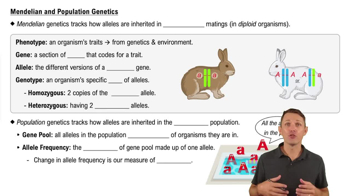
Population genetics is the study of genetic variation within populations and involves the examination of allele frequency changes under the influence of evolutionary processes such as natural selection, genetic drift, mutation, and migration. Understanding population genetics is crucial for interpreting the implications of the Hardy-Weinberg principle, as it provides insights into how and why populations evolve over time.
추천 영상:
04:26
Mendelian and Population Genetics