Ch. 23 - Evolutionary Processes
Freeman - Biological Science 8th Edition
Freeman8th EditionBiological ScienceISBN: 9780138276263당신이 사용하는 게 아니라요?교과서 변경
23장, 문제 2

Why isn't inbreeding considered an evolutionary process?
a. It does not change genotype frequencies.
b. It does not change allele frequencies.
c. It does not occur often enough to be important in evolution.
d. It does not violate the assumptions of the Hardy–Weinberg principle.

검증된 단계별 안내
1
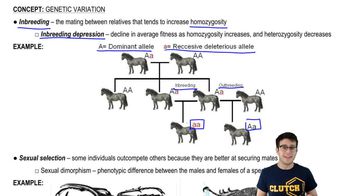
Understand the concept of inbreeding: Inbreeding refers to the mating of individuals who are closely related genetically. This can lead to an increase in homozygosity, where individuals have two identical alleles for a particular gene.
Consider the impact on allele frequencies: Inbreeding does not change allele frequencies in a population. Allele frequencies remain constant because inbreeding only affects how alleles are distributed among individuals, not the overall genetic makeup of the population.
Examine genotype frequencies: Inbreeding can change genotype frequencies by increasing the proportion of homozygous individuals. However, this change in genotype frequencies does not equate to an evolutionary process, as evolution involves changes in allele frequencies over time.
Review the Hardy-Weinberg principle: The Hardy-Weinberg principle states that allele and genotype frequencies in a population will remain constant from generation to generation in the absence of evolutionary influences. Inbreeding does not violate this principle because it does not alter allele frequencies.
Evaluate the significance in evolution: While inbreeding can have significant effects on individual fitness and population health, it is not considered an evolutionary process because it does not lead to changes in allele frequencies, which are necessary for evolution to occur.

비슷한 문제에 대한 검증된 영상 답변:

이 영상 해법은 위 문제에 도움이 된다고 튜터들이 추천한 것입니다.
영상 길이:
1m
도움이 되었나요?

주요 개념

질문에 올바르게 답하기 위해 반드시 이해해야 하는 핵심 개념들은 다음과 같습니다.

Inbreeding

Inbreeding refers to the mating of closely related individuals, which increases the chance of offspring inheriting identical alleles from both parents. While it affects genotype frequencies by increasing homozygosity, it does not alter allele frequencies in a population, which is why it is not considered an evolutionary process.
추천 영상:
가이드 코스
07:31
Inbreeding and Sexual Selection

Allele Frequencies

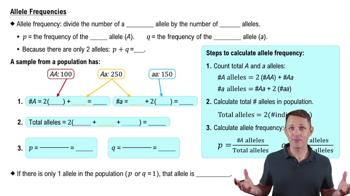
Allele frequencies represent the relative frequency of different alleles of a gene in a population. Evolutionary processes, such as natural selection, mutation, and genetic drift, change these frequencies over time. Inbreeding does not change allele frequencies, thus it does not contribute to evolution in the same way these processes do.
추천 영상:
06:36
Allele Frequencies

Hardy–Weinberg Principle

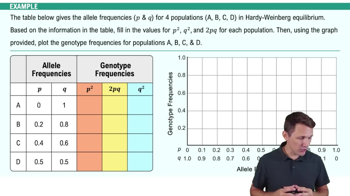
The Hardy–Weinberg principle provides a model for genetic equilibrium in a population, assuming no evolutionary influences like mutation, selection, or migration. Inbreeding does not violate this principle because it does not change allele frequencies, although it does affect genotype frequencies by increasing homozygosity.
추천 영상:
07:10
The Hardy-Weinberg Principle Example 1