Ch. 27 - Diversification of Eukaryotes
Freeman - Biological Science 8th Edition
Freeman8th EditionBiological ScienceISBN: 9780138276263당신이 사용하는 게 아니라요?교과서 변경
27장, 문제 3

Evaluate the following statements regarding motility in protists. Select True or False for each statement.
T/F Amoeboid motion is common in species with cell walls.
T/F Some protists use flagella to swim.
T/F Some protists use cilia to swim, which are shorter and more numerous than flagella.
T/F Amoeboid motion requires ATP and interactions between the proteins actin and myosin.

검증된 단계별 안내
1
Understand that amoeboid motion involves the movement of the cell by extending and retracting pseudopodia, which are temporary projections of the cell. This type of movement is typically found in cells without rigid cell walls, as the flexibility is necessary for the formation of pseudopodia.
Recognize that flagella are long, whip-like structures that protrude from the cell body and are used by some protists for locomotion. They move in a wave-like manner to propel the organism through a liquid environment.
Identify that cilia are similar to flagella but are shorter and more numerous. They beat in a coordinated fashion to create movement, allowing some protists to swim.
Acknowledge that amoeboid motion requires energy in the form of ATP. This energy is used in the interaction between actin and myosin proteins, which are involved in the contraction and relaxation processes that enable the cell to move.
Evaluate each statement based on the understanding of these concepts: Amoeboid motion is not common in species with cell walls (False), some protists use flagella to swim (True), some protists use cilia to swim, which are shorter and more numerous than flagella (True), and amoeboid motion requires ATP and interactions between actin and myosin (True).

비슷한 문제에 대한 검증된 영상 답변:

이 영상 해법은 위 문제에 도움이 된다고 튜터들이 추천한 것입니다.
영상 길이:
3m
도움이 되었나요?

주요 개념

질문에 올바르게 답하기 위해 반드시 이해해야 하는 핵심 개념들은 다음과 같습니다.

Amoeboid Motion

Amoeboid motion is a type of movement used by some protists, characterized by the extension of pseudopodia. This process involves the cytoskeleton, particularly actin and myosin proteins, and requires ATP for energy. Amoeboid motion is typically seen in protists without rigid cell walls, allowing for flexible shape changes.
추천 영상:
가이드 코스
04:07
Properties of Water- Thermal

Flagella

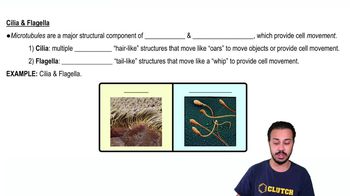
Flagella are long, whip-like structures that protrude from the cell body of certain protists, enabling them to swim. These appendages rotate or whip back and forth to propel the organism through liquid environments. Flagella are less numerous than cilia and are often used by protists for locomotion and feeding.
추천 영상:
가이드 코스
03:15
Cilia & Flagella

Cilia

Cilia are short, hair-like structures that cover the surface of some protists, facilitating movement and feeding. They beat in coordinated waves, allowing the organism to swim or move substances across its surface. Cilia are more numerous than flagella and provide efficient propulsion in aquatic environments.
추천 영상:
가이드 코스
03:15
Cilia & Flagella