Ch. 27 - Diversification of Eukaryotes
Freeman - Biological Science 8th Edition
Freeman8th EditionBiological ScienceISBN: 9780138276263당신이 사용하는 게 아니라요?교과서 변경
27장, 문제 5

Explain the logic behind the claim that the nuclear envelope is a synapomorphy that defines eukaryotes as a monophyletic group.

검증된 단계별 안내
1
Begin by understanding the term 'synapomorphy'. A synapomorphy is a shared derived trait that is present in an ancestral species and its descendants, but not in more distant relatives. It is used to define a monophyletic group, which includes all the descendants of a common ancestor.
Next, consider the structure and function of the nuclear envelope. The nuclear envelope is a double membrane that surrounds the nucleus in eukaryotic cells, separating the genetic material from the cytoplasm. This structure is crucial for the compartmentalization of cellular processes.
Recognize that the nuclear envelope is a defining feature of eukaryotic cells, distinguishing them from prokaryotic cells, which lack a true nucleus and nuclear envelope. This structural difference is significant in the classification of life forms.
Understand that the presence of the nuclear envelope in eukaryotes is a synapomorphy because it is a derived trait that originated in the common ancestor of all eukaryotes. This trait is not found in prokaryotes, which supports the idea that eukaryotes form a monophyletic group.
Conclude by explaining that the nuclear envelope's role as a synapomorphy helps scientists classify eukaryotes as a distinct lineage, emphasizing their shared evolutionary history and common ancestry, which is a fundamental concept in phylogenetics.

비슷한 문제에 대한 검증된 영상 답변:

이 영상 해법은 위 문제에 도움이 된다고 튜터들이 추천한 것입니다.
영상 길이:
1m
도움이 되었나요?

주요 개념

질문에 올바르게 답하기 위해 반드시 이해해야 하는 핵심 개념들은 다음과 같습니다.

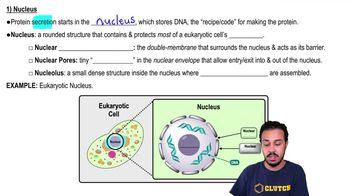
Nuclear Envelope

The nuclear envelope is a double membrane structure that surrounds the nucleus in eukaryotic cells, separating the genetic material from the cytoplasm. It plays a crucial role in regulating the exchange of materials between the nucleus and the cytoplasm, and is a defining feature of eukaryotic cells, distinguishing them from prokaryotic cells which lack a true nucleus.
추천 영상:

Synapomorphy

A synapomorphy is a shared derived trait that is present in an ancestral species and its descendants, but absent in more distant relatives. It is used in phylogenetic analysis to infer evolutionary relationships and define monophyletic groups, which include all descendants of a common ancestor. The presence of the nuclear envelope is considered a synapomorphy for eukaryotes.
추천 영상:

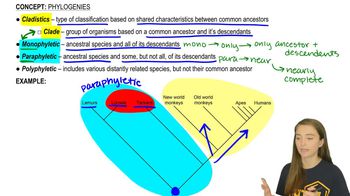
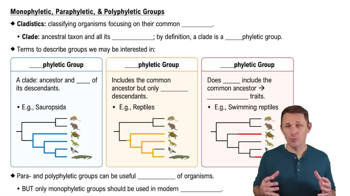
Monophyletic Group

A monophyletic group, or clade, consists of an ancestor and all its descendants, representing a single branch on the tree of life. It is defined by shared characteristics, such as synapomorphies, that are inherited from a common ancestor. Eukaryotes are considered a monophyletic group because they all share the nuclear envelope, a trait not found in prokaryotes.
추천 영상:
06:37
Monophyletic, Paraphyletic, & Polyphyletic Group
관련 실천
교과서 질문

Consider the endosymbiosis theory for the origin of the mitochondrion. How did each endosymbiotic partner benefit from the relationship?

2178
views
1
rank
교과서 질문

The most important primary producers in marine ecosystems are ___________.   

1136
views
교과서 질문

The text claims that the evolutionary history of protists can be understood as a series of morphological innovations that established seven distinct lineages, each of which subsequently diversified based on innovative ways of feeding, moving, and reproducing. Explain how the Alveolata support this claim.

791
views
교과서 질문

Evaluate the following statements regarding motility in protists. Select True or False for each statement.

T/F Amoeboid motion is common in species with cell walls.

T/F Some protists use flagella to swim.

T/F Some protists use cilia to swim, which are shorter and more numerous than flagella.

T/F Amoeboid motion requires ATP and interactions between the proteins actin and myosin.

758
views
교과서 질문

Why was finding a close relationship between mitochondrial DNA and bacterial DNA considered particularly strong evidence in favor of the endosymbiosis theory?

2273
views
교과서 질문

How can dinoflagellates be harmful to humans? a. They are transmitted by mosquitoes and cause malaria. b. They produce toxins that can be absorbed by clams and other shellfish which, when eaten by people, can lead to paralytic shellfish poisoning. c. They cause amoebic dysentery which leads to severe diarrhea and dehydration. d. They are transmitted by tsetse flies and cause 'sleeping sickness.'

552
views