Ch. 42 - Gas Exchange and Circulation
Freeman - Biological Science 8th Edition
Freeman8th EditionBiological ScienceISBN: 9780138276263당신이 사용하는 게 아니라요?교과서 변경
42장, 문제 3

Which of the following promotes oxygen release from hemoglobin?
a. A decrease in temperature
b. An increase in O₂ level.
c. A decrease in pH
d. A decrease in carbonic anhydrase activity

검증된 단계별 안내
1
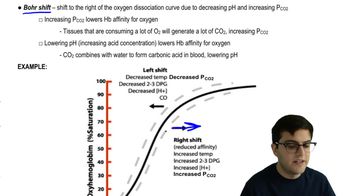
Understand the Bohr effect: The Bohr effect describes how changes in pH and carbon dioxide concentration affect hemoglobin's affinity for oxygen. A decrease in pH (more acidic environment) or an increase in carbon dioxide concentration promotes oxygen release from hemoglobin.
Analyze the options: Consider how each option affects hemoglobin's ability to release oxygen. A decrease in temperature generally stabilizes hemoglobin's structure, making it less likely to release oxygen.
Consider the role of pH: A decrease in pH (option c) indicates an increase in hydrogen ion concentration, which can lead to a conformational change in hemoglobin, reducing its affinity for oxygen and promoting oxygen release.
Evaluate the effect of carbonic anhydrase: Carbonic anhydrase is an enzyme that catalyzes the conversion of carbon dioxide and water to bicarbonate and protons. A decrease in its activity (option d) would lead to less production of protons, potentially increasing pH and reducing oxygen release.
Conclude based on the Bohr effect: Given the options, a decrease in pH (option c) is most consistent with promoting oxygen release from hemoglobin due to the Bohr effect.

비슷한 문제에 대한 검증된 영상 답변:

이 영상 해법은 위 문제에 도움이 된다고 튜터들이 추천한 것입니다.
영상 길이:
59s
도움이 되었나요?

주요 개념

질문에 올바르게 답하기 위해 반드시 이해해야 하는 핵심 개념들은 다음과 같습니다.

Hemoglobin and Oxygen Binding

Hemoglobin is a protein in red blood cells responsible for transporting oxygen from the lungs to tissues. It binds oxygen in the lungs and releases it in tissues where oxygen levels are lower. The binding and release of oxygen are influenced by various factors, including temperature, pH, and the presence of other molecules like carbon dioxide.
추천 영상:
가이드 코스
10:50
Oxygen Dissociation Curve and the Bohr Shift

Bohr Effect

The Bohr Effect describes how changes in pH and carbon dioxide concentration affect hemoglobin's affinity for oxygen. A decrease in pH (more acidic conditions) or an increase in carbon dioxide levels leads to hemoglobin releasing oxygen more readily. This is because hydrogen ions and carbon dioxide bind to hemoglobin, altering its structure and reducing its affinity for oxygen.
추천 영상:
가이드 코스
10:50
Oxygen Dissociation Curve and the Bohr Shift

Carbonic Anhydrase Activity

Carbonic anhydrase is an enzyme that catalyzes the conversion of carbon dioxide and water into carbonic acid, which dissociates into bicarbonate and hydrogen ions. This reaction is crucial for maintaining acid-base balance in blood and facilitating carbon dioxide transport. A decrease in carbonic anhydrase activity would slow this conversion, potentially affecting pH and, consequently, hemoglobin's oxygen release.
추천 영상: