Ch. 43 - Animal Nervous Systems
Freeman - Biological Science 8th Edition
Freeman8th EditionBiological ScienceISBN: 9780138276263당신이 사용하는 게 아니라요?교과서 변경
43장, 문제 7

Compare and contrast the somatic nervous system and autonomic nervous system.

검증된 단계별 안내
1
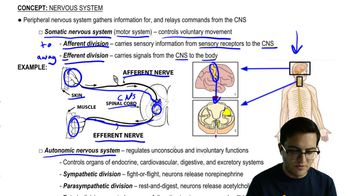
Identify the primary function: The somatic nervous system controls voluntary movements of the muscles, while the autonomic nervous system regulates involuntary functions such as heart rate, digestion, and respiratory rate.
Examine the components: The somatic nervous system consists of motor neurons that connect the central nervous system to the target muscles. The autonomic nervous system is divided into the sympathetic and parasympathetic nervous systems, which work to balance the body's response to various stimuli.
Discuss the control mechanisms: The somatic nervous system operates under conscious control, meaning one can decide to move muscles. In contrast, the autonomic nervous system functions without conscious control to manage physiological functions.
Explore the neurotransmitters involved: The somatic nervous system primarily uses acetylcholine to stimulate muscle contractions. The autonomic nervous system uses both acetylcholine and norepinephrine, depending on whether the action is part of the sympathetic or parasympathetic system.
Consider the impact of external stress: The autonomic nervous system is heavily involved in the body's response to stress, activating the 'fight or flight' response through the sympathetic system, and calming the body down through the parasympathetic system. The somatic nervous system does not directly engage with stress response but can be influenced indirectly as muscles tense up during stress.

비슷한 문제에 대한 검증된 영상 답변:

이 영상 해법은 위 문제에 도움이 된다고 튜터들이 추천한 것입니다.
영상 길이:
4m
도움이 되었나요?

주요 개념

질문에 올바르게 답하기 위해 반드시 이해해야 하는 핵심 개념들은 다음과 같습니다.

Somatic Nervous System

The somatic nervous system (SNS) is a component of the peripheral nervous system responsible for voluntary control of body movements. It consists of motor neurons that innervate skeletal muscles, allowing for conscious actions such as walking or picking up objects. The SNS also transmits sensory information from the body to the central nervous system, enabling the perception of external stimuli.
추천 영상:
가이드 코스
06:26
Peripheral Nervous System

Autonomic Nervous System

The autonomic nervous system (ANS) regulates involuntary physiological functions, including heart rate, digestion, and respiratory rate. It operates without conscious control and is divided into two main branches: the sympathetic nervous system, which prepares the body for 'fight or flight' responses, and the parasympathetic nervous system, which promotes 'rest and digest' activities. This balance is crucial for maintaining homeostasis.
추천 영상:
가이드 코스
06:26
Peripheral Nervous System

Comparison of SNS and ANS

While both the somatic and autonomic nervous systems are integral parts of the peripheral nervous system, they serve distinct functions. The SNS is involved in voluntary movements and sensory processing, whereas the ANS manages involuntary bodily functions. Additionally, the SNS typically involves a single neuron pathway from the spinal cord to the muscle, while the ANS uses a two-neuron pathway to connect the central nervous system to target organs.
추천 영상:
가이드 코스
05:43
Density of Liquid Water vs. Solid Ice