Ch. 47 - Animal Reproduction and Development
Freeman - Biological Science 8th Edition
Freeman8th EditionBiological ScienceISBN: 9780138276263당신이 사용하는 게 아니라요?교과서 변경
47장, 문제 7

How do spermatogenesis and oogenesis in humans differ with respect to numbers of cells produced, gamete size, and timing of the second meiotic division?

검증된 단계별 안내
1
Step 1: Understand the terms. Spermatogenesis is the process of formation of sperm cells in males, while oogenesis is the process of formation of egg cells or ova in females. Both processes involve meiosis, a type of cell division that results in four daughter cells each with half the number of chromosomes of the parent cell.
Step 2: Compare the number of cells produced. In spermatogenesis, one primary spermatocyte (the cell that undergoes meiosis) produces four sperm cells. In contrast, one primary oocyte in oogenesis produces only one mature egg cell or ovum. The other three cells, known as polar bodies, are much smaller and usually degenerate.
Step 3: Compare the size of the gametes. Sperm cells are much smaller than egg cells. This is because the cytoplasm of the primary oocyte is unequally divided during oogenesis, with most of the cytoplasm going to the egg cell. The polar bodies receive very little cytoplasm and are much smaller.
Step 4: Compare the timing of the second meiotic division. In spermatogenesis, the second meiotic division is completed before the sperm cells are fully mature. In oogenesis, the second meiotic division is not completed unless the egg is fertilized. If fertilization occurs, the second meiotic division is completed just before the sperm nucleus merges with the egg nucleus.
Step 5: Summarize the differences. Spermatogenesis produces four sperm cells from each primary spermatocyte, while oogenesis produces one egg cell and three polar bodies from each primary oocyte. Sperm cells are much smaller than egg cells. The second meiotic division is completed before sperm cells are fully mature, but in oogenesis, it is not completed unless the egg is fertilized.

비슷한 문제에 대한 검증된 영상 답변:

이 영상 해법은 위 문제에 도움이 된다고 튜터들이 추천한 것입니다.
영상 길이:
1m
도움이 되었나요?

주요 개념

질문에 올바르게 답하기 위해 반드시 이해해야 하는 핵심 개념들은 다음과 같습니다.

Spermatogenesis

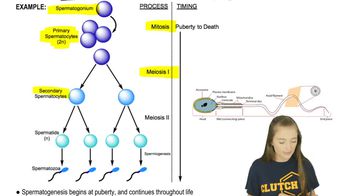
Spermatogenesis is the process of sperm cell development in males, occurring in the testes. It results in the production of four viable sperm cells from each precursor cell through two rounds of meiosis. This process is continuous and begins at puberty, with sperm being produced throughout a male's life.
추천 영상:
12:51
Spermatogenesis

Oogenesis

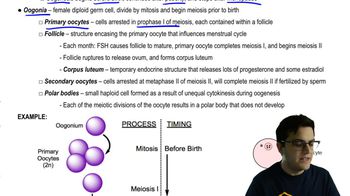
Oogenesis is the process of egg cell development in females, taking place in the ovaries. Unlike spermatogenesis, oogenesis produces only one viable ovum from each precursor cell, with the other three cells forming polar bodies that typically degenerate. This process begins before birth and is completed only upon fertilization, leading to a significant difference in timing compared to spermatogenesis.
추천 영상:
04:28
Oogenesis

Meiotic Division Timing

In spermatogenesis, the second meiotic division occurs continuously, producing mature sperm ready for fertilization. In contrast, oogenesis involves a prolonged pause in the second meiotic division, which resumes only upon fertilization. This difference in timing affects the availability of gametes and the overall reproductive strategy in humans.
추천 영상:
09:40
Introduction to Cell Division
관련 실천
교과서 질문

Propose an experiment to test the hypothesis that cells from only one region of a frog blastula form the ectoderm. What results from this experiment would support this hypothesis?

598
views

교과서 질문

True or false: The corpus luteum is retained upon implantation due to the presence of the hormone human chorionic gonadotropin (hCG).

812
views
교과서 질문

The BMI z-score is a relative measure of body mass index (BMI) that takes into account age. Higher values represent heavier individuals for a given height. The table here shows the BMI z-score of pre- and post-pubertal girls at three ages.

Which of the following conclusions can you draw from the data?

a. At a given age, there are more girls with low BMI z-scores than with high BMI z-scores.

b. At a given age, girls with high BMI z-scores are more likely to have begun puberty than girls with low BMI z-scores.

c. Girls 11, 12, and 13 years of age are equally likely to have begun puberty.

d. There is no relationship between BMI z-score and age of beginning puberty.

1629
views
교과서 질문

Give examples of negative and positive feedback in hormonal control of the human menstrual cycle. Why can a high estradiol level be considered a 'readiness' signal from a follicle?

1399
views
교과서 질문

Many frogs and mice are similar in size, yet a frog egg is vastly larger than a mouse egg. Propose a plausible explanation for this difference in the egg size.

792
views
교과서 질문

Summarize the experimental evidence that Daphnia require three cues to trigger sexual reproduction. Discuss what these cues indicate about the environment.

780
views