Ch. 7 - Inside the Cell
Freeman - Biological Science 8th Edition
Freeman8th EditionBiological ScienceISBN: 9780138276263당신이 사용하는 게 아니라요?교과서 변경
7장, 문제 2

Which of the following results provided evidence of a discrete nuclear localization signal somewhere on the nucleoplasmin protein?
a. The nucleoplasmin protein was small and easily slipped through the nuclear pore complex.
b. After cleavage of the nucleoplasmin protein, only the tail segments appeared in the nucleus.
c. Removing the tail from the nucleoplasmin protein allowed the core segment to enter the nucleus.
d. The SRP bound only to the tail of the nucleoplasmin protein, not the core segment.

검증된 단계별 안내
1
Understand the concept of a nuclear localization signal (NLS): A nuclear localization signal is a sequence of amino acids that 'tags' a protein for import into the cell nucleus by nuclear transport. Proteins with an NLS can be recognized by nuclear transport receptors and transported through the nuclear pore complex.
Analyze the options provided: Each option describes a different experimental observation related to the nucleoplasmin protein. The goal is to identify which observation suggests the presence of a discrete NLS on the protein.
Consider option b: 'After cleavage of the nucleoplasmin protein, only the tail segments appeared in the nucleus.' This suggests that the tail segments contain the NLS, as they are the only parts of the protein that enter the nucleus after cleavage.
Evaluate the significance of option b: The fact that only the tail segments appear in the nucleus after cleavage indicates that these segments have the necessary signal for nuclear entry, providing evidence of a discrete NLS located on the tail.
Conclude the analysis: Based on the evidence provided by option b, the presence of a discrete nuclear localization signal on the nucleoplasmin protein is supported by the observation that the tail segments, which contain the NLS, are able to enter the nucleus.

비슷한 문제에 대한 검증된 영상 답변:

이 영상 해법은 위 문제에 도움이 된다고 튜터들이 추천한 것입니다.
영상 길이:
3m

주요 개념

질문에 올바르게 답하기 위해 반드시 이해해야 하는 핵심 개념들은 다음과 같습니다.

Nuclear Localization Signal (NLS)

A Nuclear Localization Signal (NLS) is a sequence of amino acids that 'tags' a protein for import into the cell nucleus by nuclear transport. Proteins with an NLS are recognized by nuclear transport receptors, which facilitate their passage through the nuclear pore complex. Understanding NLS is crucial for identifying how proteins are selectively transported into the nucleus.
추천 영상:
06:10
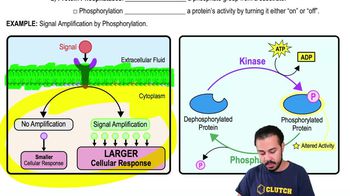
Signal Amplification

Nucleoplasmin Protein Structure

Nucleoplasmin is a pentameric protein involved in chromatin assembly and is known for its role in nuclear transport. It consists of distinct segments, typically a core and a tail, each potentially having different functions or signals. The structure of nucleoplasmin is essential for understanding how its segments contribute to its localization and function within the cell.
추천 영상:
08:02
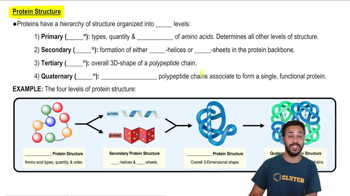
Protein Structure

Nuclear Pore Complex (NPC)

The Nuclear Pore Complex (NPC) is a large protein complex that spans the nuclear envelope, acting as a gateway for the transport of molecules between the nucleus and the cytoplasm. It allows the passage of small molecules by passive diffusion, while larger molecules require active transport facilitated by signals like the NLS. Understanding NPC function is key to comprehending how proteins like nucleoplasmin are transported into the nucleus.
추천 영상:
가이드 코스
06:15
Origin of Complex Traits