Ch. 10 - Sequences and Infinite Series
Briggs - Calculus: Early Transcendentals 3rd Edition
Briggs3rd EditionCalculus: Early TranscendentalsISBN: 9780136847243당신이 사용하는 게 아니라요?교과서 변경
10장, 문제 10.6.43

39–44. {Use of Tech} Estimating infinite series Estimate the value of the following convergent series with an absolute error less than 10⁻³.


∑ (k = 1 to ∞) (−1)ᵏ / kᵏ

검증된 단계별 안내
1
Recognize that the series given is an alternating series of the form \(\sum_{k=1}^{\infty} \frac{(-1)^k}{k^k}\), where the terms alternate in sign and decrease in absolute value as \(k\) increases.
Recall the Alternating Series Estimation Theorem, which states that the absolute error when approximating an alternating series by its first \(n\) terms is less than or equal to the absolute value of the first omitted term, i.e., \(|R_n| \leq |a_{n+1}|\).
To estimate the sum with an absolute error less than \(10^{-3}\), find the smallest integer \(n\) such that the absolute value of the \((n+1)\)-th term satisfies \(\left| \frac{(-1)^{n+1}}{(n+1)^{n+1}} \right| < 10^{-3}\).
Calculate the partial sum \(S_n = \sum_{k=1}^n \frac{(-1)^k}{k^k}\) by adding the first \(n\) terms of the series.
Use the partial sum \(S_n\) as the estimate of the infinite series sum, knowing that the error is less than \(10^{-3}\) due to the Alternating Series Estimation Theorem.

비슷한 문제에 대한 검증된 영상 답변:

이 영상 해법은 위 문제에 도움이 된다고 튜터들이 추천한 것입니다.
영상 길이:
3m

주요 개념

질문에 올바르게 답하기 위해 반드시 이해해야 하는 핵심 개념들은 다음과 같습니다.

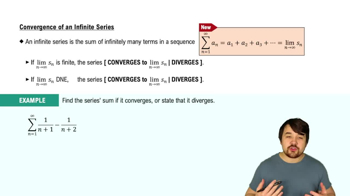
Convergence of Infinite Series

An infinite series converges if the sum of its terms approaches a finite limit as the number of terms increases indefinitely. For alternating series like this one, convergence can often be tested using the Alternating Series Test, which requires terms to decrease in absolute value and approach zero.
추천 영상:
가이드 코스
06:52
Convergence of an Infinite Series

Alternating Series Estimation Theorem

This theorem states that for an alternating series with decreasing terms, the absolute error when approximating the sum by the first n terms is less than or equal to the absolute value of the (n+1)th term. This helps in determining how many terms are needed to achieve a desired error bound.
추천 영상:
가이드 코스
06:00
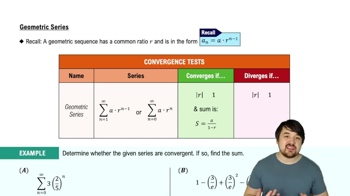
Geometric Series

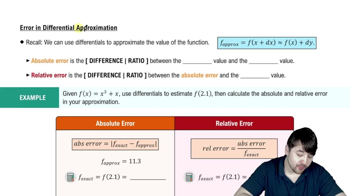
Absolute Error and Approximation

Absolute error measures the difference between the true value of a series and its approximation. To estimate a series within a specified absolute error (e.g., less than 10⁻³), one must sum enough terms so that the remainder (error) is smaller than this threshold, ensuring the approximation is sufficiently accurate.
추천 영상:
가이드 코스
04:57
Determining Error and Relative Error