Explain why the magnitude of the remainder in an alternating series (with terms that are nonincreasing in magnitude) is less than or equal to the magnitude of the first neglected term.
Ch. 10 - Sequences and Infinite Series
10장, 문제 10.5.23
9–36. Comparison tests Use the Comparison Test or the Limit Comparison Test to determine whether the following series converge.
∑ (k = 1 to ∞) sin(1 / k) / k²
검증된 단계별 안내1
First, identify the general term of the series: \(a_k = \frac{\sin(1/k)}{k^2}\).
Recall that for large \(k\), \(\sin(1/k)\) behaves approximately like \(1/k\) because \(\sin x \approx x\) when \(x\) is close to 0.
Use this approximation to compare \(a_k\) with a simpler series term: \(b_k = \frac{1/k}{k^2} = \frac{1}{k^3}\).
Since \(\sum_{k=1}^\infty \frac{1}{k^3}\) is a p-series with \(p=3 > 1\), it converges.
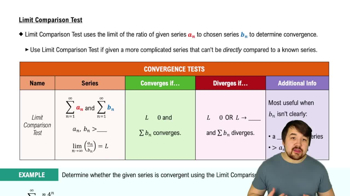
Apply the Limit Comparison Test by computing \(\lim_{k \to \infty} \frac{a_k}{b_k} = \lim_{k \to \infty} \frac{\sin(1/k)/k^2}{1/k^3} = \lim_{k \to \infty} \frac{\sin(1/k)}{1/k}\). Since this limit is finite and nonzero, both series share the same convergence behavior, so the original series converges.

비슷한 문제에 대한 검증된 영상 답변:
이 영상 해법은 위 문제에 도움이 된다고 튜터들이 추천한 것입니다.
영상 길이:
3m도움이 되었나요?
주요 개념
질문에 올바르게 답하기 위해 반드시 이해해야 하는 핵심 개념들은 다음과 같습니다.
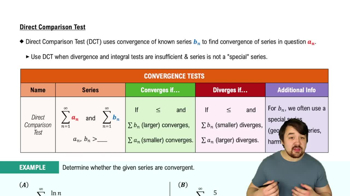
Comparison Test
The Comparison Test determines the convergence of a series by comparing it to a second series with known behavior. If the terms of the given series are smaller than those of a convergent series with positive terms, then the given series also converges. Conversely, if the terms are larger than those of a divergent series, the given series diverges.
추천 영상:
가이드 코스
Direct Comparison Test
Limit Comparison Test
The Limit Comparison Test compares two series by taking the limit of the ratio of their terms. If this limit is a positive finite number, both series either converge or diverge together. This test is useful when direct comparison is difficult but the terms behave similarly for large indices.
추천 영상:
가이드 코스
Limit Comparison Test
Behavior of sin(1/k) for large k
For large values of k, sin(1/k) can be approximated by its argument 1/k because sin(x) ≈ x when x is close to zero. This approximation helps simplify the given series terms to roughly 1/(k³), aiding in the application of comparison tests with p-series.
추천 영상:
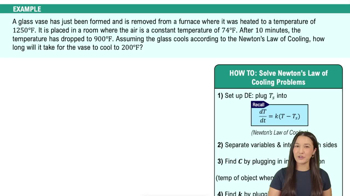
Newton's Law of Cooling Example 5
관련 실천
교과서 질문
86
views
교과서 질문
23–38. Divergence, Integral, and p-series Tests Use the Divergence Test, the Integral Test, or the p-series test to determine whether the following series converge.
∑ (k = 1 to ∞) k / eᵏ
59
views
교과서 질문
13–52. Limits of sequences
Find the limit of the following sequences or determine that the sequence diverges.
{ⁿ√(e³ⁿ⁺⁴)}
34
views
교과서 질문
32–49. Choose your test Use the test of your choice to determine whether the following series converge absolutely, converge conditionally, or diverge.
∑ (from k = 1 to ∞) (−1)ᵏ / k⁰.⁹⁹
33
views
교과서 질문
Simplify k! / (k + 2)! for any integer k ≥ 0.
60
views
교과서 질문
39–44. {Use of Tech} Estimating infinite series Estimate the value of the following convergent series with an absolute error less than 10⁻³.
∑ (k = 1 to ∞) (−1)ᵏ / kᵏ
60
views