Explain why the magnitude of the remainder in an alternating series (with terms that are nonincreasing in magnitude) is less than or equal to the magnitude of the first neglected term.
Ch. 10 - Sequences and Infinite Series
10장, 문제 10.7.5
Simplify k! / (k + 2)! for any integer k ≥ 0.
검증된 단계별 안내1
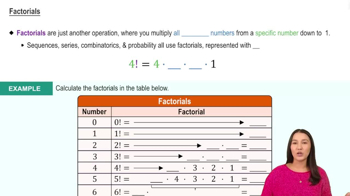
Recall the definition of factorial: for any integer n ≥ 0, n! = n × (n - 1) × (n - 2) × ... × 1, and 0! = 1 by convention.
Express the denominator (k + 2)! in terms of k!: write (k + 2)! as (k + 2) × (k + 1) × k!.
Rewrite the original expression \( \frac{k!}{(k + 2)!} \) by substituting the expanded form of (k + 2)!: \( \frac{k!}{(k + 2) \times (k + 1) \times k!} \).
Cancel the common factor k! in numerator and denominator, simplifying the expression to \( \frac{1}{(k + 2) \times (k + 1)} \).
Conclude that the simplified form of \( \frac{k!}{(k + 2)!} \) is \( \frac{1}{(k + 2)(k + 1)} \) for any integer k ≥ 0.

비슷한 문제에 대한 검증된 영상 답변:
이 영상 해법은 위 문제에 도움이 된다고 튜터들이 추천한 것입니다.
영상 길이:
1m도움이 되었나요?
주요 개념
질문에 올바르게 답하기 위해 반드시 이해해야 하는 핵심 개념들은 다음과 같습니다.
Factorial Definition
The factorial of a non-negative integer n, denoted n!, is the product of all positive integers from 1 up to n. By definition, 0! = 1. Understanding factorials is essential for simplifying expressions involving factorial terms.
추천 영상:
Factorials
Factorial Expansion and Cancellation
To simplify ratios of factorials like k! / (k + 2)!, expand the larger factorial to reveal common factors. For example, (k + 2)! = (k + 2)(k + 1)k!, allowing cancellation of k! in numerator and denominator.
추천 영상:
Factorials
Simplification of Rational Expressions
After canceling common factorial terms, simplify the remaining expression by performing arithmetic operations. This often reduces complex factorial ratios to simpler algebraic fractions or products.
추천 영상:
Simplifying Trig Expressions
관련 실천
교과서 질문
86
views
교과서 질문
21–42. Geometric series Evaluate each geometric series or state that it diverges.
41.∑ (k = 1 to ∞) 4 / 12ᵏ
42
views
교과서 질문
13–52. Limits of sequences
Find the limit of the following sequences or determine that the sequence diverges.
{ⁿ√(e³ⁿ⁺⁴)}
34
views
교과서 질문
9–36. Comparison tests Use the Comparison Test or the Limit Comparison Test to determine whether the following series converge.
∑ (k = 1 to ∞) sin(1 / k) / k²
79
views
교과서 질문
32–49. Choose your test Use the test of your choice to determine whether the following series converge absolutely, converge conditionally, or diverge.
∑ (from k = 1 to ∞) (−1)ᵏ / k⁰.⁹⁹
33
views
교과서 질문
39–44. {Use of Tech} Estimating infinite series Estimate the value of the following convergent series with an absolute error less than 10⁻³.
∑ (k = 1 to ∞) (−1)ᵏ / kᵏ
60
views