Ch. 10 - Sequences and Infinite Series
Briggs - Calculus: Early Transcendentals 3rd Edition
Briggs3rd EditionCalculus: Early TranscendentalsISBN: 9780136847243당신이 사용하는 게 아니라요?교과서 변경
10장, 문제 10.3.67

54–69. Telescoping series
For the following telescoping series, find a formula for the nth term of the sequence of partial sums {Sₙ}. Then evaluate limₙ→∞ Sₙ to obtain the value of the series or state that the series diverges.


67. ∑ (k = 1 to ∞) 3 / (k² + 5k + 4)

검증된 단계별 안내
1
Start by factoring the denominator of the general term in the series. The denominator is \(k^2 + 5k + 4\). Factor it as \((k + 1)(k + 4)\).
Rewrite the general term \(\frac{3}{k^2 + 5k + 4}\) as \(\frac{3}{(k + 1)(k + 4)}\). Next, use partial fraction decomposition to express this as \(\frac{A}{k + 1} + \frac{B}{k + 4}\) for constants \(A\) and \(B\).
Set up the equation \(\frac{3}{(k + 1)(k + 4)} = \frac{A}{k + 1} + \frac{B}{k + 4}\). Multiply both sides by \((k + 1)(k + 4)\) to get \(3 = A(k + 4) + B(k + 1)\). Solve for \(A\) and \(B\) by choosing convenient values for \(k\) or by equating coefficients.
Once you find \(A\) and \(B\), write the nth partial sum \(S_n = \sum_{k=1}^n \frac{3}{(k + 1)(k + 4)} = \sum_{k=1}^n \left( \frac{A}{k + 1} + \frac{B}{k + 4} \right)\). Separate the sums and write out the terms to identify the telescoping pattern.
Use the telescoping property to cancel terms and find a simplified expression for \(S_n\). Then, evaluate \(\lim_{n \to \infty} S_n\) by analyzing the behavior of the remaining terms as \(n\) approaches infinity to determine if the series converges or diverges.

비슷한 문제에 대한 검증된 영상 답변:

이 영상 해법은 위 문제에 도움이 된다고 튜터들이 추천한 것입니다.
영상 길이:
8m
도움이 되었나요?

주요 개념

질문에 올바르게 답하기 위해 반드시 이해해야 하는 핵심 개념들은 다음과 같습니다.

Telescoping Series

A telescoping series is a series whose partial sums simplify by canceling intermediate terms, leaving only a few terms from the beginning and end. This simplification makes it easier to find a formula for the nth partial sum and evaluate the series' limit.
추천 영상:
가이드 코스
06:00
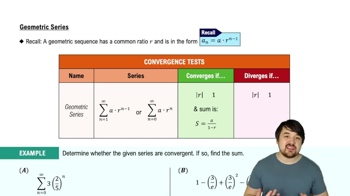
Geometric Series

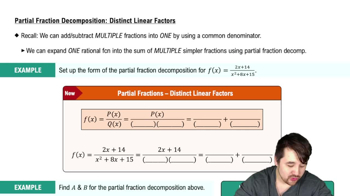
Partial Fraction Decomposition

Partial fraction decomposition breaks a rational function into simpler fractions that are easier to sum or integrate. For series like ∑ 3/(k² + 5k + 4), factoring the denominator and decomposing helps express terms in a telescoping form.
추천 영상:
가이드 코스
10:07
Partial Fraction Decomposition: Distinct Linear Factors

Limit of Partial Sums and Convergence

The limit of the sequence of partial sums determines whether an infinite series converges or diverges. If the limit exists and is finite, the series converges to that value; otherwise, it diverges.
추천 영상:
가이드 코스
08:01
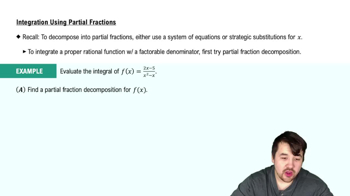
Integration Using Partial Fractions